Inquisitorial Stormtroopers Repressor Transport

The Repressor tank is often used by Sisters of Battle as transport, and by the Adeptus Arbites in an anti insurgency role. I started building and painting this model back in 2007, I recently retrieved it from storage and decided that I would try and finish painting it. I realised I had made quite significant progress and it wouldn’t take too long to finish it off.

Having sprayed the model with Citadel Zandri Dust over the existing Tausept Ochre base coat and black undercoat, I started the detailing, using Leadbelcher on the weapons and the exhausts. The next step was painting the iconography and purity seals. I then gave the model a wash using Citadel shades. I then did some additional shading using different shades. The next stage was some drybrushing, for this I used Citadel Zandri Dust. I also took the time to brighten up the purity seals and other iconography after it was dulled down by the shades and washes. I added the tracks.

There is still some work to do with this model, but I am pleased I have made progress and nearly finished it.

See the workbench feature on the Inquisitorial Stormtroopers Repressor Transport.

The Bretonnian Joust

The Bretonnian Joust

I have always liked this jousting diorama, The Bretonnian Joust, by Dave Andrews which won the Open Competition in the 1996 Golden Demon awards. The level of detail is outstanding. There are hoof marks in the ground, created using clay. The manuscript on the back is handwritten.

More photographs of The Joust.


Drybrushing the Typhon

My latest model for my Imperial Fists Horus Heresy force is the Typhon Heavy Siege Tank.

The Typhon Heavy Siege Tank was released as a plastic kit for The Horus Heresy. I’ve always liked the Forge World resin model and so was pleased to get one of the new plastic kits for my Imperial Fists force.

Having started constructing the model, I finished putting it together. The next stage was a white undercoat. I then gave the model a partial base coat of Army Painter Desert Yellow. I then gave the model a base coat of Army Painter Daemonic Yellow. I painted the bolter and the exhausts using Citadel Leadbelcher. It was then onto shading the model and then shading it some more. I also painted the tracks.

For the next stage I used some Citadel Layer Yriel Yellow. I took a large brush and gave the model, what I would call, a heavy drybrush. I put paint on the brush, and then used some kitchen towel to remove most of the paint, and then using a stippling process added paint to the model. I then used the same process with Citadel Layer Flash Gitz Yellow.

I then gave the model a light drybrush of Citadel Layer Dorn Yellow.

See the workbench feature on the Typhon Heavy Siege Tank.

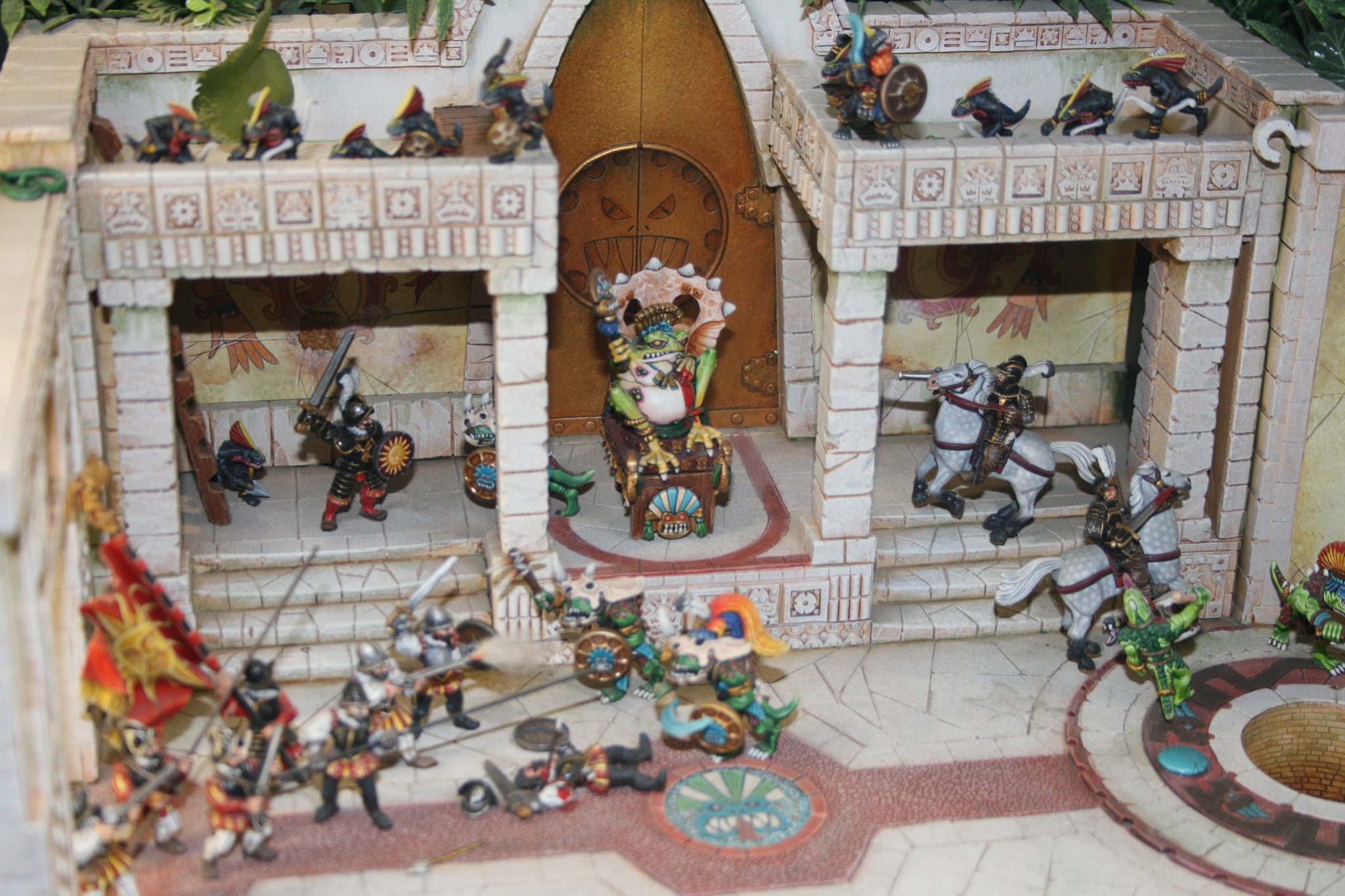
Invading the land of the Lizardmen

The land of the Lizardmen is invaded by the Empire of Men. Tilean or Estalian Conquistadors attack a Slann temple, trying to free a captive.

Invading the land of the Lizardmen

This beautiful diorama was part of the displays at Warhammer World and is quite old, from the 1990s I think.

More photographs of the diorama from an earlier trip to Warhammer World.


Headlighting the Predator

The Predator is perhaps the best known and most widespread variant of the basic Rhino chassis. Augmented with superior armour and firepower, it entirely sacrifices the Rhino’s troop transport capacity in favour of ammunition and generators for its formidable weapon systems. 

Having got this kit for Christmas, I started putting the model together. For painting I kept the sponsons separate and I can easily remove the turret as well. I gave the model an undercoat of Citadel White Scar. I gave the model a couple of light coats of Daemonic Yellow. I  painted the main weapon, and the exhausts, with Leadbelcher. It was then onto shading the model. For the next stage I used some Citadel Layer Yriel Yellow. I took a large brush and gave the model, what I would call, a heavy drybrush. I then did some more drybrushing some lighter yellow paints. I then fixed the tracks to the Predator.

The next stage was adding some more details to the model, namely the headlights.

For the front headlights I used Citadel Layer Dorn Yellow. For the other lights in the headlights I used Citadel Base Mephiston Red.

I then did the protective grilles with an UNI black pen, rather than use paint on them.

I now need to add some more weathering.

I then do need to add some transfers.

See the workbench feature on the Deimos Pattern Predator Battle Tank.

Headlighting the Rhino

The Rhino is the most widely used armoured personnel carrier in the Imperium. Based on ancient STC technology, the fundamental design is robust, reliable, and easy to maintain, with an adaptive power plant that can run off a wide variety of fuels.

I bought the plastic Deimos Pattern Rhino when it came out in the summer, you can see the workbench for that Rhino here.  I was lucky enough to get a second Rhino for a Christmas present. The model has many more parts and is a more detailed kit than the original plastic Rhino kit that came out in the 1980s. I constructed the model to the instructions, though I left the tracks off to paint separately. I gave the model an undercoat of Citadel White Scar. I gave the model a couple of light coats of Daemonic Yellow. I also painted the bolter and exhausts with Leadbelcher. I then shaded the model. For the next stage I used some Citadel Layer Yriel Yellow. I took a large brush and gave the model, what I would call, a heavy drybrush. I then did some more drybrushing. I then fixed the tracks to the Rhino.

The next stage was adding some more details to the model, namely the headlights.

For the front headlights I used Citadel Layer Dorn Yellow. For the other lights in the headlights I used Citadel Base Mephiston Red.

I then did the protective grilles with an UNI black pen, rather than use paint on them.

I now need to add some more weathering.

I then do need to add some transfers.

Here is this Rhino with my first Deimos Pattern Rhino.

See the workbench feature on the Deimos Pattern Rhino II.

Ork Wartrakks in the desert

Wartrakks are Ork tracked vehicles that are modified off the versatile warbuggy design by Mekboyz. Essentially a Warbuggy mounted upon a sturdy track unit, a Wartrakk sacrifices its speed for the ability to traverse rough terrain such as a ruined city and deliver heavier firepower. Wartrakks wield either a twin-linked Big Shoota or Rokkit Launcha.

This model was originally designed for Gorkamorka, and then became part of Warhammer 40K with Codex Orks.

I have added an Ork glyph to the frontal armour plate.

See the workbench feature on this Wartrakk.

There were at the time some Forge World conversion kits, including this lovely little fuel bowser.

There isn’t a similar model in the current range, which is a pity.

See the workbench feature on this Aircraft Traktor and Launch Trolley.

Hawker Hart

This Hawker Hart was on display at RAF Cosford.

Hawker Hart

The Hawker Hart is a British two-seater biplane light bomber aircraft that saw service with the Royal Air Force (RAF). It was designed during the 1920s by Sydney Camm and manufactured by Hawker Aircraft. The Hart was a prominent British aircraft in the inter-war period, but was obsolete and already side-lined for newer monoplane aircraft designs by the start of the Second World War, playing only minor roles in the conflict before being retired.

You could imagine though in the timeline of the A Very British Civil War that the Hawker Hart could have been used in that conflict.

Hawker Hart

Several major variants of the Hart were developed, including a navalised version for the Royal Navy’s aircraft carriers.

More photographs of the Hawker Hart at RAF Cosford.

Photographs of the Hawker Hart at RAF London.

Painting the Typhon Tracks

My latest model for my Imperial Fists Horus Heresy force is the Typhon Heavy Siege Tank.

The Typhon Heavy Siege Tank was released as a plastic kit for The Horus Heresy. I’ve always liked the Forge World resin model and so was pleased to get one of the new plastic kits for my Imperial Fists force.

Having started constructing the model, I finished putting it together. The next stage was a white undercoat. I then gave the model a partial base coat of Army Painter Desert Yellow. I then gave the model a base coat of Army Painter Daemonic Yellow. I painted the bolter and the exhausts using Citadel Leadbelcher. It was then onto shading the model and then shading it some more.

I had used Citadel Agrax Earthshade Shade on the tracks, forgetting that I should have done a heavy drybrush of Gorthor Brown first.

So I did the heavy drybrush of Gorthor Brown .

I then washed the tracks (again) with Citadel Agrax Earthshade Shade.

I nearly forgot to paint the extra track pieces that come with the Typhon kit (as it is longer than the standard Land Raider). Once I remembered I did them the same way as the rest of the tracks.

After painting and shading them, I drybrushed them lightly, first with Leadbelcher. I then did a very light drybrush with Terminatus Stone.

See the workbench feature on the Typhon Heavy Siege Tank.