Land Raider in the desert

Here is my Grey Knights Land Raider in the desert.

Land Raider

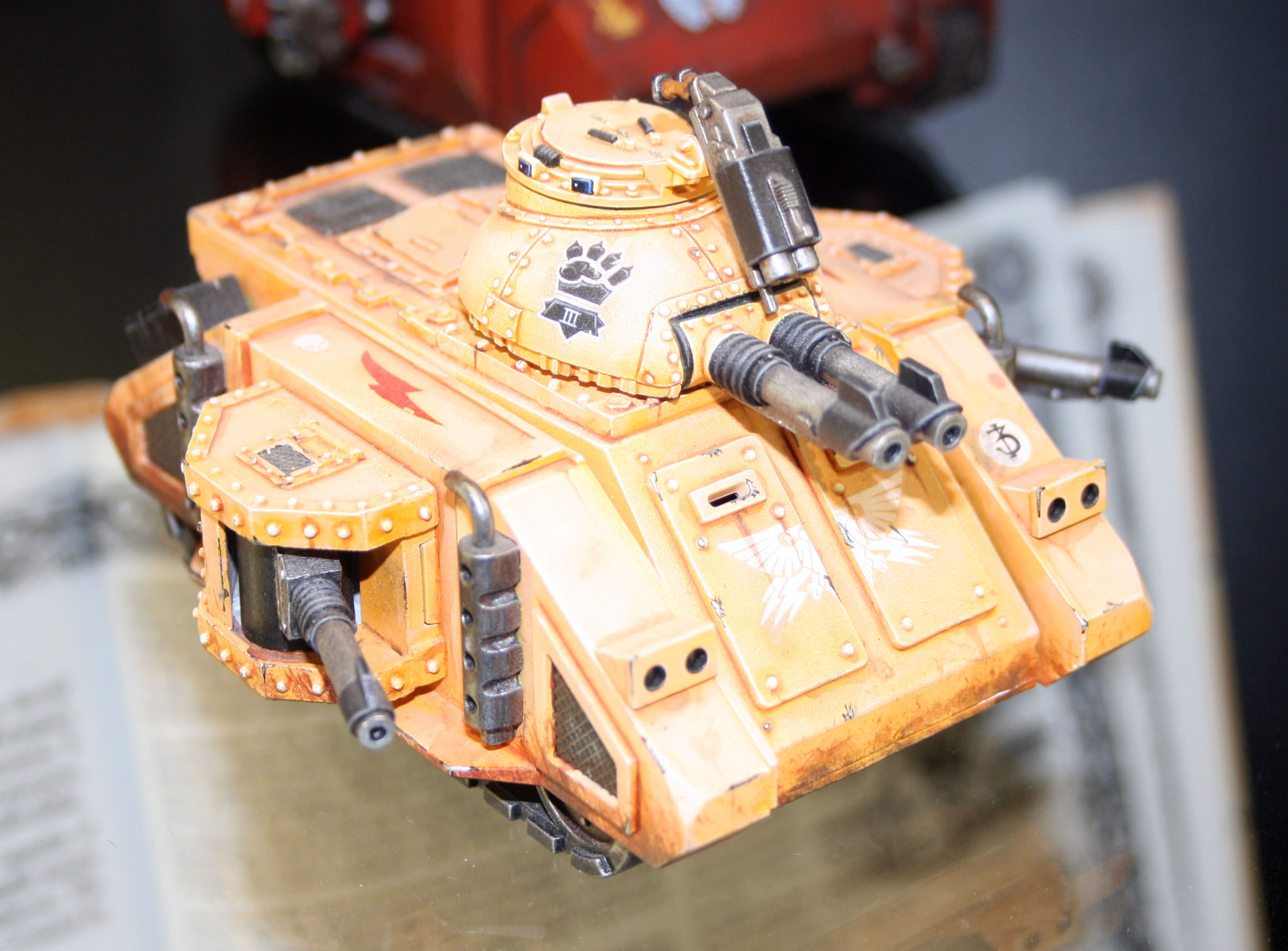
Originally planned to be a Grey Knights Land Raider, despite the iconography, I decided I would paint it as an Imperial Fists Land Raider

Land Raider

I used the same paint scheme I had used on my Deimos Pattern  Rhino. Originally for the basecoat I used Tausept Ochre. After retreiving the model from storage, the first thing I did was spray the underneath of the model with Citadel Zandri Dust. I gave the model a couple of light sprays of Army Painter Daemonic Yellow. I painted the weapon sub-assemblies. added detailing and painted the iconography. Then using various Citadel shades I washed and shaded the model. For the next stage I used some Citadel Layer Yriel Yellow. I took a large brush and gave the model, what I would call, a heavy drybrush.  The tracks for the Land Raider were painted, and the iconography was completed with washes and highlights. The finished tracks were then glued to the Land Raider with superglue.

See the full  workbench feature on the Land Raider.

A34 Comet

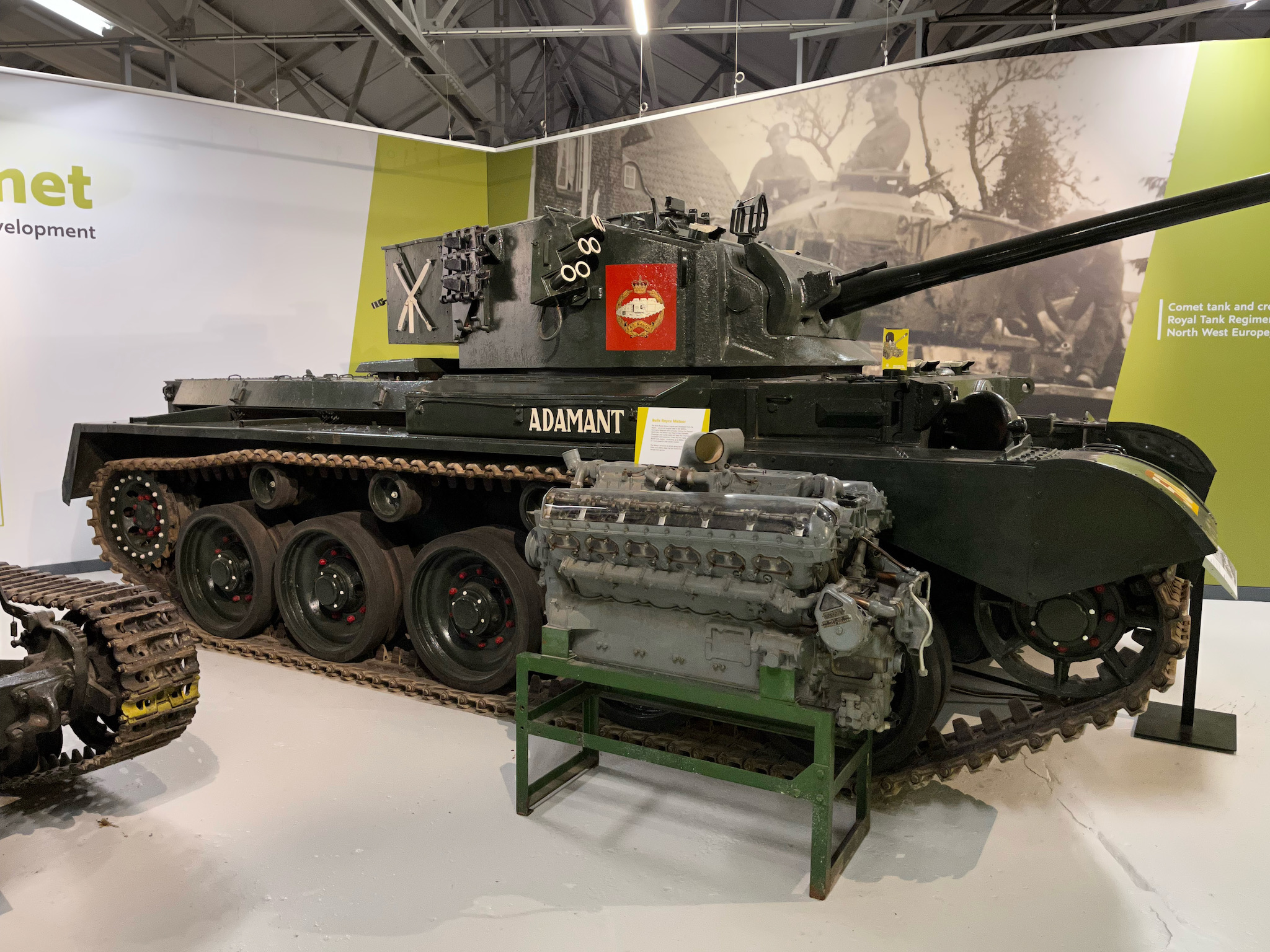
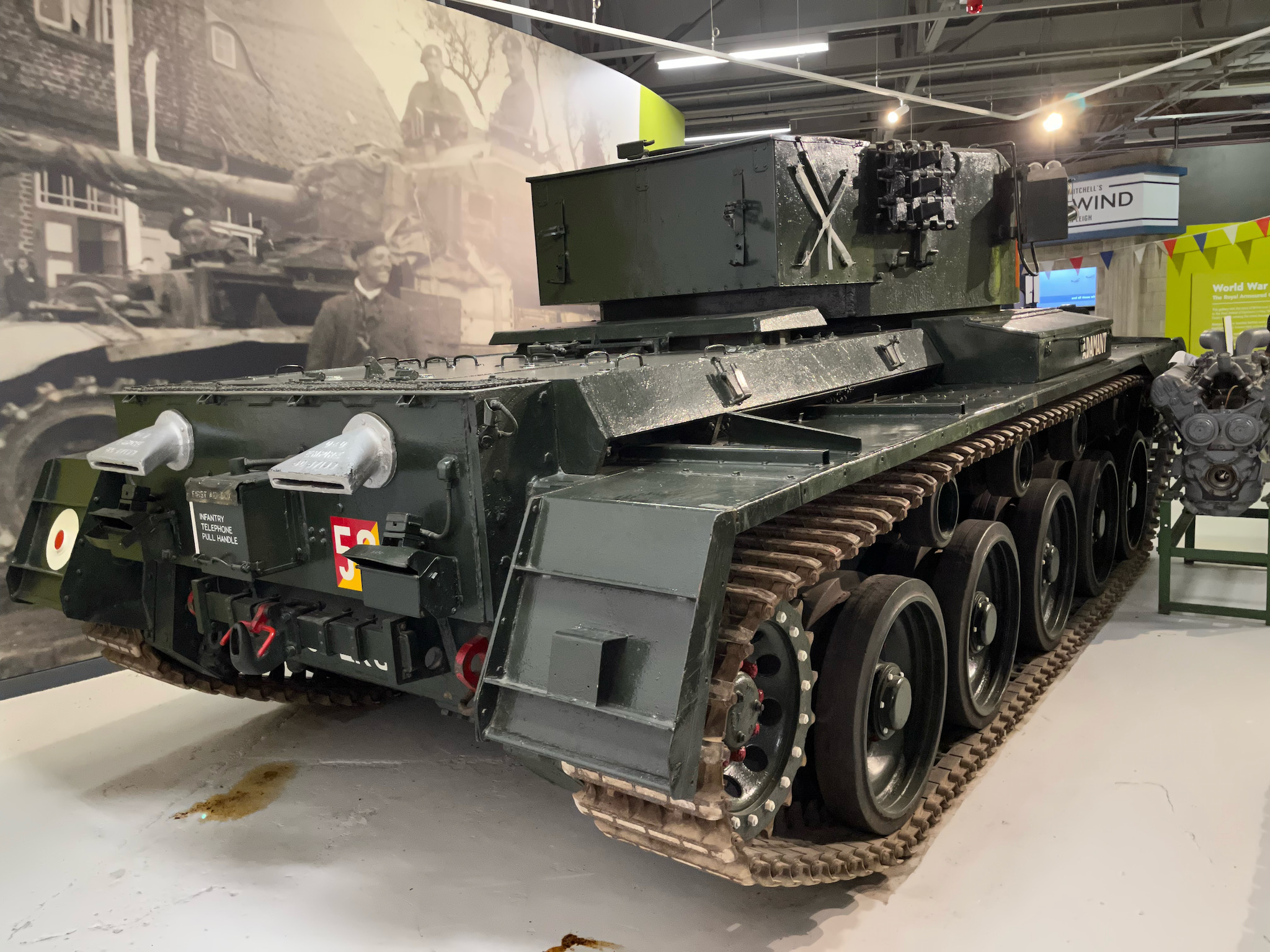
This A34 Comet tank was on display at the Tank Museum at Bovington.

The A34 Comet was a British cruiser tank that was developed in the late stages of World War II. It was based on the Cromwell tank, but it had a number of significant improvements, including a new 17-pounder gun, a fully-welded hull and turret, and a new suspension system.

The Comet entered service in 1944 and was used by British armoured units in the final stages of the war in Europe. It proved to be a very effective tank, and was credited with knocking out German tanks.

The Comet was also used by the British Army in the Korean War, where it again proved to be a very capable tank. It was retired from British service in 1958.

The Comet was a very successful tank, and it was one of the most important British tanks of the Second World War. It was a major improvement over the Cromwell, and it was able to give the British Army a tank that was capable of taking on the latest German tanks. The Comet was also a very reliable tank, and it was easy to maintain.

The Comet’s success led to the development of the Centurion tank, which was the main battle tank of the British Army for many years. The Comet’s design features were also incorporated into other British tanks, such as the Challenger and the Chieftain.

The Comet is a reminder of the British Army’s ability to develop and field effective tanks in a short period of time. It is also a testament to the skill and dedication of the British tank crews who used it in battle.

More photographs of this Comet Tank and also here.

Comet Tank at the entrance to the Imperial War Museum Duxford.

Comet on display at the Imperial War Museum Duxford in their Land Warfare Exhibit.

I do have some of the Flames of War plastic models, but they are still currently still in their boxes. I have been thinking of using them not only for Late War Flames of War games, but also 1950s Cold War games. The Comet remained in British service until 1958. Reading the Hot War books from Harry Turtledove has inspired me to think about gaming some scenarios from the books. British Comets and Centurions versus Russians T34-85 and T54 Soviet tanks with American M26 Pershing and M48 Patton tanks. In the book there are also Sherman manned by (West) German forces.

Why such a liking for this tank, well, as with other models, I suspect that it was because I bought and made the Matchbox Comet many, many years ago.

Deimos Pattern Predator

The Predator is perhaps the best known and most widespread variant of the basic Rhino chassis. Augmented with superior armour and firepower, it entirely sacrifices the Rhino’s troop transport capacity in favour of ammunition and generators for its formidable weapon systems. 

Having finished painting the Predator, I photographed the model on my desert terrain board.

Deimos Pattern Predator

Another view.

Deimos Pattern Predator

See the workbench feature on the Deimos Pattern Predator Battle Tank.


Razorback in the desert

One model I got many years ago, well in 2006, was a Forgeworld Razorback the one with the much bigger turret, which I much prefer over the plastic kit version that you could get in the shops back then. I recently retrieved it from storage and decided that I would try and finish painting it.

I took some photographs of the Razorback on my desert scenery tile.

There is still some work to do with this model, but I am pleased I have made progress and nearly finished it.

I like how the Inquisitorial iconography has turned out on the model.

It’s a pity that, that range has been retired. I found some more resin purity seals and a spare Rhino frontal armour plate in one of my bits box.

See the workbench feature on the Razorback.

Boulton Paul Defiant

This Boulton Paul Defiant was on display at RAF Cosford.

Boulton Paul Defiant

The Boulton Paul Defiant was a British two-seat turret fighter aircraft that served with the Royal Air Force (RAF) during the Second World War. The Defiant was designed and built by Boulton Paul Aircraft as a “turret fighter”, without any fixed forward-firing guns, a design also found in the Blackburn Roc of the Royal Navy.

Boulton Paul Defiant

During 1935, the concept of a turret-armed defensive fighter to counter the bomber threat emerged during a time in which the RAF anticipated having to defend Great Britain against massed formations of unescorted enemy bombers. The RAF did not expect bombers to be escorted by fighters because fighters would not have the range to reach the UK from Germany.  In theory, turret-armed fighters would approach an enemy bomber from below or from the side and coordinate their fire. The separation of the tasks of flying the aircraft and firing the guns would allow the pilot to concentrate on putting the fighter into the best position for the gunner to engage the enemy. However, manually-traversed turrets were viewed as having becoming more problematic and increasingly inadequate to effectively respond to ever-faster hostile aircraft, thus there was considerable interest in using a power-augmented turret.

Boulton Paul Defiant

The Defiant entered service in December 1939, and initially achieved some success during the Battle of Britain, shooting down 65 German aircraft. However, its lack of forward-firing guns made it vulnerable to attacks from the front, and it was soon withdrawn from front-line service. The Defiant was later used as a night fighter, and also for air-sea rescue and target towing.

In mid-1942 it was replaced by better performing night-fighters, the Bristol Beaufighter and de Havilland Mosquito.

The Defiant was powered by a single Rolls-Royce Merlin engine, and had a maximum speed of 489 km/h. It was armed with four .303 Browning machine guns in a rear-facing turret. The Defiant had a crew of two: the pilot and the rear gunner.

The Defiant was a capable aircraft, but it was ultimately limited by its design. Its lack of forward-firing guns made it vulnerable to attacks from the front, and it was also relatively slow and had a limited range. Despite these limitations, the Defiant played an important role in the Battle of Britain, and it continued to serve with the RAF until the end of the war.

A total of 1,033 Defiants were built, and the type was retired from RAF service in 1945. They were used to test ejection seats before being retired.

On a previous visit the Boulton Paul Defiant was being assembled.

Fairey Delta 2 at RAF Cosford

Fairey Delta 2 at RAF Cosford

The Fairey Delta 2 was a British supersonic research aircraft produced by the Fairey Aviation Company in response to a specification from the Ministry of Supply for a specialised aircraft for conducting investigations into flight and control at transonic and supersonic speeds. Features included a delta wing and a drooped nose. On 6 October 1954, the Delta 2 made its maiden flight, flown by Fairey test pilot Peter Twiss; two aircraft would be produced. The Delta 2 was the final aircraft to be produced by Fairey as an independent manufacturer.

Rear view of the Fairey Delta 2 at RAF Cosford

The Fairey Delta 2 was the first jet aircraft to exceed 1000 mph in level flight. On 10 March 1956, it set a new world speed record of 1,132 mph. The Delta 2 held the absolute World Air Speed Record for over a year. It continued to be used for flight testing, and was allocated to the Royal Aircraft Establishment (RAE) in 1958.

Another photograph of the Fairey Delta 2.

Adding the Dreadhammer Siege Cannon

My latest model for my Imperial Fists Horus Heresy force is the Typhon Heavy Siege Tank.

The Typhon Heavy Siege Tank was released as a plastic kit for The Horus Heresy. I’ve always liked the Forge World resin model and so was pleased to get one of the new plastic kits for my Imperial Fists force.

Having started constructing the model, I finished putting it together. The next stage was a white undercoat. I then gave the model a partial base coat of Army Painter Desert Yellow. I then gave the model a base coat of Army Painter Daemonic Yellow. I painted the bolter and the exhausts using Citadel Leadbelcher. It was then onto shading the model and then shading it some more. I also painted the tracks. The Typhon was then drybrushed.

I glued in the Dreadhammer Siege Cannon and then added the frontal armour.

See the workbench feature on the Typhon Heavy Siege Tank.

Deimos Pattern Rhino

The Rhino is the most widely used armoured personnel carrier in the Imperium. Based on ancient STC technology, the fundamental design is robust, reliable, and easy to maintain, with an adaptive power plant that can run off a wide variety of fuels.

I was pleased to see one of the new Horus Heresy releases announced at Warhammer Fest was the Plastic Deimos Pattern Rhino. So when it was available for pre-order I clicked through and ordered the kit from my local FLGS.

Having finished painting them, I photographed them on my desert terrain board.

I was lucky enough to get a second Rhino for a Christmas present. This I painted in the same way as the first Rhino.

See the workbench feature on the first Deimos Pattern Rhino.

See the workbench feature on the second Deimos Pattern Rhino.

Matilda I

The Tank, Infantry, Mk I, Matilda I (A11) was a British infantry tank of the Second World War. Despite being slow, cramped and armed with only a single machine gun, the Matilda I had some success in the Battle of France in 1940, owing to its heavy armour which was proof against the standard German anti-tank guns. However, it was essentially useless in an attacking sense, as its weak armament made it toothless in combat against enemy armour, and the tank was obsolete before it even came into service.

There are two Matilda I tanks at the Bovington Tank Museum. One is in running order, though it doesn’t have an authentic engine and gearbox.

The hull and turret were well protected against contemporary anti-tank weapons but the tracks and running gear were exposed and more vulnerable than on tanks that had protected tracks. The lack of a gun with anti-tank capability severely limited its utility on the battlefield.

The other is painted to represent T8106 a tank of the 4th Royal Tank Regiment in France in May 1940.

The Battle of France was the only time the Matilda I saw combat. The tank was cheaply built as the British government wanted each of the tanks to be built on a very restricted budget in the build-up to the Second World War.