Dwarf Anvil of Doom

The Dwarf Anvil of Doom is one of the most ancient heirlooms of the Dwarf race. It is on these anvils that the greatest rune weapons have been forged. Each anvil is covered in runes that modern Runesmiths cannot begin to fathom. When striking runes on the anvil, each Runelord uses techniques taught to him by his master that were in turn taught by his master and so on back to the dawn of time. Because of this, no two anvils function in exactly the same way.

This is the model from Warhammer World and GamesDay 2005.

I think it’s interesting that at one time the model was based. Looking at the images, one of them shows the Runelord with his hammer above his shoulder (at Games Day 2005)  and another behind his neck (in Warhammer World).

You can now buy the Anvil of Doom from Games Workshop.

Dwarfen Mountain Holds

These Dwarfs were on display at Warhammer World.

In the grim and perilous world of Warhammer: The Old World, the Dwarfen Mountain Holds, collectively known as the Karaz Ankor in their ancient tongue, stand as bastions of stubborn defiance against a hostile world. These colossal fortresses, carved deep into the living rock of the Worlds Edge Mountains and other ranges, represent the heart of Dwarf civilisation. Far from mere strongholds, they are intricate underground cities, sprawling networks of tunnels, grand halls, and cunningly devised defences, all designed to safeguard the Dwarfs’ immense wealth and ancient traditions.

While many of the once-mighty Holds have fallen to Greenskin incursions, Skaven infestation, or the ravages of Chaos, the Dwarfs are a race defined by their indomitable spirit and their meticulously kept “Book of Grudges.”

More photographs of Dwarfs.

The Battle of Matorea

The Warhammer Old World diorama, “The Battle of Matorea,” is a breathtaking tableau that vividly brings to life a dramatic clash between the chivalrous Bretonnian Knights and the ancient, undead legions of the Tomb Kings of Khemri. This expertly crafted scene captures a pivotal moment in what must have been a desperate struggle, highlighting the contrasting aesthetics and fighting styles of these two iconic factions.

Settra the Imperishable lays siege to the coastal city of Matorea with a massive undead host as Cecil Gastonne, the Wyrm Slayer rallies its hopelessly outnumbered defenders. Just as the city’s defences begin to fail, the trumpeting of silver clarions sounds in the east, heralding the arrival of Duke Gastille. Have the duke and his knights arrived in time to lift the siege, or will they join the doomed defenders in a heroic death?

At the heart of the diorama, the Bretonnian Knights, resplendent in their vibrant heraldry and polished plate armor, are depicted mid-charge, lances lowered and banners flying high. The dynamism of their assault is palpable, conveying the sheer force and faith with which these champions of the Lady throw themselves into battle. One can almost hear the thundering hooves and the shouts of “For the Lady!” as they aim to shatter the brittle ranks of their skeletal foes. The diorama likely showcases various knightly orders, perhaps even a Duke or a Grail Knight, leading the charge with unwavering determination, their mounts rearing or galloping furiously into the fray.

Opposing this glorious charge, the Tomb Kings of Khemri present a stark and unsettling contrast. Their skeletal warriors, ancient and unfeeling, form an unyielding tide of bone and rusted bronze. Hierophants and Tomb Princes, perhaps astride macabre chariots or mighty constructs like Ushabti, would be strategically positioned, directing their automaton armies with an eerie, silent resolve. The diorama would no doubt emphasize the sheer numbers of the Tomb Kings, with ranks of skeleton warriors, archers, and perhaps even animated constructs like Screaming Skull Catapults or Necrolith Colossi, adding to the sense of overwhelming, relentless pressure. The bleached bones and dusty, tattered banners of Khemri create an atmosphere of dread and ancient power, starkly contrasting with the vibrant colours of Bretonnia.

“The Battle of Matorea” isn’t just a collection of miniatures; it’s a narrative frozen in time. The composition likely draws the viewer’s eye to key points of conflict – a Bretonnian Knight’s lance impaling a skeletal champion, a Foot Knight desperately defending a standard against a tide of mummified horrors, or a magical duel between a Bretonnian Damsel and a Liche Priest. Through meticulous detail and expert painting, the diorama effectively conveys the chaos, heroism, and horror of war in the Old World, making it a truly immersive and captivating piece for any Warhammer enthusiast. It serves as a testament to the rich lore and enduring appeal of the setting, particularly the epic conflicts that define its factions.

More photographs of The Battle of Matorea.

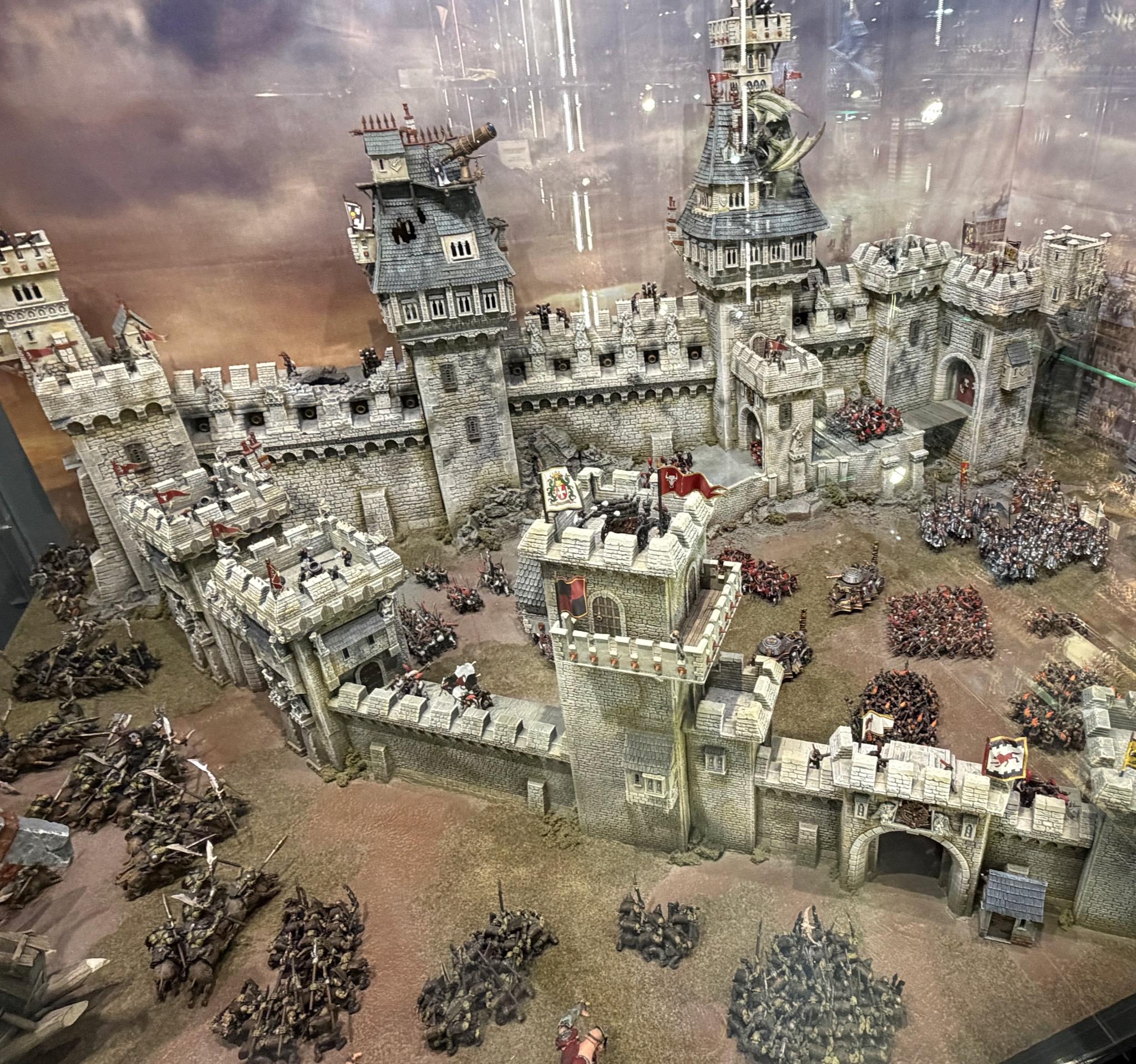
The Siege of Volganoff

The Siege of Volganoff was originally displayed as the Siege of Altdorf at Games Day 2010 and was then put into place at Warhammer World in 2015. A few years later it was reduced in size. The Chaos forces were replaced with Orcs and the the “new” diorama was entitled the Siege of Volganoff.

The diorama has changed quite a bit over the years. More photographs of the Siege of Volganoff.

Dwarf Gyrocopter Pilot

I did think I had this model somewhere, however the pilot has turned up.

This was the original Dwarf Gyrocopter and personally I think the best. It comes across more as an autogyro rather than a helicopter, whereas the later models do feel more like helicopters, almost too sophisticated for a fantasy setting.

This is the original pilot, later Citadel did a pilot with a helmet with a winged helm, which you could argue was more fantasy than this pilot.

You can tell there are issues with my modelling here as the seat of the dwarf pilot has a large glob of epoxy glue there, this was when I use that over superglue.

Now I just need to find the Gyrocopter.