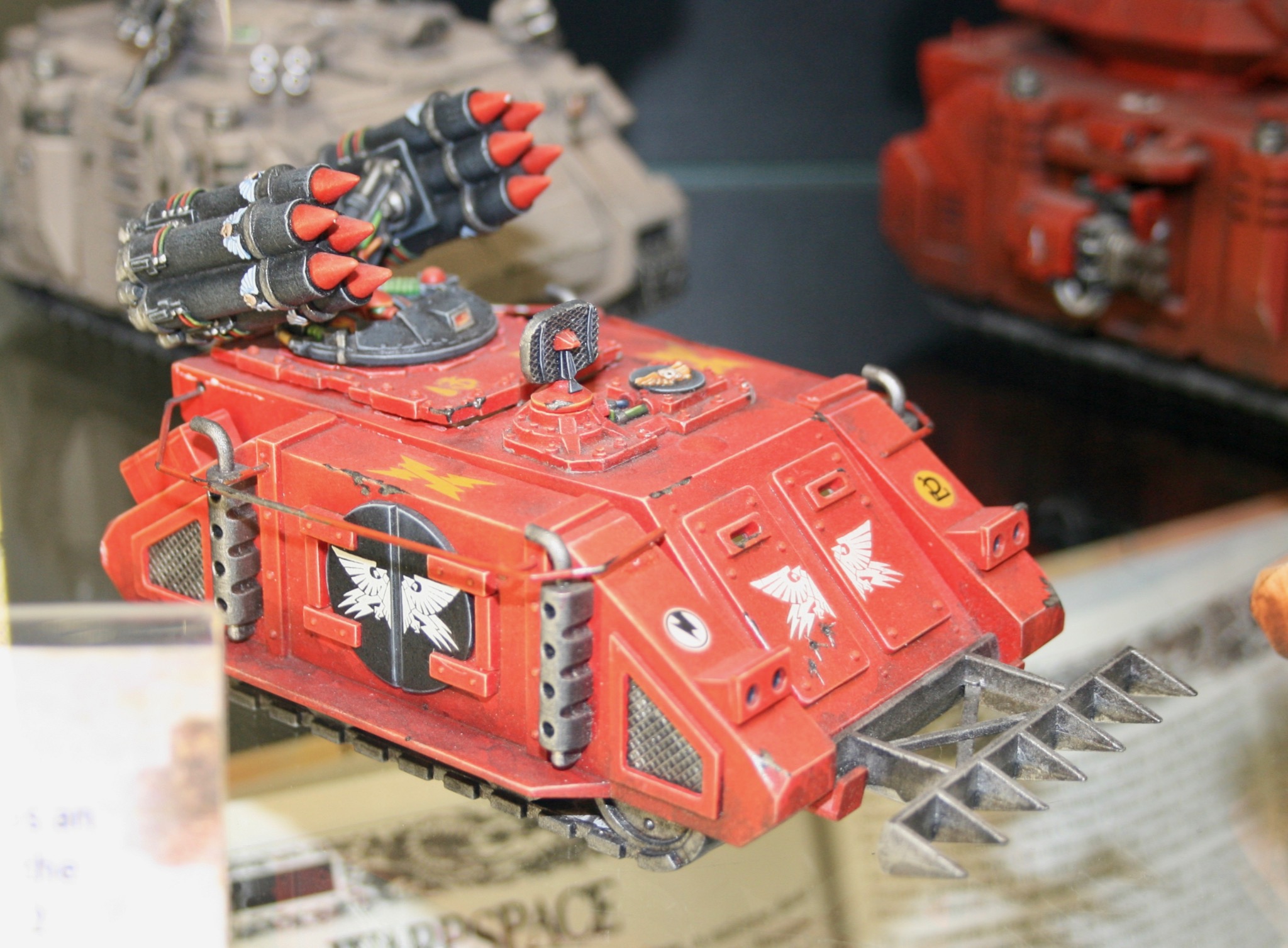
“Original” Space Marine Whirlwind at Warhammer World

The Whirlwind is an Imperial artillery support vehicle based upon the Standard Template Construct (STC) Rhino armoured personnel carrier (APC) chassis that is now primarily used by the Space Marine Chapters of the Adeptus Astartes.

This is the kit version of the original Whirlwind artillery vehicle, based on the original Rhino kit. It was on display at Warhammer World.

"Original" Space Marine Whirlwind at Warhammer World

It comprised a plastic Rhino kit and metal components.

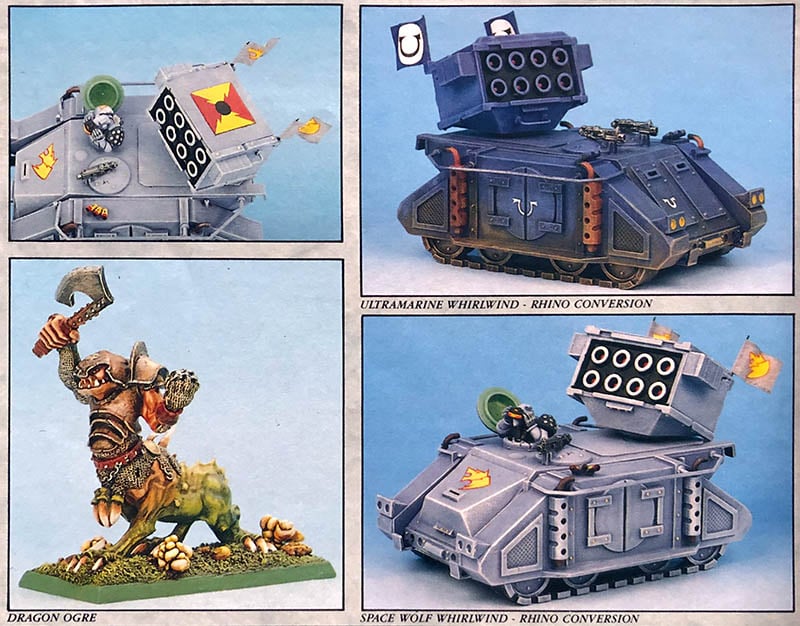
The original Whirlwind was a conversion using a slottabase and plasticard for the rocket launcher. This was published in the September 1989 issues of White Dwarf, #117.

Whirlwind

The Rhino APC is perhaps the most common vehicle in the Imperium. As a basic design in the STC system, it exists in thousands of variants, each of which can be considered a vehicle in its own right. Each different design is much more than a simple conversion of the standard Rhino; every one fulfills a different role, and is impossible to better. The Whirlwind is just one of these designs.

Here are the instructions, just in case you want to build your own. Continue reading ““Original” Space Marine Whirlwind at Warhammer World”

Typhon Heavy Siege Tank Sponsons

My latest model for my Imperial Fists Horus Heresy force is the Typhon Heavy Siege Tank.

The Typhon Heavy Siege Tank was released as a plastic kit for The Horus Heresy. I’ve always liked the Forge World resin model and so was pleased to get one of the new plastic kits for my Imperial Fists force.

Having started constructing the model, I finished putting it together. The next stage was a white undercoat. I then gave the model a partial base coat of Army Painter Desert Yellow. I then gave the model a base coat of Army Painter Daemonic Yellow. I painted the bolter and the exhausts using Citadel Leadbelcher. It was then onto shading the model and then shading it some more. I also painted the tracks. The Typhon was then drybrushed. I glued in the Dreadhammer Siege Cannon and added the frontal armour.

I had undercoated the sponson weapons and then painted the armour with Army Painter Desert Yellow. I then painted the lascannons with Citadel Leadbelcher. The sensor covering was then painted with Citadel Layer Flash Gitz Yellow.

Typhon sponson weapons

These were then attached to the Typhon.

Typhon Heavy Siege Tank

It was then onto shading the sponsons. I used some Citadel Reikland Fleshshade Shade on them.

Typhon Heavy Siege Tank

Typhon Heavy Siege Tank

The next stage will be affixing the tracks.

See the workbench feature on the Typhon Heavy Siege Tank.

Guy Armoured Car

This Guy Armoured Car was on display at the Tank Museum.

Guy Armoured Car

The Guy Armoured Car was a British armoured car produced in limited numbers during Second World War. The car saw limited action during the Battle of France.

Guy Armoured Car

The manufacturer, Guy Motors, did not have enough capacity to produce the armored car alongside their artillery tractors, so they passed the design and construction techniques to Rootes, who used them to create the Humber Armored Car.

Six Guy Armored Cars were sent to France with the British Expeditionary Force (BEF), but they were lost when France fell to the Germans.

Four cars, two each with the 12th Lancers and 2nd Northamptonshire Yeomanry, had their guns removed and additional seats fitted in 1940 for use in the Coats Mission to evacuate the Royal family in the event of a German invasion of Britain during the Second World War.

The Coats Mission was a special British army unit established in 1940 for the purpose of evacuating King George VI, Queen Elizabeth, and their immediate family in the event of a German invasion of Britain during the Second World War. It was led by Major James Coats, MC, Coldstream Guards, later Lieutenant-Colonel Sir James Coats, Bt.

The force consisted of:

    • A special company of the Coldstream Guards. There were five officers and 124 Guardsmen based at Bushey Hall Golf Club. Every officer and Guardsman was personally interviewed by Major Coats before being assigned to the company.
    • A troop of the 2nd Northamptonshire Yeomanry based at Windsor Castle commanded by Lieutenant Michael Tomkin. They were equipped with four Guy Armoured Cars. Their role was to evacuate Princess Elizabeth and Princess Margaret.
    • A Royal Army Service Corps section of 12 men with four Leyland Tiger buses based at Bushey Hall Golf Club. Their role was to transport the Coldstream Guards company.
    • Military Police from the Provost Company of the 1st London Division for escort and traffic control, commanded by Captain Sir Malcolm Campbell, MBE.

The Coats Mission was never called upon to carry out its mission, as the German invasion of Britain never materialized. However, the unit’s existence was a sign of the British government’s determination to protect the Royal Family, even in the face of the most dire circumstances.

The Coats Mission is a fascinating example of the lengths that the British government was willing to go to in order to protect its monarchy. It is also a reminder of the importance of contingency planning, even in the face of unlikely events.

I have been thinking about creating a game based on the Coats Mission with an assault by German Paratroopers in an attempt to capture the Royal Family.

Another photograph of the Guy Armoured Car.

Incom T-47 Snowspeeder parts

The Incom T-47 Snowspeeder is a two-person, all-terrain vehicle used by the Rebel Alliance during the Galactic Civil War.

Incom T-47 Snowspeeder flying towards an Imperial AT-AT Walker.

Though you can get an “official” Snowspeeder model for Star Wars Legion, I have been thinking for a while about getting the Revell 1/52nd scale model kit of the Snowspeeder. Mainly as I wanted to use it as scenery (more than as a vehicle in the game) and partly down to cost. The Revell kit was £8 and the “official” Snowspeeder model was over £30 when I last looked on Amazon.

Incom T-47 Snowspeeder

The kit contains 23 parts across four sprues.

I was disappointed with the size of the crew figures, for what is described as 1/52nd scale. They are really tiny.

The nest stage will be painting some components black before constructing the model.

British Aerospace EAP

The British Aerospace EAP (Experimental Aircraft Programme) was a British technology demonstrator aircraft developed by aviation company British Aerospace (BAe) as a private venture. It was designed to research technologies to be used for a future European combat aircraft, and eventually formed the basis for the multinational Eurofighter Typhoon.

BAe EAP

The EAP first flew on August 8, 1986, and made its public debut at the Farnborough Air Show later that year. It was powered by two Turbo-Union RB199 engines and had a maximum speed of Mach 1.4. The aircraft was made of carbon fiber composites and titanium, and featured a number of innovative technologies, including fly-by-wire controls, relaxed static stability, and an advanced radar system.

The EAP flew for over 200 hours and helped to validate many of the technologies that would later be used on the Eurofighter Typhoon. It was retired in 1991, but its legacy lives on in the Typhoon, which is one of the most advanced combat aircraft in the world.

It is now on display at RAF Cosford, and here are more photographs.

40K Ork Trukk with Krooz Missilz

Decided that I would reboot a conversion idea I had for a 40K Ork Trukk with Krooz Missilz.

Many years ago I made a simple conversion to create an Epic Ork Trukk with Krooz Missulz (aka an Orkish version of the Imperial Deathstrike Missile Launcher. The model is built using a Flakwagon base, a firing platform from a Pulsa Rokitt and the Krooz Missulz? Well it’s a 40k scale Fighta-Bommer Missile.

In the most recent versions of Warhammer 40K there are no models and no rules for this kind of weapon. However there were rules for Apocalypse some years ago for what looked like a Krooz Missilz, but was described as a Pulsa Rokkit.

The (scratchbuilt) model used for the data sheet was much larger than the original metal Pulsa Rokkits from an earlier edition of Warhammer 40K. Those metal ones were much more like the Epic version.

I had planned to make a 40K version of this rocket many years ago. However like many projects it got shelved and I never made much progress with it. Having found some of the parts I decided to restart the project.

I am going to be using one of my unfinished Ork Trukk models as the platform for the rocket.

The flatbed doesn’t have the sides, so can be used for this, or other Ork heavy weapons.

The base for the missile part of the  model will be the fuel tank from a 1/300th Academy Space Shuttle model kit.

In the kit, the rocket boosters were attached to the fuel tank. The rocket boosters were separated and will be used as different kinds of Ork rokkits. The fuel tank was then ready for conversion.

You can see how large the fuel tank is compared to the trukk.

I did though first, using a Grot Bomb Launcha firing frame, mock up the Ork Trukk with Krooz Missilz.

This was working for me. I wanted to Orkify the missile, so started to add details using spare parts from various kits and some plasticard and plastic struts.

Pleased with how it is looking, but the missile needs a lot more work.

Sd.Kfz. 265 Panzerbefehlswagen

The Sd.Kfz. 265 Panzerbefehlswagen (light armoured command vehicle) was a German Army’s first purpose-designed armoured command vehicle; a type of armoured fighting vehicle designed to provide a tank unit commander with mobility and communications on the battlefield. A development of the Army’s first mass-produced tank, the Panzer I Ausf. A, the Sd. Kfz. 265 saw considerable action during the early years of the war, serving in Panzer units through 1942 and with other formations until late in the war.

This rare Sd.Kfz. 265 Panzerbefehlswagen is on display at Bovington.

Sd.Kfz. 265 Panzerbefehlswagen

The Sd. Kfz. 265 was based on the Panzer I Ausf. A chassis, but it had its turret removed and replaced with a superstructure that housed additional radios and other communications equipment. The superstructure was located at the rear of the vehicle, and it was designed to provide the commander with a good view of the battlefield. The Sd. Kfz. 265 was also equipped with a single 7.92mm machine gun, which was mounted in the hull.

The Sd. Kfz. 265 was crewed by three men: the commander, the driver, and the radio operator. The commander was responsible for directing the unit’s movements and for communicating with other units. The driver was responsible for driving the vehicle, and the radio operator was responsible for operating the vehicle’s communications equipment.

The Sd. Kfz. 265 was a relatively simple and inexpensive vehicle to produce, and it was well-suited for its intended role as a command tank. It was reliable and easy to maintain, and it had good mobility and range. However, it was lightly armoured and lightly armed, and it was not suitable for combat.
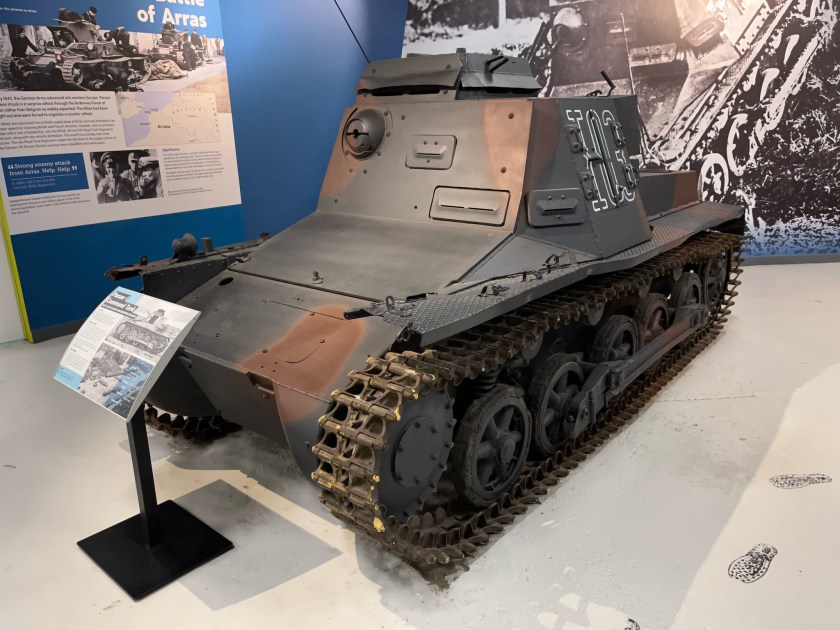
The Panzer I Command Tank was first used in combat during the Spanish Civil War, and it saw extensive use during the early years of World War II. It was eventually replaced by more capable command tanks, such as the Panzer III Command Tank, but it remained in service until the end of the war.

Design of the Panzer I began in 1932 and mass production began in 1934. Intended only as a training tank to introduce the concept of armoured warfare to the German Army, the Panzer I saw combat in Spain during the Spanish Civil War, in Poland, France, the Soviet Union and North Africa during the Second World War, and in China during the Second Sino-Japanese War. Experiences with the Panzer I during the Spanish Civil War helped shape the German Panzerwaffe’s invasion of Poland in 1939 and France in 1940.

I didn’t know until a few years ago that the German tanks in 1940 were painted grey and brown, I had always thought they were just grey. I personally blame Matchbox  for this.

Matchbox Panzer II box art

It was only after Blitzkrieg was released back in 2010 by Battlefront that I noticed the grey and brown camouflage scheme.

As recently as ten years ago the overwhelming consensus regarding early war German AFV paint schemes was that they were all painted in uniform overall panzer grey (Dunkelgrau – RAL 7021 – formerly RAL 46). However, in 2002 Tom Jentz and Hilary Doyle published an article based on primary sources stating all German vehicles at the beginning of World War II were painted in a two tone camouflage scheme of panzer grey with one third of the vehicle painted in a disruptive pattern of dark brown (Dunkelbraun – RAL 7017 – formerly RAL 45). The order to move to an overall panzer grey scheme was not signed until the end of July 1940.
Space Marine Chaplin on a bike

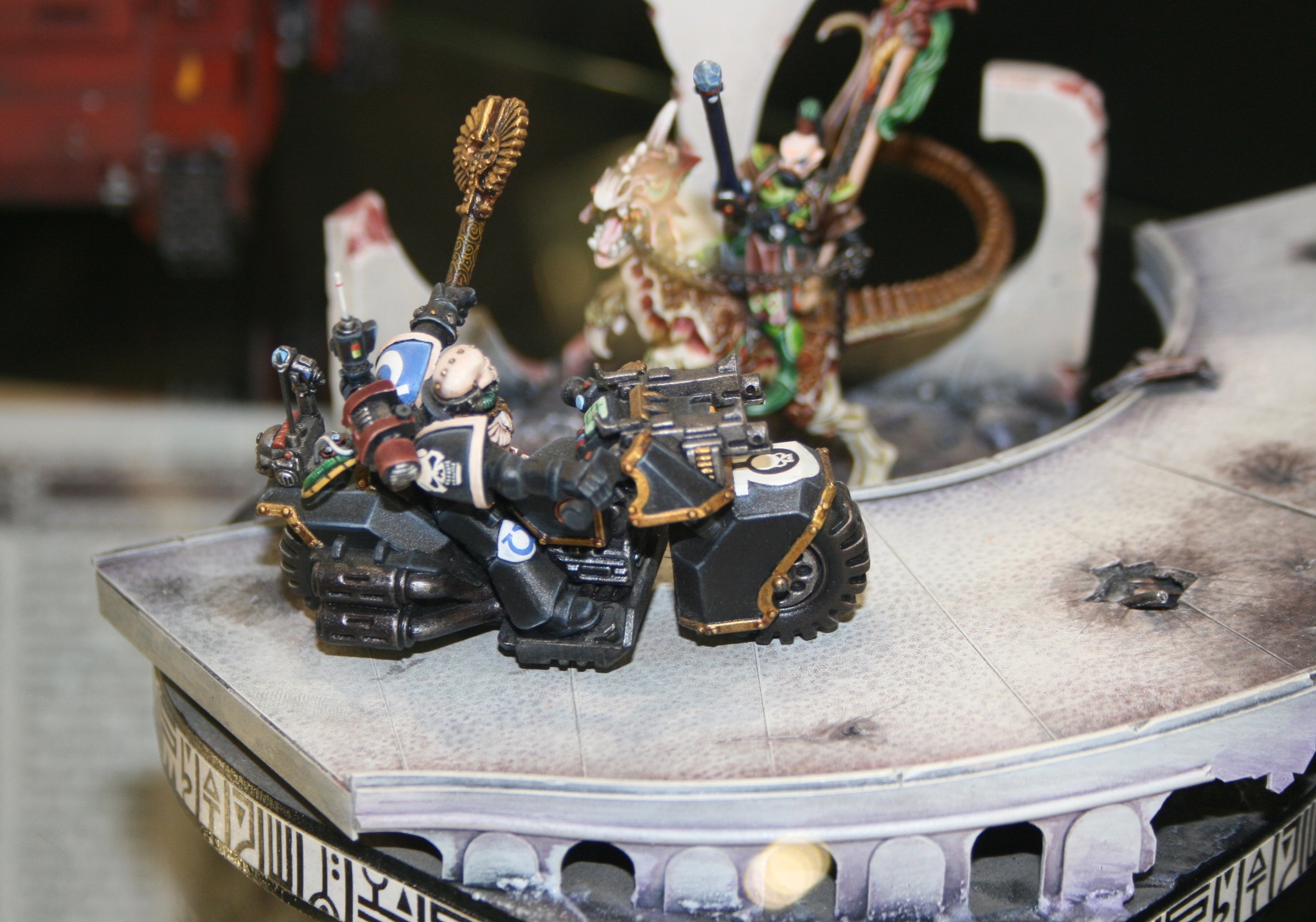
There was a Golden Demon winning Duel (from 2007) that was on display in Warhammer World. It comprises a Space Marine Chaplin on a bike fighting an Eldar Exodite on a giant lizard.

Space Marine Chaplin on a bike

The Exodites were a concept that had Eldar using giant lizards as mounts and large mounts for weapons (in a similar way to Elephants or Squiggoths). It was never taken further by Citadel, though some Epic concepts were sculptured and cast, but never went on sale. The concept proved popular with some and as a result there is a range of unofficial material on the web, and some lovely models such as this one.

Larger view of the duel.

Home Guard Mark IV Male Tank

I am in the process of building a Bolt Action 28mm Home Guard force, I did want to add some armour to them with a Mark IV Male World War One tank put into service, even if it was merely as a mobile pillbox.

Having constructed and undercoated the Mark IV Tank the next stage was a base coat of Army Green Spray from the Army Painter range. I then used a Humbrol Tank Grey 67 spray for the dark colour camouflage pattern. For the tracks I used Citadel Gorthor Brown. I then gave the model a wash.

Here is the Mark IV in my desert terrain.

Home Guard Mark IV Male Tank

It isn’t quite finished I want to do some more weathering, as well as apply some markings. However, I am quite pleased with how it looks now.

Home Guard Mark IV Male Tank

See the workbench feature on the Home Guard Mark IV Male Tank.

BAC TSR-2

The TSR-2 was a cancelled Cold War strike and reconnaissance aircraft developed by the British Aircraft Corporation (BAC) for the Royal Air Force in the late 1950s and early 1960s.

This is one of the three prototypes, XR220, at RAF Cosford.

BAC TSR-2

The British Aircraft Corporation TSR-2 was a strike and reconnaissance aircraft that was developed for the Royal Air Force (RAF) in the late 1950s and early 1960s. It was designed to be a high-speed, low-level aircraft that could penetrate well-defended enemy airspace and attack targets with nuclear or conventional weapons.

The TSR-2 was a radical design for its time. It had a delta wing, which gave it excellent low-speed performance, and two powerful engines that allowed it to fly at Mach 2. It was also equipped with a sophisticated electronic warfare suite that would have made it difficult for enemy radar to track.

BAC TSR-2

The TSR-2 was cancelled in 1965 due to a combination of factors, including rising costs, political opposition, and the changing nature of warfare. However, it remains one of the most iconic British aircraft ever designed.

Although never developed beyond the prototype stage, the British Aircraft Corporation TSR2 was one of the most exciting and controversial British combat aircraft designs of the 1960s.

BAC TSR-2

The cancellation of the project is a subject of great discussion and debate to this day.