Wow.
Doctor Who. Coming early 2020. pic.twitter.com/qXLm6Jppgm
— Doctor Who Official (@bbcdoctorwho) November 23, 2019
Lots of interesting looking stuff in there.
Rumour has it the first episode will be on New Year’s Day.
warhammer, wh40k, flames of war, bolt action, aeronautica imperialis, star wars, models, news, views and stuff
Wow.
Doctor Who. Coming early 2020. pic.twitter.com/qXLm6Jppgm
— Doctor Who Official (@bbcdoctorwho) November 23, 2019
Lots of interesting looking stuff in there.
Rumour has it the first episode will be on New Year’s Day.
Yes that title is correct this is the original limited edition Space Orc (not Ork) that was released in the 1980s (think it was 1985) on display at Warhammer World. This was the first limited edition (hence LE1) and arrived before the Space Marine LE2.

Here is a photograph of my model, which I bought and painted in the 1980s.

Nice to see one of my favourite rule sets of all time, Dirtside II available for free download.

I played Dirtside quite a bit in the 1990s and even put on a display game for it at Salute one year. I much preferred it at the time to the Epic rules which were around. Though when Epic40000 was released I did start playing those rules for a while.
Dirtside II is a rules system for playing combined-arms ground combat with miniatures in a science-fictions setting.
They were first published in 1993 by Ground Zero Games.
They are now available as free download from the GZG website.
Here is an article I wrote for Dirtside.
Further articles.
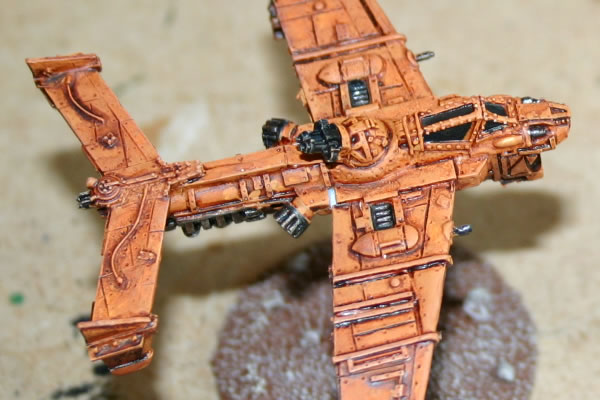
I realised that I had some time ago painted some Ork Bommerz for Epic Armageddon.
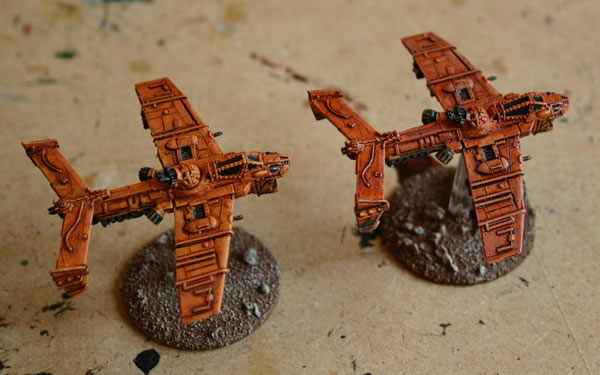
These would be ideal for Aeronautica Imperialis.
I am not 100% but I think they will be the size (scale) as the current plastic models. I must find them (and my other Ork aircraft).
This Mark VIII “The International” Tank was on display at Bovington Tank Museum. It is the last remaining survivor of the six Mark VIII tanks which were completed for Britain.

When the United States declared war on Germany in 1917 the US Army started to look at tanks. They favoured the American Renault as their light tank but used British Mark V and Mark V* tanks for their heavy battalion. However they had their own ideas on tank design and, in co-operation with the British Tank Corps came up with a new heavy tank design for 1919.
The Mark VIII tank also known as the Liberty or The International was an Anglo-American tank design of the First World War intended to overcome the limitations of the earlier British designs and be a collaborative effort to equip France, the UK and the US with a single heavy tank design.
Production at a site in France was expected to take advantage of US industrial capacity to produce the automotive elements, with the UK producing the armoured hulls and armament. The planned production levels would have equipped the Allied armies with a very large tank force that would have broken through the German defensive positions in the planned offensive for 1919. In practice manufacture was slow and only a few vehicles were produced before the end of the war in November 1918.
Many people have thought that the tank used in the Indiana Jones and the Last Crusade

Mechanical effects supervisor George Gibbs said this movie was the most difficult one of his career. He visited a museum to negotiate renting a small French World War I tank, but decided he wanted to make one. The tank was based on the tank Mark VIII, which was thirty-six feet (eleven meters) long, and weighed twenty-five tons. Gibbs built the tank over the framework of a twenty-five ton excavator, and added 6.4 ton tracks, that were driven by two automatic hydraulic pumps, each connected to a Range Rover V8 engine. Gibbs built the tank from steel, rather than aluminum or fiberglass, because it would allow the realistically suspensionless vehicle to endure the rocky surfaces. Unlike its historical counterpart, which had only the two side guns, the tank had a turret gun added as well. It took four months to build, and was transported to Almería on a Short Belfast plane, and then a low loader truck.
I had meant to buy what I thought was a Copplestone Castings’ Mark IX Beast, a similar model of the Indiana Jones tank, but it appeared that it was no longer manufactured or sold by North Star Figures.
It's not. It was never Copplestones, it belonged to HLBSCo, but I think they sold the whole range to another company. Sorry can't help more.
— NorthStarFigs (@NorthStarFigs) November 12, 2019
So it appeared that it wasn’t even a Copplestones Castings, but was by the Honourable Lead Boiler Suit Company (HLBSCo).
Sometimes you should buy things when you see them and not wait…
So it was originally designed and manufactured by the Honourable Lead Boiler Suit Company (HLBSCo) they were small and relatively new. I even remember discussing licensing the models for a commercial version of Tally Ho!
So I did some searching on the Google and found that the tank is available today with the other HLBSCo models from Empress Miniatures.

When the Germans realised what a threat tanks could be they made their trenches wider to trap them; one answer to this was to build longer tanks and the Mark V was stretched by six feet to create the Mark V*. As an interim solution this was adequate but a further improved version, the Mark V** was designed for 1919.
This Mark V** Female Tank was on display at the Bovington Tank Museum.

With the Armistice in November 1918 production of all new tanks was curtailed and the Mark V** never saw action.
In 1918 the Royal Engineers established a depot at Christchurch, just east of Bournemouth, to experiment with tanks. The result was that, by 1919 this particular tank ‘Ol Faithful’ had been adapted with hydraulic lifting gear so that it could carry and lay a bridge and undertake mine clearing or demolition tasks. Thus it became the first true Engineer tank, a type now common in most armies. This tank was still being used as a ballast weight to test the new Bailey Bridge in 1941.
In a previous blog post I showed a photograph of the Mark V Male at Bovington.
This massive Imperial Guard parade was part of a display at Warhammer World. You can see super heavy tanks and other tanks.
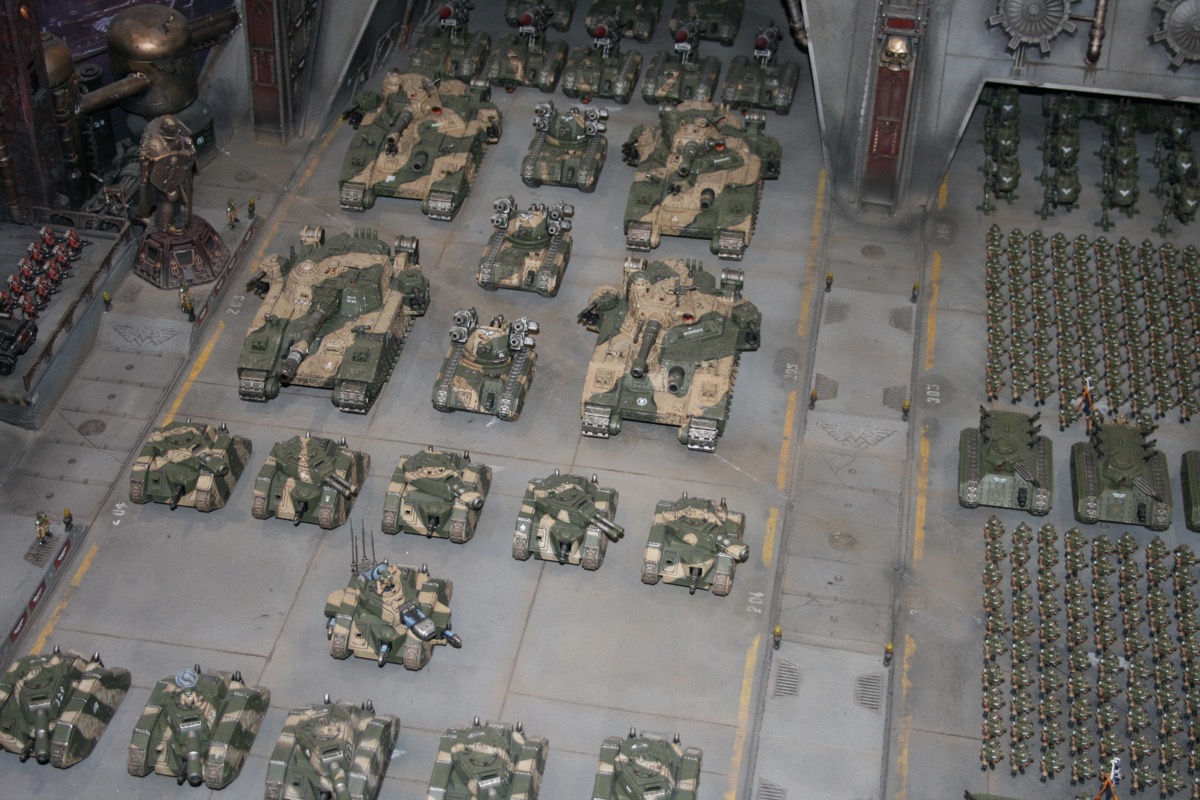
There was also infantry and Chimera APCs as well.
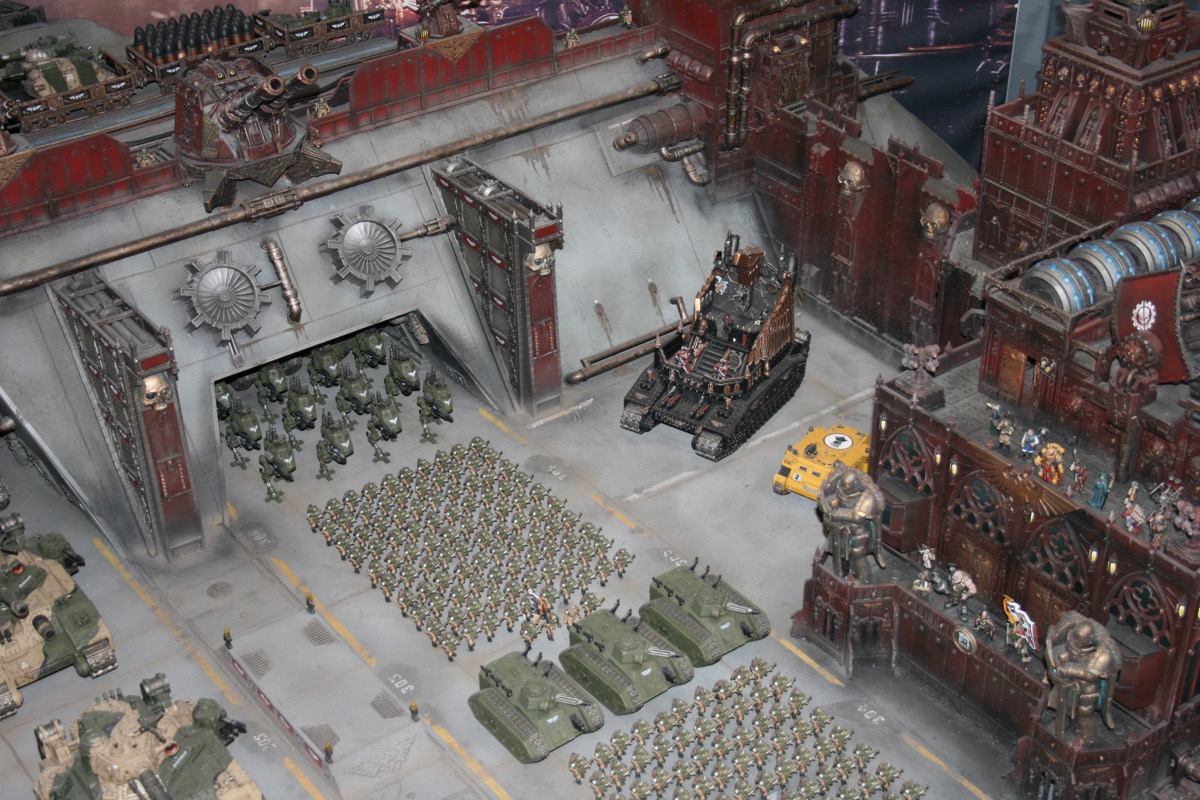
Watching the whole thing was Imperial officials.
I have written before about the influence of Matchbox and Airfix and the impact it has on the models I buy for gaming.
When I was young, before I started this wargaming lark, I use to make up plastic kits. In the main these were the pocket money kits I could buy from my local model shop and these were manufactured by Airfix and Matchbox. I recall preferring the Matchbox kits as they came with a piece of scenery.
…I have started to realise how much my knowledge of World War Two vehicles and armour has been skewed by making those plastic kits all those years ago. They have also influenced what models I am buying and which ones I like.
A similar thing can be said when it comes to looking around Museums and seeing vehicles and aircraft. So it’s no surprise when I saw the AEC Matador and 5.5″ Howtizer at the Land Warfare Exhibit at the Imperial War Museum Duxford, the first thing that came to mind, was the classic Airfix kit.

The Airfix model scene is from Europe, however the actual truck on display at Duxford is painted in desert colours.
The AEC Matador was a heavy 4×4 truck and medium artillery tractor built by the Associated Equipment Company for British and Commonwealth forces during the Second World War.

This truck served on Malta with the Royal Malta Artillery during World War Two.

The BL 5.5 inch Gun was a British artillery gun introduced during the middle of the Second World War to equip medium batteries.

This example, a Mark III, served with 25 Field Artillery Battery, RA (V), Hertfordshire and Bedfordshire Yeomanry, being withdrawn in 1977 after the barrel had fired over 1500 rounds.

This BAe Harrier GR9 was hanging from the ceiling of the Imperial War Museum in London.

The British Aerospace Harrier II is a second-generation vertical/short takeoff and landing (V/STOL) jet aircraft used previously by the Royal Air Force (RAF) and, between 2006 and 2010, the Royal Navy (RN). The aircraft was the latest development of the Harrier Jump Jet family, and was derived from the McDonnell Douglas AV-8B Harrier II. Initial deliveries of the Harrier II were designated in service as Harrier GR5; subsequently upgraded airframes were redesignated accordingly as GR7 and GR9.
The GR9 was developed via the Joint Update and Maintenance Programme (JUMP), which significantly upgraded the Harrier fleet’s avionics, communications systems, and weapons capabilities during scheduled periods of maintenance in an incremental manner.
The aircraft on display was delivered as a GR5 in 1992 and was subsequently upgraded to a GR7 and then a GR9. It saw service in Iraq, Kosovo and Afghanistan. It was damaged in 2010 in the USA, before being declared as scrap. In 2012 it was offered for sale to the IWM.
The British Mark V tank was an upgraded version of the Mark IV tank. It was first deployed in 1918, used in action during the closing months of World War I, and in the Allied intervention in the Russian Civil War on the White Russian side, and by the Red Army, after they were captured.
Although similar in appearance to earlier models the Mark V was a much better tank, more powerful and easier to drive. It was equipped with the new Ricardo six-cylinder engine and Wilson’s epicyclic steering system which meant that one man could handle all the controls, compared with four in the Mark IV.
Among the new features was a rear cab for the commander, complete with signalling apparatus and a rear machine-gun position. Our exhibit also carries an unditching beam, which was first introduced in the Mark IV. This would be used if the tank got stuck in mud – chained to the tracks it was drawn under the tank and gave it something solid to grip.
This Mark V Tank was in display at the Tank Museum in Bovington.

The Mark V is shown in the Markings of 8th (H) Battalion (No. H41), Tank Corps at the time of the Battle of Amiens (8 August 1918). Commanded by a young officer named Whittenbury this actual tank took part in the battle and its young commander was awarded the Military Cross.
The last confirmed use of the Mk V in battle was by units of the Red Army during the defence of Tallinn against German forces in August 1941
In 1945, Allied troops came across two badly damaged Mk V tanks in Berlin. Photographic evidence indicates that these were survivors of the Russian Civil War and had previously been displayed as a monument in Smolensk, Russia, before being brought to Berlin after the German invasion of the Soviet Union in 1941.

Accounts of their active involvement in the Battle of Berlin have not been verified.
