Wartrakks are Ork tracked vehicles that are modified off the versatile warbuggy design by Mekboyz. Essentially a Warbuggy mounted upon a sturdy track unit, a Wartrakk sacrifices its speed for the ability to traverse rough terrain such as a ruined city and deliver heavier firepower. Wartrakks wield either a twin-linked Big Shoota or Rokkit Launcha.
This model was originally designed for Gorkamorka, and then became part of Warhammer 40K with Codex Orks.
I have added an Ork glyph to the frontal armour plate.
The Hawker Hart is a British two-seater biplane light bomber aircraft that saw service with the Royal Air Force (RAF). It was designed during the 1920s by Sydney Camm and manufactured by Hawker Aircraft. The Hart was a prominent British aircraft in the inter-war period, but was obsolete and already side-lined for newer monoplane aircraft designs by the start of the Second World War, playing only minor roles in the conflict before being retired.
You could imagine though in the timeline of the A Very British Civil War that the Hawker Hart could have been used in that conflict.
Several major variants of the Hart were developed, including a navalised version for the Royal Navy’s aircraft carriers.
My latest model for my Imperial Fists Horus Heresy force is the Typhon Heavy Siege Tank.
The Typhon Heavy Siege Tank was released as a plastic kit for The Horus Heresy. I’ve always liked the Forge World resin model and so was pleased to get one of the new plastic kits for my Imperial Fists force.
I had used Citadel Agrax Earthshade Shade on the tracks, forgetting that I should have done a heavy drybrush of Gorthor Brown first.
So I did the heavy drybrush of Gorthor Brown .
I then washed the tracks (again) with Citadel Agrax Earthshade Shade.
I nearly forgot to paint the extra track pieces that come with the Typhon kit (as it is longer than the standard Land Raider). Once I remembered I did them the same way as the rest of the tracks.
After painting and shading them, I drybrushed them lightly, first with Leadbelcher. I then did a very light drybrush with Terminatus Stone.
I have some Daemonhunters Inquisitorial Stormtroopers which are based on the Cadian Kasrkin I decided many years ago to add a unit based on the Tallarn.
The Rolls-Royce Armoured Car was a British armoured car developed in 1914 and used during the First World War, Irish Civil War, the inter-war period in Imperial Air Control in Transjordan, Israel and Mesopotamia, and in the early stages of the Second World War in the Middle East and North Africa. The Royal Naval Air Service (RNAS) raised the first British armoured car squadron during the First World War.
This Rolls Royce Armoured Car is the oldest vehicle at the Tank Museum still in running order.
It is a hundred years old, built at Rolls Royce’s Derby Works in 1920 and first saw service in Ireland the following year. It’s painted as it was with the 5th ACC in Shanghai.
Spent time in Scarborough between 1922 and 1927, it was then shipped to Shanghai for 2 years before spending 1929 to 1938 in Egypt with the 5th Armoured Car Company, Royal Tank Corps, 12th Royal Lancers and 11th Hussars. After taking part in anti-invasion patrols with the 1st Derbyshire Yeomanry the car came to Bovington in 1940 and joined The Tank Museum collection in 1946.
So today was pre-order today for the new edition of Warhammer. The boxed set Leviathan was on sale.
If you’re looking to plunge headfirst into the new edition of Warhammer 40,000, look no further than this glorious boxed set. Warhammer 40,000: Leviathan comes complete with two powerful armies of spectacular new miniatures, pitting a force of mighty Space Marines against an unending xenos swarm of Tyranids against the backdrop of the Fourth Tyrannic War. The set also includes an exclusive rulebook, which delves into the game’s grimdark, futuristic setting and provides a full set of rules for playing thrilling games with your Citadel miniatures.
I did notice that my FLGS stock with 20% off, sold out within five minutes, and initially there was a one hour queue for the main Games Workshop site.
Now over twelve hours later, Leviathan is still available to order on the main Workshop site. Games Workshop have obviously learnt their lessons from previous releases. So if you want a copy you can still get one.
Despite the FOMO (fear of missing out) I decided that I would not order a copy. I think it would just be a large pile of plastic that would never get painted. I know I have been painting some Space Marine vehicles recently, and I didquite like the Tyranid miniatures, I knew I would probably never get around to painting them. I might get the rules later on, but I didn’t respond to the hype and I don’t feel bad at not pre-ordering a box.
I was looking for something else when I found my Forge World Ork Mega Dread. I had got so far with it, I am surprised I hadn’t got around to finishing it off.
I bought mine at GamesDay 2009 and purchased it with two Killkannons as I didn’t think much of the Rippa-Claw, it looked flimsy in comparison to the model as a whole.
The construction process started off with the body, then the legs and the thighs. The legs were then attached to the body. The weapons were put together and then attached to the body. After constructing the model, it was undercoated. After basecoating the model, I gave the model a wash. The next stage was giving the model more washes….
I now need to think about what to do next. I think the model is quite dark.
I will certainly add some metallic paint and rust to the engines on the back of the dread.
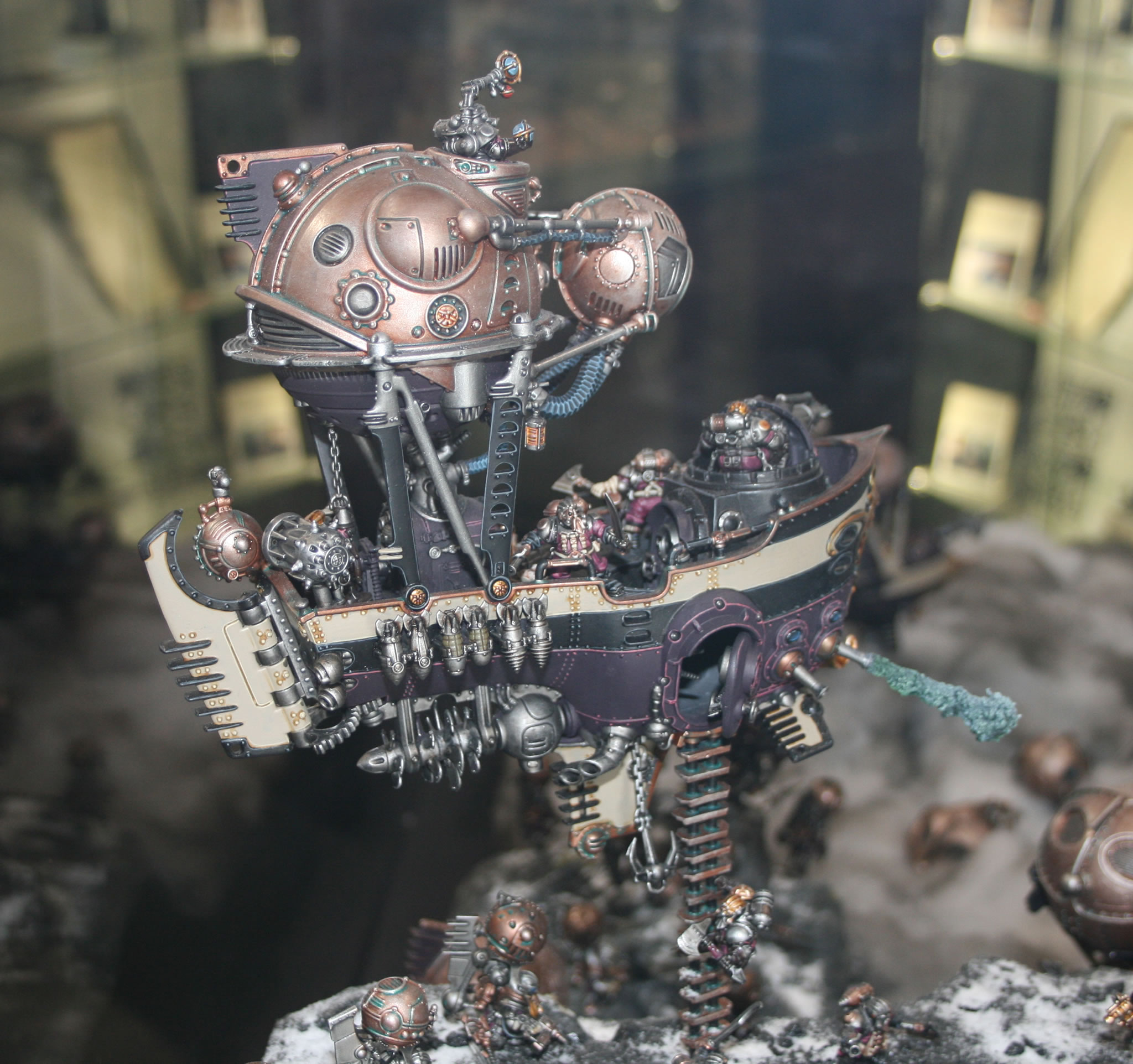
This Arkanaut Ironclad was on display at Warhammer World.
Arkanaut Ironclad
The Arkanaut Ironclad is the jewel in the crown of the Kharadron Overlords’ airfleets. It is a majestic airship that is bristling with weaponry. Its deep cargo holds can be laden with aether-gold or it can be loaded to the gunwales with Arkanaut Companies or Grundstok Thunderers.
The Ironclad is the largest vessel routinely seen in the Kharadron airfleets. It is clad in layer upon layer of riveted iron plates, making it incredibly tough and protective. The Ironclad is armed with a fearsome array of weapons, including aether-shot carbines, bombs, and torpedoes. These weapons can pour astonishing amounts of firepower on anything that gets between the Kharadron Overlords and their bounty of aether-gold.
The Ironclad is a formidable warship that is feared by its enemies. It is a symbol of the Kharadron Overlords’ technological prowess and their mastery of the skies.
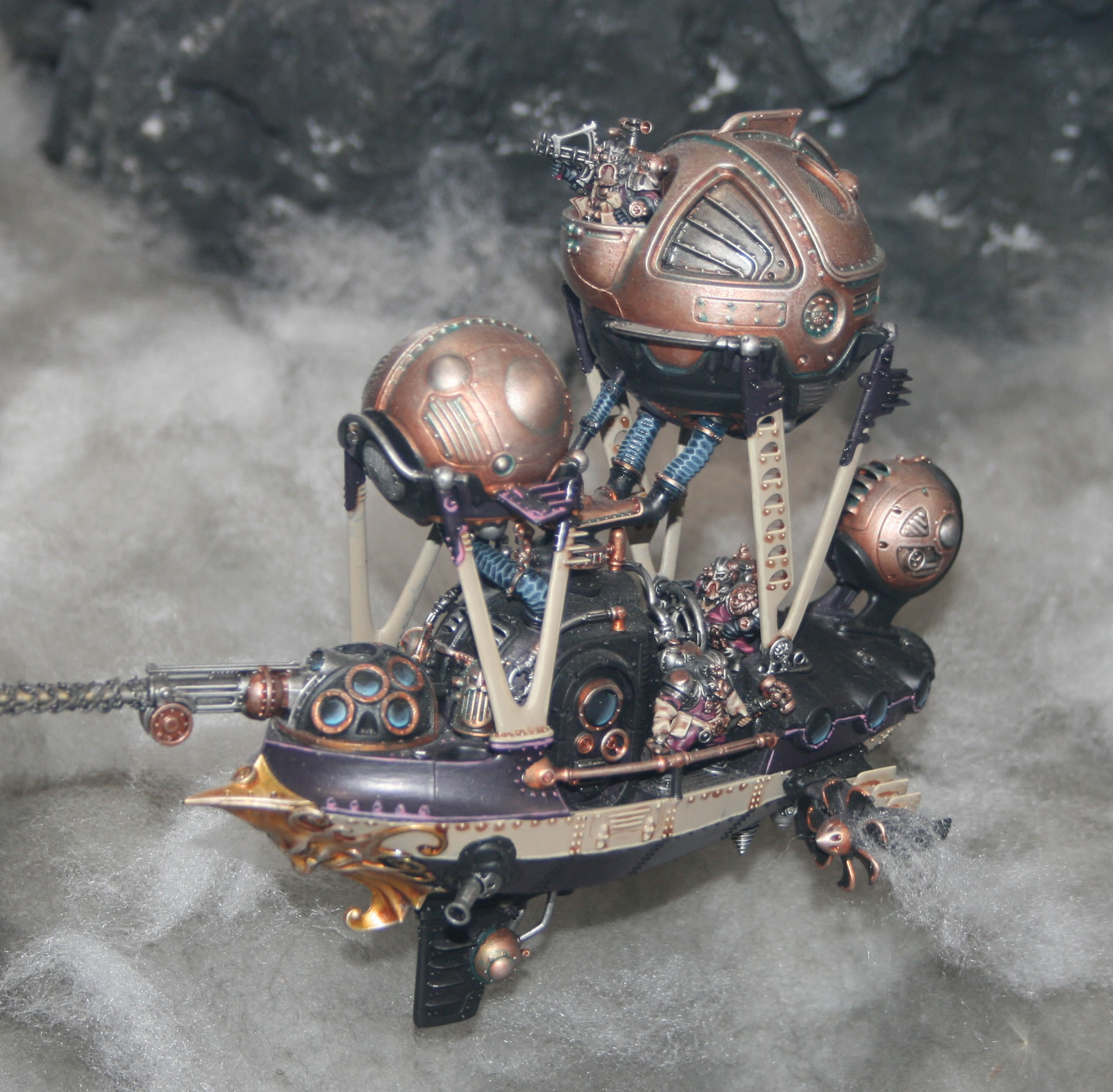
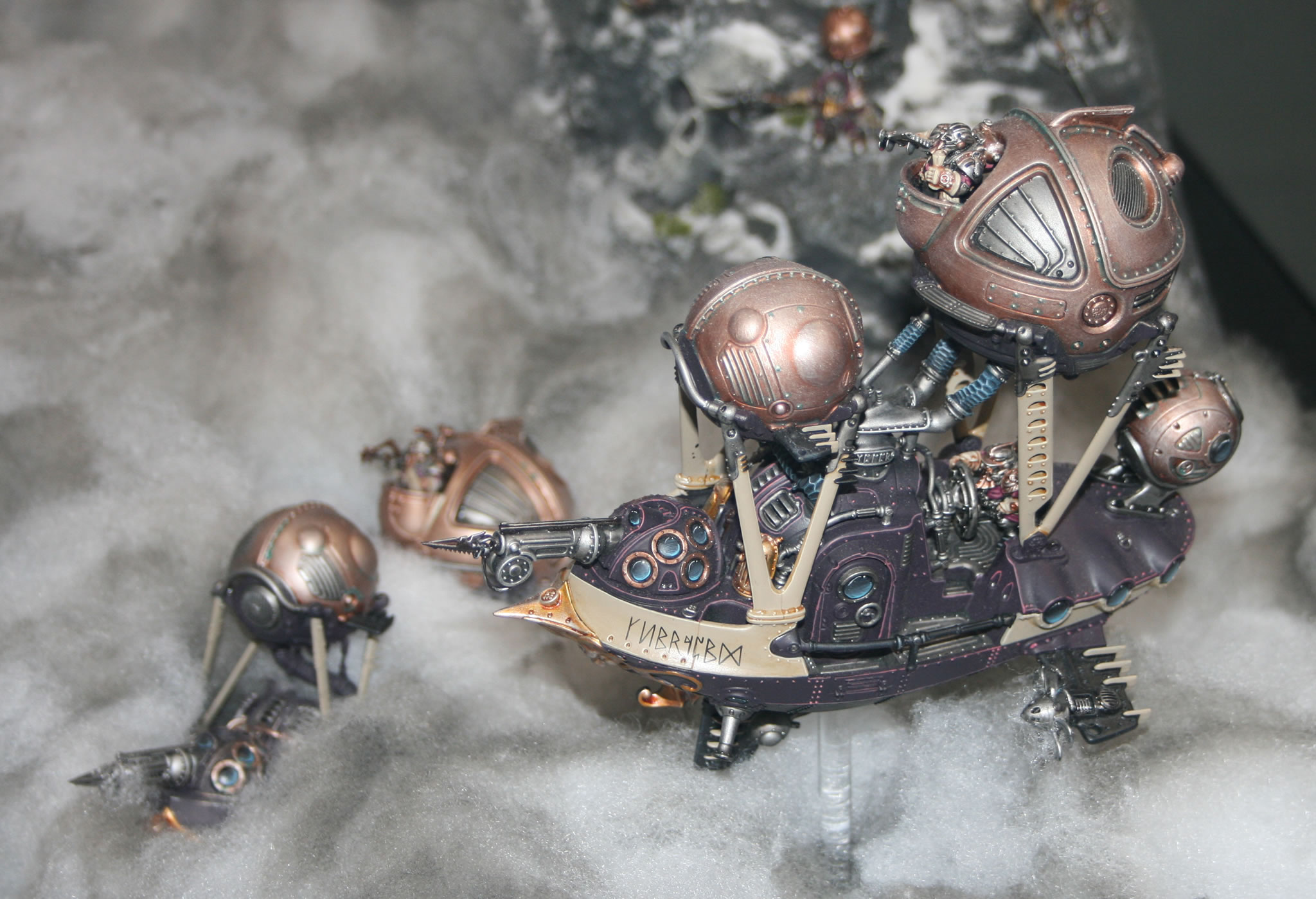
These Arkanaut Frigates were on display at Warhammer World.
Arkanaut Frigate
The Arkanaut Frigate is a versatile airship that represents centuries of refinement by the shipwrights of the Endrineers Guild. It is a balance of speed, transport capacity, and firepower, making it a mainstay of the Kharadron Overlords’ airfleets.
The frigate’s sleek hull is made of Aether-Khemist-treated gromril, making it both strong and light. This allows it to reach speeds of up to 150 knots, while still being able to carry a significant amount of cargo and troops. It is also fast and powerful enough to escape the gravitational drag of a density hole.
The frigate’s buoyancy endrin is powered by Aether-gold, and it allows the ship to stay aloft even in the most turbulent conditions. This makes it ideal for long-range missions, as well as for operating in dangerous environments, such as those found in the Eightpoints. It retains enough firepower to level a city should the need arise.
The frigate’s main armament is a pair of sky cannons, which can fire explosive shells that can level a city block. It also carries a number of smaller weapons, such as aethershot carbines and boarding weapons. This gives the frigate the firepower it needs to take on a variety of targets, from enemy airships to ground forces.
The Arkanaut Frigate is a powerful and versatile airship that is essential to the Kharadron Overlords’ war effort. It is a symbol of their technological prowess and their mastery of the skies. It is a formidable warship that is feared by its enemies.