Ork Bommer Bitz

Here are two further components of my Ork Bommer, the cockpit and the rear turret assemblies. Initially they had a white sprayed undercoat.

The interiors were painted Chaos Black and drybrushed with Boltgun Metal. I then using Vallejo Middlestone for the exterior parts that will be showing. This (in theory) is the same colour as the original sprayed basecoat. The next stage

"Excuse me sir…"

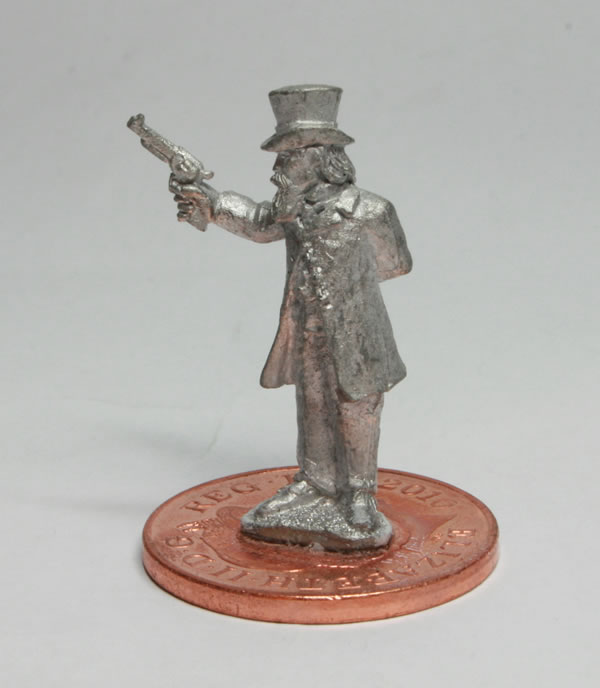
I was looking for some other stuff when I found some more Wargames Foundry Old West figures. This is Cemetery Sam.

Cemetery Sam

He is from the Old West Townsfolk – The Town Vigilance Committee – OW117 set.

I was thinking of buying some Victorian models to go alongside my Victorian Science Fiction vehicles, but here I had some all the time. My intention after painting them is to use them with the Old West rules.

1914 British Infantry

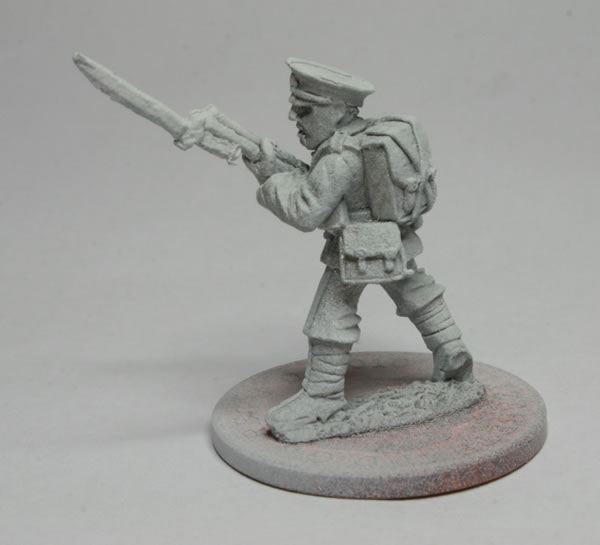
I have four metal models from this range that I bought some time ago, not sure if that was the only ones I bought or if I have merely mislaid and lost the others…. I thought I had ten, but there are only four.

I gave the models a white undercoat. Here is one of the models, an infantryman advancing.

1914 British Infantry

I will give the models a base coat of khaki next.

1914 British Infantry

I have been thinking about how I might use the models once I have finished painting them. I did think they would work well in a Victorian Science Fiction Scenario alongside my Steam Tank.

Another idea was to use them in a Doctor Who scenario fighting the Robot Mummies or the Cybermen. They are almost the right era for the Robot Mummies and would make for an interesting pre-UNIT or even Torchwood scenario.

Camouflaging the Ork Bommer

I decided after basecoating the Ork Bommer that I might do an experiment with this model and apply some camouflage. I decided to add a second spray, after masking off some of the basecoat, of a different contrasting colour. Looking through the cupboard I realised that I only had a dark green, whereas I did think a darker brown would have worked well. Ah well, I had time to paint, not much time though to go out and buy some new paint!

In terms of masking I had three options, use some masking fluid, masking tape or blu-tac. I decided not to use the masking fluid, as I had not used it before, though I will probably have a go with it for the glass canopies. I did consider using masking tape, but I wanted curved lines not straight. So in the end went with the blu-tac.

This I stuck on the model and then gave the model a spray of British Armour Green.

As this was an Ork scheme, I didn’t use any kind of regular pattern with the camouflage.

After letting the paint fully dry, I removed the blu-tac.

I was very pleased with the end result.

Next stage will be the detailing, painting the engines and guns, as well as the crew and cockpit.

British Normandy Village Defence

British armoured forces defend a Normandy Village under a counterattack from German Forces.

Churchill and Humber Armoured Cars

A Sherman Firefly takes cover, behind a small hill.

Sherman Firefly

The rest of the Sherman platoon starts to move forward.

The rest of the Sherman platoon starts to move forward

Models from Simon’s collection, scenery from mine.

Top Ten Posts of 2013

Here are my top ten blog posts in reverse order. As is typical most posts are from previous years.

10. Dwarf City under attack
9. Marneus Calgar of the Ultramarines’ Land Raider
8. How to Paint Citadel Miniatures: Tau Empire
7. Warhammer Fantasy Village
6. Flames of War – Battle of the Bulge
5. Warhammer Siege Diorama
4. Forge World Diorama – Games Day 2012
3. Death Korps of Krieg
2. Duel
1. Beautiful Dystopian Wars

Constructing the Ork Bommer

As is the case with most of the new kits from Games Workshop, this model comes with a range of choices on how you fit the kit together. You can build a fighter version, a ground attack variant or a dive-bomber.

The most popular configurations of the Ork Bommer are the Dakkajet, the Burna-Bommer and the Blitza-Bommer.

I decided that I would build mine as per the Burna-Bommer, as I liked the rear turret, but would arm mine with the weaponry from the Blitza-Bommer and a couple of extra forward firing big shootaz!

The model went together quite easily. Though I do feel that the CAD style of the instructions makes them more difficult to follow than the traditional line art that I remember from making Airfix kits in the 1970s and 1980s.

The main issue I had was with the rear horizontal fins. The way they are connected means it is not a strong joint and initially the fin drooped. I therefore had to prop it up whilst the glue cured.

With the way I am going to paint the model I kept the cockpit, pilot and turret assembly separate, and the bombs as well.

The next stage will be a white undercoat followed by a base coat of German Armour Yellow (well that’s what I had in the cupboard).

15mm Normandy Village

More photographs of my 15mm Normandy Village for Flames of War.

You can imagine that this would be the view from the gun camera of an RAF ground attack Typhoon attempting to flush out some entrenched Germans. You can see I have used the outbuildings to complement the Flames of War Normandy houses.

Here is an overhead view of the buildings.

As well as Battlefront roads and houses, I also have in there some of the nice 4Ground laser etched wooden buildings.