Any colour you like as long it is black…

I have undercoated my Cutta.
warhammer, wh40k, flames of war, bolt action, aeronautica imperialis, star wars, models, news, views and stuff
Any colour you like as long it is black…
I have undercoated my Cutta.

The Daimler Scout Car, known in service as the “Dingo” (after the Australian wild dog), was a British light fast 4WD reconnaissance vehicle also used in the liaison role during the Second World War. In 1938 the British War Office issued a specification for a scouting vehicle. Out of three designs submitted by Alvis, BSA and Morris, the one by BSA was selected. The actual production was passed to Daimler, which was a vehicle manufacturer in the BSA group of companies. The vehicle was officially designated Daimler Scout Car, but became widely known as Dingo, which was the name of the competing Alvis prototype.
The Flames of War blister comes with three of them.

These are very nice models. I will probably use them with my Late War British, though they have the potential to be used for Early War too.
These are resin models with metal wheels and crew.

See the full workbench feature on the British Daimler Dingo.
I was in my local GW store buying some flesh coloured paint (for my Old West cowboys) when I noticed they had the turf packs in stock. I looked at both the Mordheim Turf and the Middlenland Tufts, but in the end decided I liked the look of the Mordheim Turf better and bought a pack.
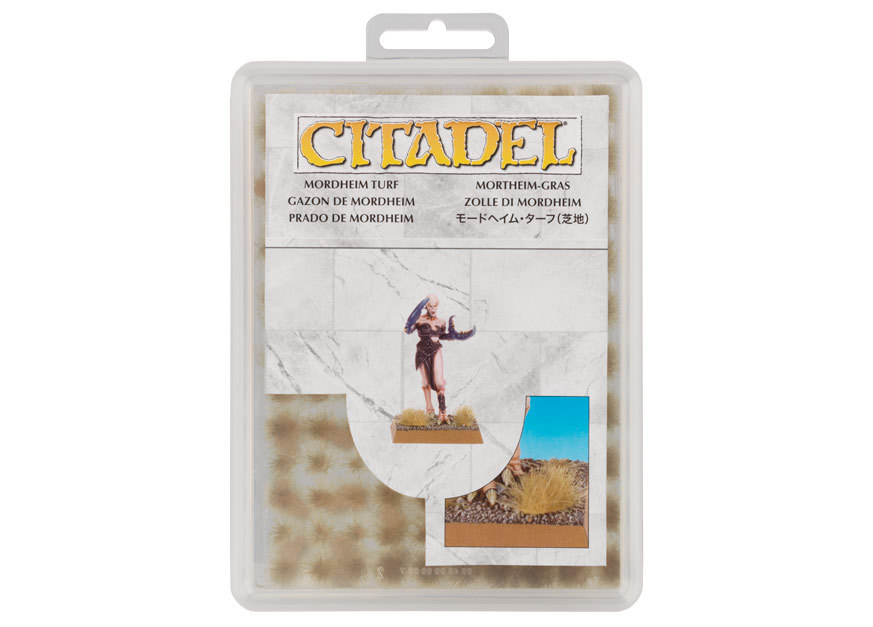
Mordheim Turf is a pallid yellow colour, and when your Warhammer armies march across it, a few choice tufts on their bases will really help to set the scene. Each sheet is 210 x 148 mm in size (or 8.3 x 5.8 inches if you prefer Imperial measurements), and holds 200 individual grass tufts of varying sizes, ranging from large patches of foliage to small clumps. They’ve also been specifically designed to stand up straight, adding a little extra height to the bases of your models. Once you’ve finished painting your miniatures, simply peel off the tufts you want to use and stick them to your bases using a dab of Citadel PVA Glue.
I have seen similar products before and in the olden days I use to cut tufts of sisal (string) for tufts of grass. These tufts however appear to be much finer and less coarse than sisal is. I am intending to use them mainly with my Flames of War bases and possibly my Old West miniatures rather than my Orks.
They’re not cheap at £8.00 per pack but compared to the Army Painter range seem to be of similar value. Will be interesting to see the results.
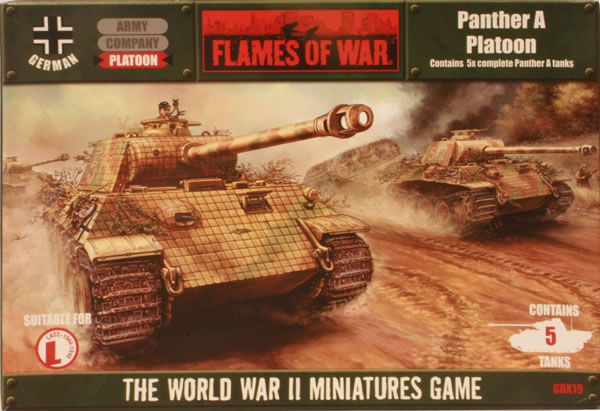
I bought this box set as it was available at Hobbycraft for a much cheaper price than the list price last year.
Panther is the common name of a medium tank fielded by Nazi Germany in World War II that served from mid-1943 to the end of the European war in 1945. It was intended as a counter to the T-34, and to replace the Panzer III and Panzer IV; while never replacing the latter, it served alongside it as well as the heavier Tiger tanks until the end of the war. The Panther’s excellent combination of firepower, mobility, and protection served as a benchmark for other nations’ late war and immediate post-war tank designs, and it is frequently regarded as one of the best tank designs of World War II.
The resin and metal certainly fills the box.
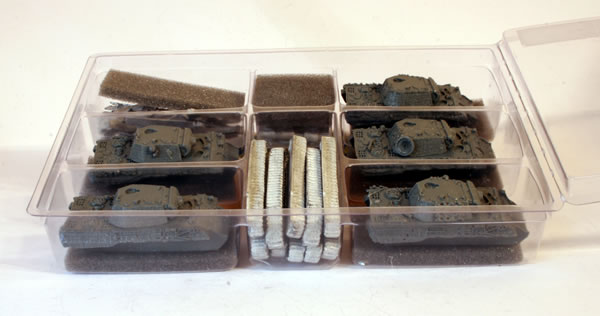
There are five Panthers in the box and the hulls and turrets are in resin.
These are clean castings and the detail is very good, the Panthers for example have the Zimmeritt paste and you can see how the where it has “chipped off” has been modelled onto the hull.
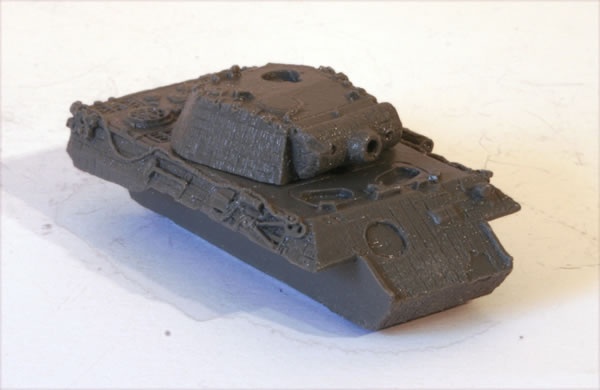
Each of the castings is different, with this one there are spare tracks attached to the turret as extra armour.
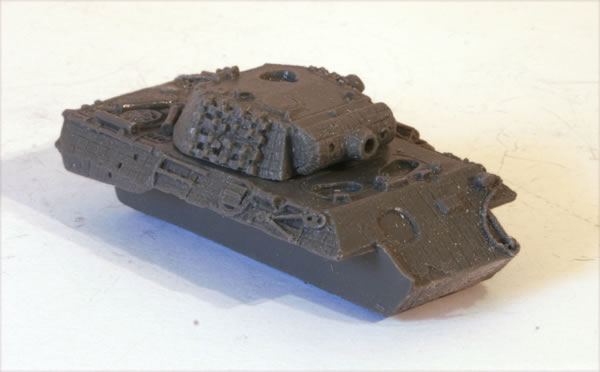
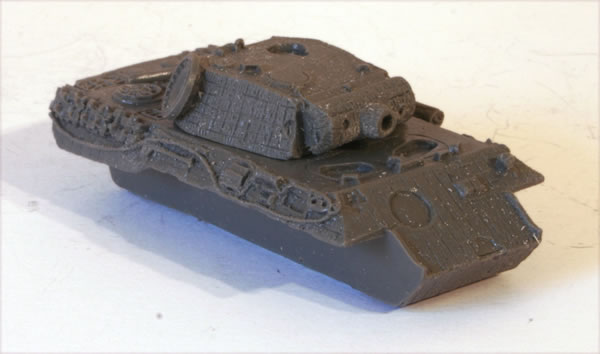
They are very clean castings and the small piece of flash on the turret with this model was basically all that needed to be cleaned off.
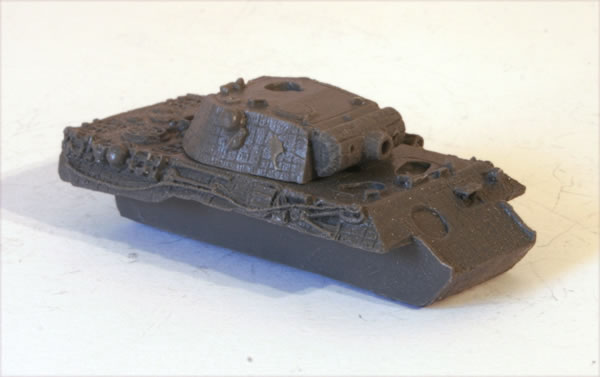
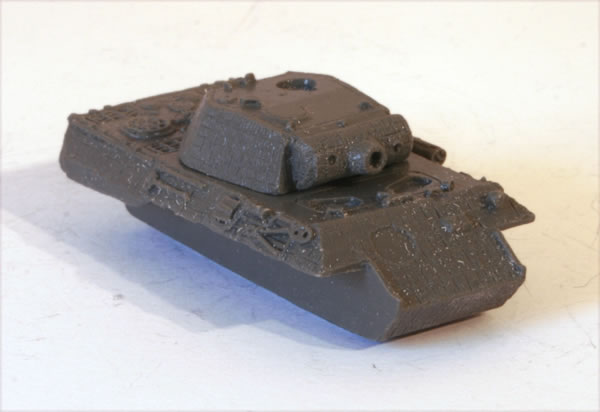
The castings needed mininal cleaning before the next stage of constructing the models.
See the workbench feature on my Flames of War Panther A Platoon.
The SdKfz 251 (Sonderkraftfahrzeug 251) half-track was an armored fighting vehicle designed and first built by Germany’s Hanomag company during World War II. One of the most common, and best armoured of the wartime half-tracks, the SdKfz 251 was designed to transport the panzergrenadiers of the German mechanized infantry corps into battle. Widely known simply as “Hanomags” by both German and Allied forces, they were widely produced throughout the war, with over 15,252 vehicles and variants produced in total by various manufacturers.
This is an old metal model that I think was made by SDD. I am using it as a testbed for which method I should use with my Flames of War resin models and I suspect in the end it will probably end up as a piece of scenery.
Having given the model a basecoat of Warpaint German Armour the next stage will be to add the disruptive camouflage.
I thought long and hard about how to do this, and I didn’t have or really wanted to buy an airbrush, even though that appears to be the accepted method for doing late war German camouflage.
What I did was take an old paintbrush and cut off the bristles leaving a quarter inch. This brush is then used to stipple on the camouflage pattern.

I used Reflective Green (890) and Chocolate Brown (872).

I am quite pleased with the effect.
Though the official German manual during the war told how the camo pattern was to be applied, it said the raw paint mixture was to be mixed with petrol and sprayed onto the vehicles. Reality and short supplies of petrol meant that more often the camo pattern was “painted” onto the vehicles, sometimes with brushes and sometimes with rags.
I do like the effect that the airbrush gives these models, I am not sure if I have the requisite skill to do it justice on small models like this.
See the workbench feature on the German SdKfz 251 Armoured Half Track.
The 17 pounder, Self Propelled, Achilles was a British variant of the American M10 Tank destroyer armed with the powerful British Ordnance QF 17 pounder anti-tank gun in place of the standard 3″ (76.2 mm) Gun M7. With a total of 1,100 M10s converted, the 17 pdr SP Achilles was the second most numerous armoured fighting vehicle to see service armed with the 17 pounder gun, behind the Sherman Firefly.
Having given the model a white undercoat, and as I had run out of Humbrol Dark Green, I gave the models a complete spray of Warpaint British Armour.


Next stage will be painting some of the details and the crew.


See the workbench feature on the British M10 / 17pdr SP Achilles.
The Tank, Heavy, TOG 2 was a prototype British super-heavy tank design produced in the early part of the Second World War in case the battlefields of northern France turned into a morass of mud, trenches and craters as had happened during the First World War. In the end it never went into production, but as part of the Flames of War Mid-War Monsters range you can buy it and use it in alternate history games.
I was going to (as I have done with other models) give the TOG2 tanks a spray from underneath of a Humbrol Dark Green, however I ran out of paint after doing one. So in the end I gave all three models a basecoat of Warpaint British Armour.


The command tank has the commander sticking himself out of the turret…

The three TOGs.


See the workbench feature on these huge tanks.
The Sherman Firefly was a World War II British variant of the American Sherman tank, fitted with the powerful British 17 pounder anti-tank gun as its main weapon. Originally conceived as a stopgap until future British tank designs came into service, the Sherman Firefly became the most common vehicle with the 17 pounder in World War II.
After giving a base coat for the underneath of Humbrol Dark Green. The model was then given a spray of Warpaint British Armour. The Dark Green spray adds shadow.


As you can see from this closeup, the spray does give the model an even coat, and combined with the sculpting does show off the cast turret that the Firefly had.

Here is the Firefly with three regular Shermans (the resin models from Open Fire).

See the workbench feature on my Flames of War Sherman Firefly VC.
The Tank, Cruiser, Challenger (A30) was a British tank of World War 2. It mounted the 17 Pounder gun on the Cromwell chassis to add heavier anti-tank firepower to the cruiser tank units.
Having given the Challenger a white undercoat. The next stage was a base coat for the underneath of Humbrol Dark Green. This added shadow and depth to the main (top) base coat of Warpaint British Armour which was then sprayed on.


Here is the Challenger next to it’s little brother, the Cromwell IV.

See the full workbench feature on my Challenger A30.
I purchased a Flames of War box of the German Panzergrenadier Headquarters. In the box you get a bunch of resin, plastic and metal. So having cleaned the metal castings, I glued the infantry to some wooden sticks using wood glue. I then gave the models a white undercoat.
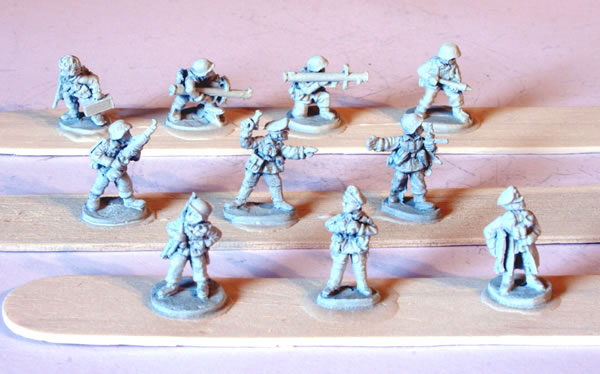
See the workbench feature on this boxed set.