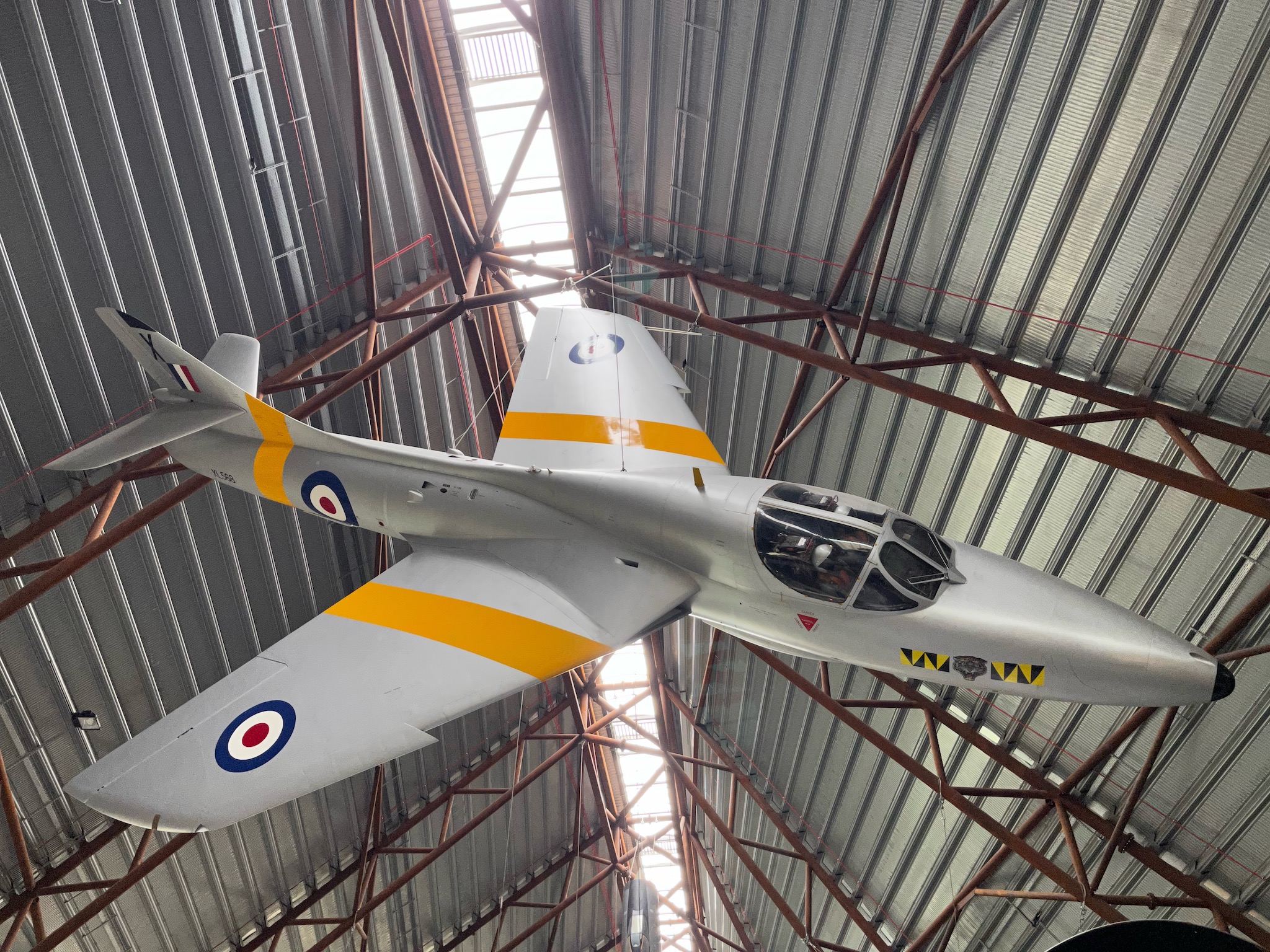
Hunter T.7A XL568

Hunter T.7A XL568

The Hawker Hunter is a transonic British jet-powered fighter aircraft that was developed by Hawker Aircraft for the Royal Air Force (RAF) during the late 1940s and early 1950s. It was designed to take advantage of the newly developed Rolls-Royce Avon turbojet engine and the swept wing, and was the first jet-powered aircraft produced by Hawker to be procured by the RAF.

XL568 was first flown, as a T.7, in 1958. She was delivered to 74 Squadron and later converted to a T.7A. Continuing to serve with 74, she also passed through the hands of 237 OCU before ending her active duty days with 208 and later 12 Squadron at RAF Lossiemouth, where she was painted in Black Arrows colours in her final years of flying.

She was retired to ground instructional duties at RAF Cranwell and in early February 2002 was acquired by the RAF Museum for display at Cosford. Losing her black scheme and being repainted in early training colours, she is now on display in a dramatic pose inside the Cold War Exhibition.

More photographs of the Hunter T.7A.

Photographs of the Hawker Hunter F.6A at Duxford.

Photographs of the Hawker Hunter FGA9 at RAF London.

It’s the end of Aeronautica Imperialis as we know it…

Legion Imperialis Logo

An FAQ about the new Legion Imperialis has been published. 

As you might expect there is a lot of commentary about Legion Imperialis, including some interesting stuff about the scale of the new game.

Has the scale changed since Epic 40,000?

Sort of. Your classic Epic games of yesteryear had a fairly inconsistent scale: tanks, infantry and Titans were only roughly proportionally in line with each other. Legions Imperialis, on the other hand, is far more consistent. Infantry is the same size in relation to vehicles as their larger Warhammer: The Horus Heresy – Age of Darkness equivalent miniatures would be. Generally speaking, the new models are much more detailed, and a little bigger.

It will be interesting to do some comparisons when the new models become available. It’s true that over the years models did change in size, but were pretty consistent across a single game, with models only really changing when there was a new release.

I think the sad news is the announcement of the retirement of Warhammer 40000 era Aeronautica Imperialis.

Support for Adeptus Titanicus and Aeronautica Imperialis (in the Horus Heresy setting only) will continue, so you can continue to play these games alongside this exciting new epic scale game.

So there will continue to be support the Horus Heresy era for Aeronautica Imperialis, but we will lose support for xenos and  Astra Militarum aircraft.

This being a Horus Heresy-era game, xenos craft from the Aeronautica Imperialis range will be sitting this one out. Additionally, as the Astra Militarum of the 41st Millennium wasn’t an entity during the Horus Heresy, Vulture Gunships, Valkyrie Assault Carriers, and Vendetta Assault Carriers will not be part of the game. These will be leaving the range soon, so if you want a fleet of tiny Xenos and Astra Militarum aircraft to call your own, pick them up now.

Yes you don’t need support to play the game, we get that.

You will still be able to enjoy the game with your existing collections, but support for models specific to the Warhammer 40,000 setting will be ceasing soon, and the relevant miniatures will be coming off sale.

However without new releases to inspire and engage, less and less people will play the game.

So no more Aeronautica Imperialis, well no more Aeronautica Imperialis for the Warhammer 40000 setting.

I am also, as I blogged previously, a little disappointed that there won’t be any xenos races, or even 40k era Imperial forces.

Legions Imperialis is a new game which is set firmly in the era of the Horus Heresy, letting you recreate the biggest and bloodiest battles fought in the civil war that set the galaxy aflame. There are no plans to expand this game into Warhammer 40,000 at the moment.

I guess at the moment doesn’t mean never, but if it was going to happen, it’s years away.
Cruiser Tank, Mk I (A9)

The A9 Cruiser Tank was a British cruiser tank of the interwar period. It was the first cruiser tank, a fast tank designed to bypass the main enemy lines and engage the enemy’s lines of communication, as well as enemy tanks. It was developed by Vickers-Armstrongs and was first produced in 1937.

This Cruiser Tank, Mk I (A9) was on display at the Tank Museum at Bovington.

Cruiser Tank, Mk I (A9)

The A9 was armed with a 2-pounder (40 mm) main gun and three .303-inch (7.7 mm) machine guns. It had a top speed of 25 miles per hour (40 km/h) on road and 15 miles per hour (24 km/h) off. Its armor was relatively thin, at only 14 mm (0.55 in) thick on the front and 10 mm (0.39 in) thick on the sides.

Cruiser Tank, Mk I (A9)

The A9 was used by the British Army in the early years of World War II. It saw action in the Battle of France in 1940 and in the North African Campaign in 1941. It was soon replaced by more modern tanks, such as the Cruiser Mk IV.

The A9 was a relatively successful tank for its time. It was fast and maneuverable, and its main gun was effective against early German tanks. However, its thin armor made it vulnerable to enemy fire, and it was soon replaced by more heavily armored tanks.

Though entering service in 1938, development had started earlier with the pilot model of the medium tank design being finished in 1936. This makes it an ideal tank for use during the Very British Civil War background.

Hungarian MiG-21PF Fishbed

A Hungarian MiG-21PF at RAF Cosford.

Hungarian MiG-21PF Fishbed

The Mikoyan-Gurevich MiG-21 (NATO reporting name: Fishbed) is a supersonic jet fighter and interceptor aircraft, designed by the Mikoyan-Gurevich Design Bureau in the Soviet Union. It was one of the most successful and numerous aircraft ever built, with over 10,000 produced. The MiG-21 was the first successful Soviet aircraft combining fighter and interceptor characteristics in a single airframe.

Hungarian MiG-21PF Fishbed

The MiG-21 was introduced into service in 1959 and was used by the Soviet Union and many other countries around the world. It saw extensive combat use in the Vietnam War, the Arab-Israeli Wars, and the Indo-Pakistani War. The MiG-21 was retired from Soviet service in 1993, but it is still in use by a number of countries, including India, China, and Vietnam.

Hungarian MiG-21PF Fishbed

The MiG-21 is a small, lightweight aircraft with a delta wing. It is powered by a single Tumansky R-13M-300 turbojet engine, which gives it a top speed of Mach 2.1. The MiG-21 is armed with a variety of weapons, including air-to-air missiles, air-to-ground missiles, and cannons.

The MiG-21 is a highly maneuverable aircraft, and it was known for its ability to perform high-g turns. However, it was also criticized for its lack of range and its limited avionics.

Despite its shortcomings, the MiG-21 was a highly successful aircraft. It was simple to fly and maintain, and it was relatively inexpensive to produce. This made it a popular choice for many countries, and it helped to shape the course of air combat during the Cold War.

More photographs of the MiG-21 Fishbed.

Deimos Pattern Predator in the desert

The Predator is perhaps the best known and most widespread variant of the basic Rhino chassis. Augmented with superior armour and firepower, it entirely sacrifices the Rhino’s troop transport capacity in favour of ammunition and generators for its formidable weapon systems. 

Having finished painting the Predator, I photographed the model on my desert terrain board.

Deimos Pattern Predator in the desert

Deimos Pattern Predator alongside a Deimos Pattern Rhino.

Deimos Pattern Predator in the desert

See the Deimos Pattern Predator Miniatures Gallery.

See the workbench feature on the Deimos Pattern Predator Battle Tank.

What about the Xenos for Legions Imperialis?

Following the announcement of the new Legions Imperialis, there was an air of disappointment across social media in regard to the Horus Heresy setting for Legions Imperialis and as a result we wouldn’t be seeing Xenos forces.

I mentioned in my post that this was likely.

Of course this is Warhammer: The Horus Heresy, so we’re not going to see any Xenos armies I would have thought. I would like to have seen new Ork models in this scale, a Great Gargant would have been nice. Ah well one can dream.

Warhammer: The Horus Heresy – Legions Imperialis

Some have said that if the game is successful, we might see a Warhammer 40K version which would mean Xenos forces being released.

Without sounding a little negative, I do wonder if this would happen. Adeptus Titanicus was released in 2018 and we’ve not seen any Xenos Titans.

Though we have seen alien races in Aeronautica Imperialis, so maybe we might for a future version of Legion Imperialis (but it might need a different name).

Carro Armato M14/41 Medium Tank

This Carro Armato M14/41 was on display at Bovington.

MI4/41

The M 14/41 was a four-crew medium tank that served from 1941 in the Royal Italian Army.

The M14/41 was a successor to the lighter and slower M13/40, fitted with a more powerful and reliable engine. The first were built in August 1941 and were used until the end of the fighting in North Africa. Even when they were first used, the M14/41s firepower and armour were outdated against newer Allied tanks.

MI4/41

Built in 1942, this MI4/41 was sent to North Africa. It is believed to have been abandoned and captured soon afterwards. It came to The Tank Museum in 1951.

MI4/41

Operation Compass was the first large British military operation of the Western Desert Campaign during the Second World War. British, Empire and Commonwealth forces attacked Italian forces of the 10th Army in western Egypt and Cyrenaica, the eastern province of Libya, from December 1940 to February 1941. Italian tanks were outclassed by British tanks in Operation Compass. Poor Italian leadership and tactics made things worse. A total of 145 of the earlier M13/40 model tanks were lost-almost all the Italians had in Libya. In fact, so many were captured infact, that the British briefly used it themselves.

Another post on the Carro Armato M14/41 at Bovington.

Legions Imperialis: Return of the Epic

Warhammer: The Horus Heresy – Legions Imperialis

Yesterday saw the announcement of Warhammer: The Horus Heresy – Legions Imperialis or the return of Epic back into the fold.

Legions Imperialis is a new game of small (or epic) large scale warfare. This is not quite Epic as we remember it, as the scale is the same as (the new) Adeptus Titanicus and Aeronautica Imperialis. This does mean though that all those legacy epic armies are not going to be compatible. They’ve not completely forgotten the Epic games of old.

Warhammer has previously made several games in epic scale, and we’ll be taking a look down memory lane later this month, and this new game system is based on the best bits of previous incarnations of these epic scale games – while adding lots of cool new elements.

There are some really nice new miniatures, and the advances in design and manufacturing shows in the preview photographs.

I think the downside maybe that, is these models contain lots of parts. I quite liked how in the olden days the models were complete on the sprue. The kits from Adeptus Titanicus and Aeronautica Imperialis do contain a lot of parts. Yes it makes the models more detailed, but it also makes it a bit of a modelling challenge. 

I like how they describe the boxed set contains 223 miniatures.

Warhammer: The Horus Heresy – Legions Imperialis miniatures

There are a whopping 223 miniatures in the box, split between Space Marines, Solar Auxilia, and Titans. That’s 106 Space Marine infantry and walkers, five Space Marine tanks, 104 Solar Auxilia infantry and walkers, six Solar Auxilia tanks, and two Warhound Titans with brand-new plastic weapon options. 

Well, 210 of those are infantry models. You get eleven tanks in total. True that the 210 figure incudes walkers and dreadnoughts.

Personally I would like to have seen more tanks. I do like the Malcador tanks, something we never saw in Epic.

malcador tanks

All the models look really nice.

I do wonder what new models for this game we will see released. Will we see a Capitol Imperialis for example, that would be great.

They did say in the preview page:

All of the scenery that was released with Adeptus Titanicus is also returning for use in Legions Imperialis, with more to follow.

So we will probably see some new scenery sets, wonder what they will be?

I am pleased to see this release and I do think it will be one I will pre-order. I am apprehensive about how much it will cost to build an army, but that is just something I will have to accept. Back in the day (we’ll the 1990s) I managed to get a bunch of Epic stuff in a series of sales at Games Workshop at really low prices. That I doubt we will see again.

Of course this is Warhammer: The Horus Heresy, so we’re not going to see any Xenos armies I would have thought. I would like to have seen new Ork models in this scale, a Great Gargant would have been nice. Ah well one can dream.