Battlegroup Afghanistan at Bovington

The men of the Royal Armoured Corps have been involved in some of the fiercest fighting since World War Two. Now they tell their story. Explore a recreated Forward Operating Base, experience the living conditions of the modern soldier. See a range of new vehicles used in Afghanistan.

Battlegroup Afghanistan was a exhibition at the Tank Museum at Bovington.

The Jackal or MWMIK (from “Mobility Weapon-Mounted Installation Kit”) is a family of vehicles designed and developed by Supacat for use by the British Army and Royal Air Force Regiment.

The primary role of the vehicle in the British Army is deep battlespace reconnaissance, rapid assault and fire support – roles where mobility, endurance and manoeuvrability are important – and it has also been used for convoy protection.

Scimitar Armoured Reconnaissance Vehicle.

The FV107 Scimitar is a similar armoured reconnaissance vehicle (sometimes classed as a light tank) also used by the British Army. It was manufactured by Alvis in Coventry.

It was issued to Royal Armoured Corps armoured regiments in the reconnaissance role.

It is very similar to the FV101 Scorpion, but mounts a high velocity 30 mm L21 RARDEN cannon instead of a 76 mm gun.

This is a BvS 10 (known as the Viking All-Terrain Vehicle) was developed by Hagglunds Vehicle (now BAE Systems Hagglunds) for the UK Royal Marines.

Currenly on loan from the Royal Marines Armoured Support Group (ASG), the Tank Museum’s Viking exhibit is the second of the two original pre-production BvS 10 which were extensively trialled by the Royal Marines for 12 months from mid-2001. As well as fitting the bar armour, wire cutter and a Mark II Platt Mount protected weapons station (kindly supplied by the Royal Marines ASG), Tank Museum Workshop staff have modified aerials, added IR lights, stowage etc. and repainted and extensively upgraded the original pre-production BvS 10 to look like a Royal Marine ASG Viking Mk I in contemporary service in Afghanistan.

This Panther Command and Liaison Vehicle (CLV) is shown with the damage it incurred from an IED.

A total of 401 Panthers were delivered to the British armed forces by summer 2009. Panther CLVs were built during 2006-09 and replaced a range of vehicles that were reaching the end of their operational lives.


Return of the Terrain

Next week sees the opportunity to order some old Warhammer 40000 terrain kits.

Spice up your 41st Millennium battlefields with a range of classic Warhammer 40,000 terrain returning on a Made to Order basis, starting with a Void Shield Generator complete with functioning cogs that can be left unglued and rotated. The Sub-cloister and Storage Fane set is an all-purpose pair of ruined Imperial buildings, while Plasma Regulators and Conservators make for great scatter terrain between larger buildings.

If you want to give your battlefield the air of an industrial hub or forge world, four returning kits from the Battlezone: Mechanicus range are the perfect way to add some brutal Imperial architecture. The Ferratonic Furnace and Pyrolation Incinerator add high gantries and ample vantage points for getting the drop on your opponents, while towering Alchomite Stacks and buzzing Haemotrope Reactors provide troops with cover as they advance through the forge.

I have some of these terrain models from the Imperium partwork series which was available a couple of years back.

I have quite a few of the ruined Imperial building kits as well as a Haemotrope Reactor.

Depending on the prices of the kits, I might get one or two.

Ultramarines Gladiator Valiant

Ultramarines Gladiator Valiant
Ultramarines Gladiator Valiant at Warhammer World

The Valiant lays down blistering volleys of fire as its escorts transports or supports infantry in ferocious fighting, crossing rushing watercourses, sucking marshlands and bubbling lava with equal ease. Its twin las-talons spit death at the foe, making short work of enemy armour and cracking open fortified positions.

Ultramarines Gladiator Valiant at Warhammer World

Like the Predator is to a Rhino, the design of the Gladiator is based upon that of an Impulsor’s chassis, and has been designed to serve as a front line battle tank rather than a transport vehicle.

Centurion Mark I

This is the Centurion Mark I T352416 at Bovington.

The Centurion tank was one of the most successful post-war tank designs. It was introduced in 1945, just too late to see combat in the Second World War. However, it went on to serve in a number of conflicts, including the Korean War, the Vietnam War, and the Arab-Israeli wars.

Development of the Centurion began in 1943 with manufacture beginning in January 1945. Six prototypes arrived in Belgium less than a month after the war in Europe ended in May 1945, so too late to see action.

More photographs of the Bovington Centurion Mark I.

Of course in any alternative history scenario where the war continued after May 1945 in Europe, the Centurion Mk I would have seen action. Likewise in a another alternative history scenario where either Stalin decided to press West after defeating Nazi Germany to take over Western Europe, or the Western Allies decided to “liberate” Eastern Europe from the yoke of Stalin’s communist oppression, again the Centurion Mk I would have seen action.

You can now get a Mark I from Battlefront.

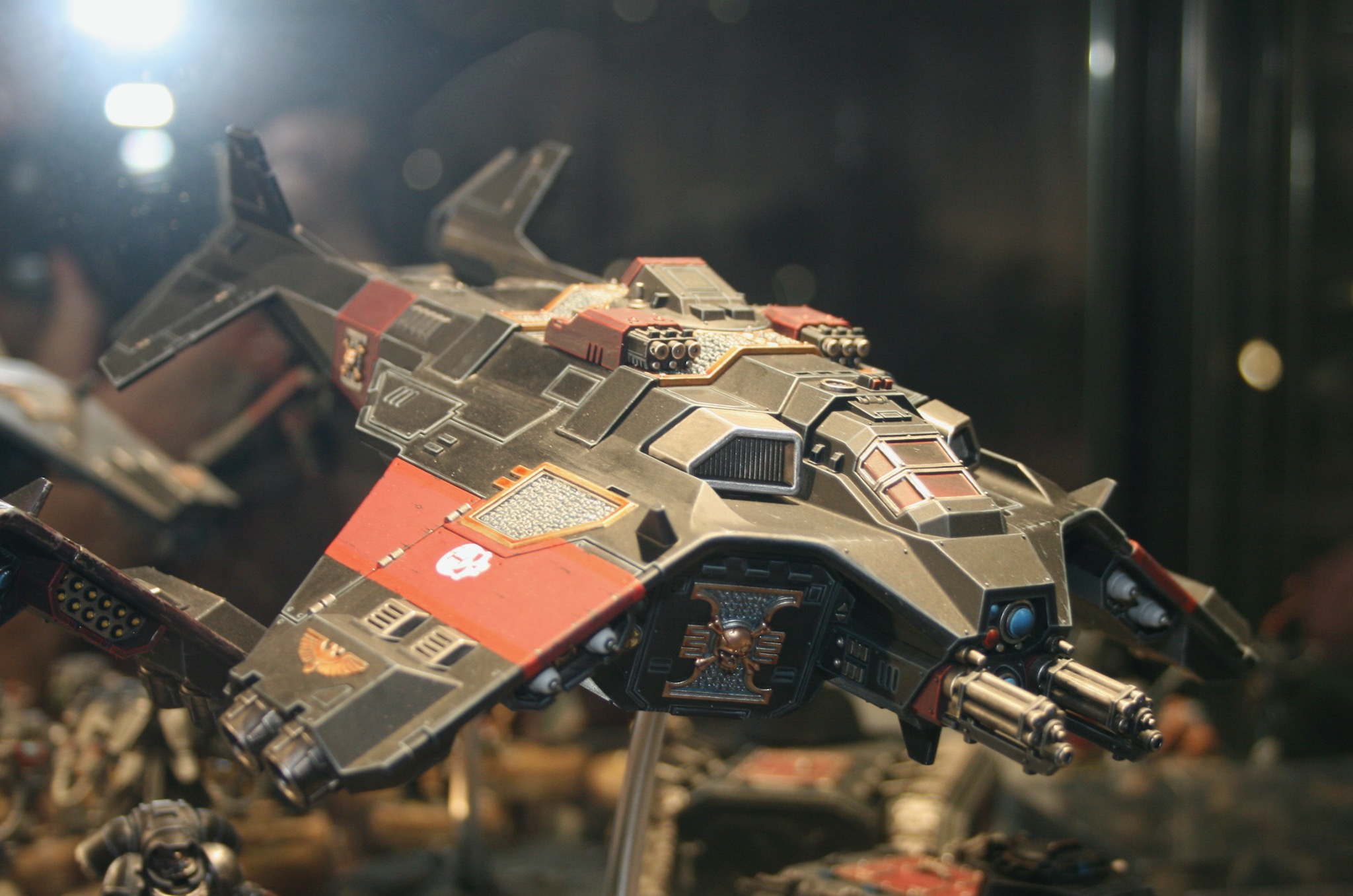
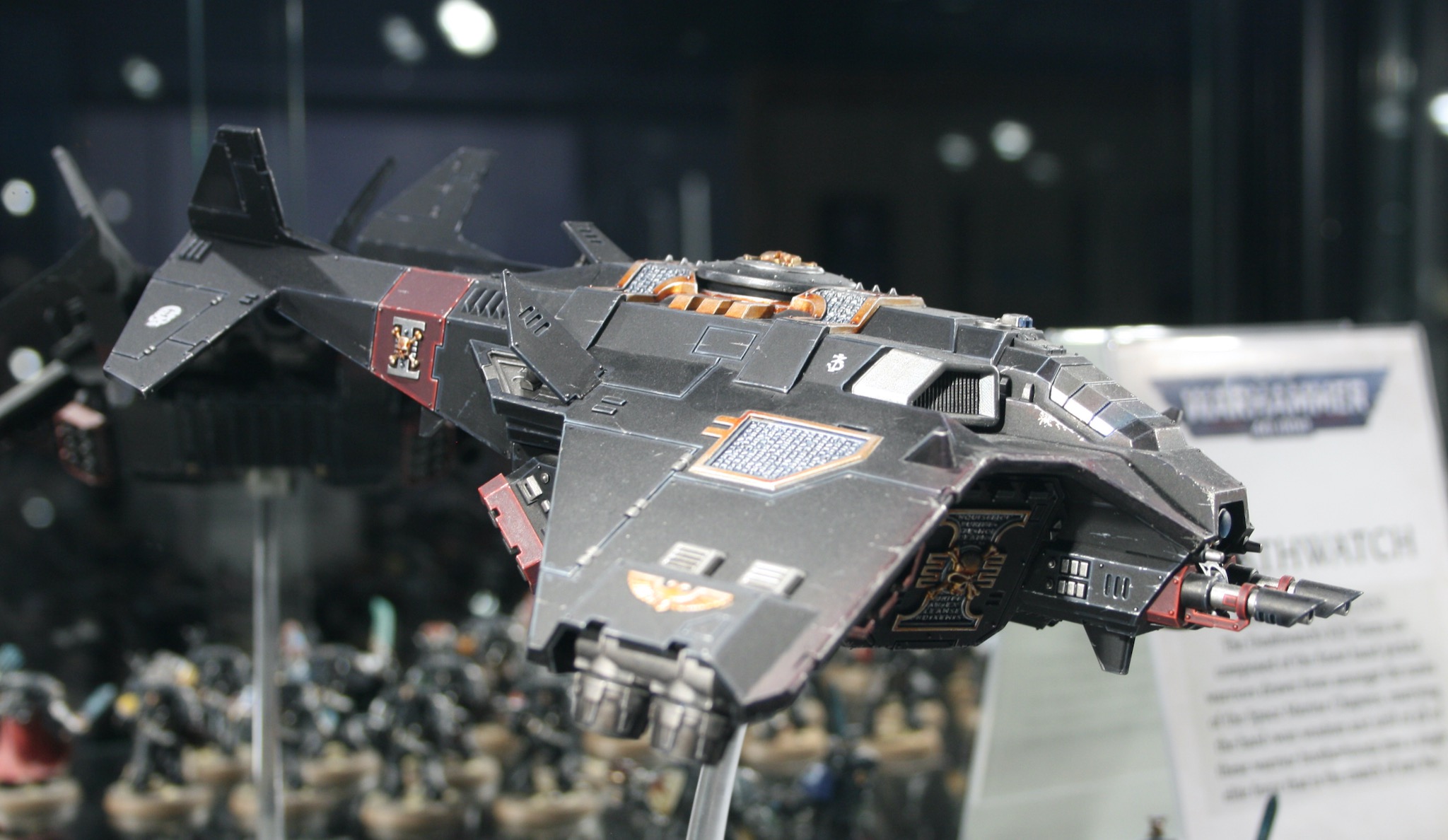
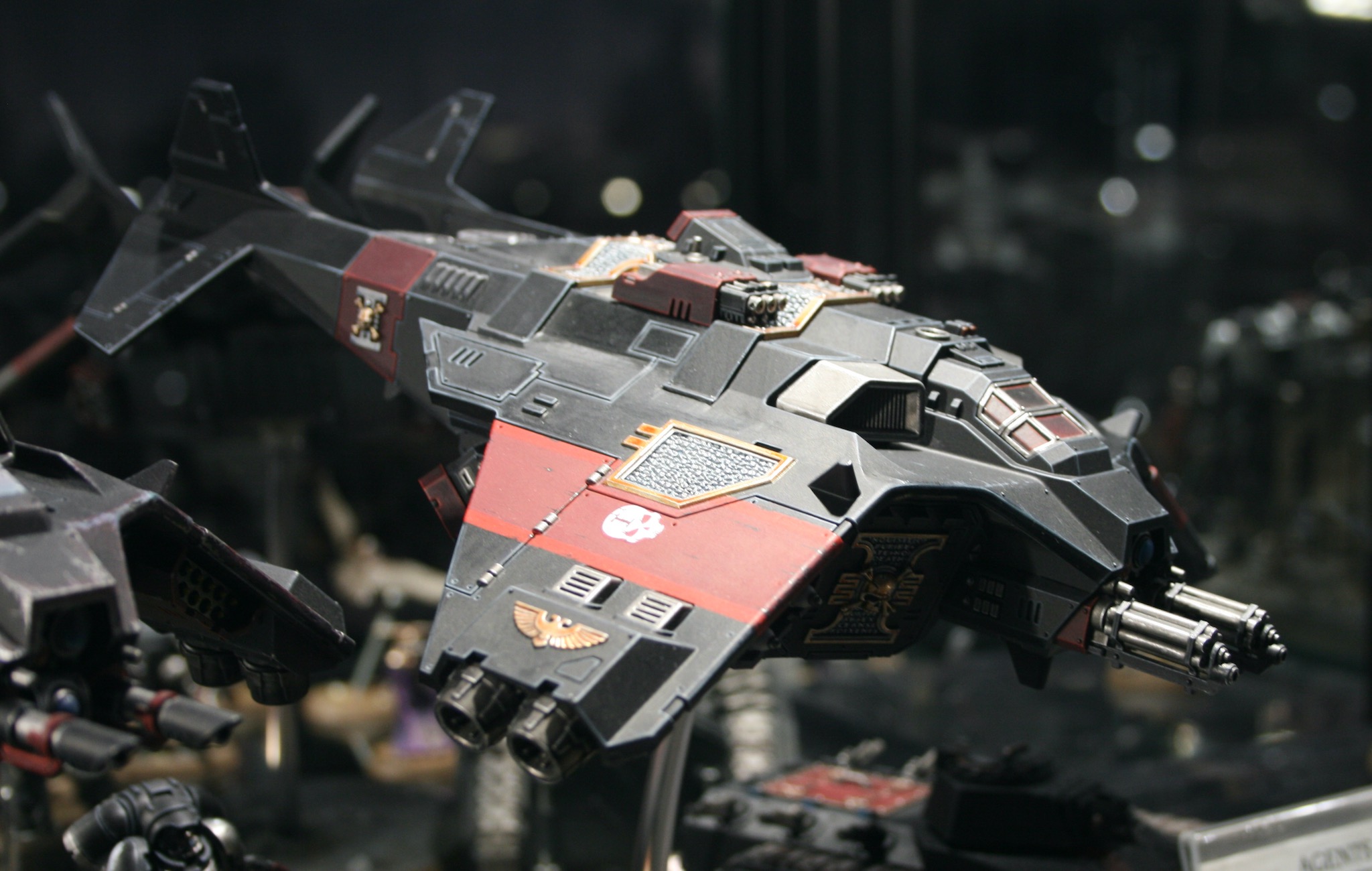
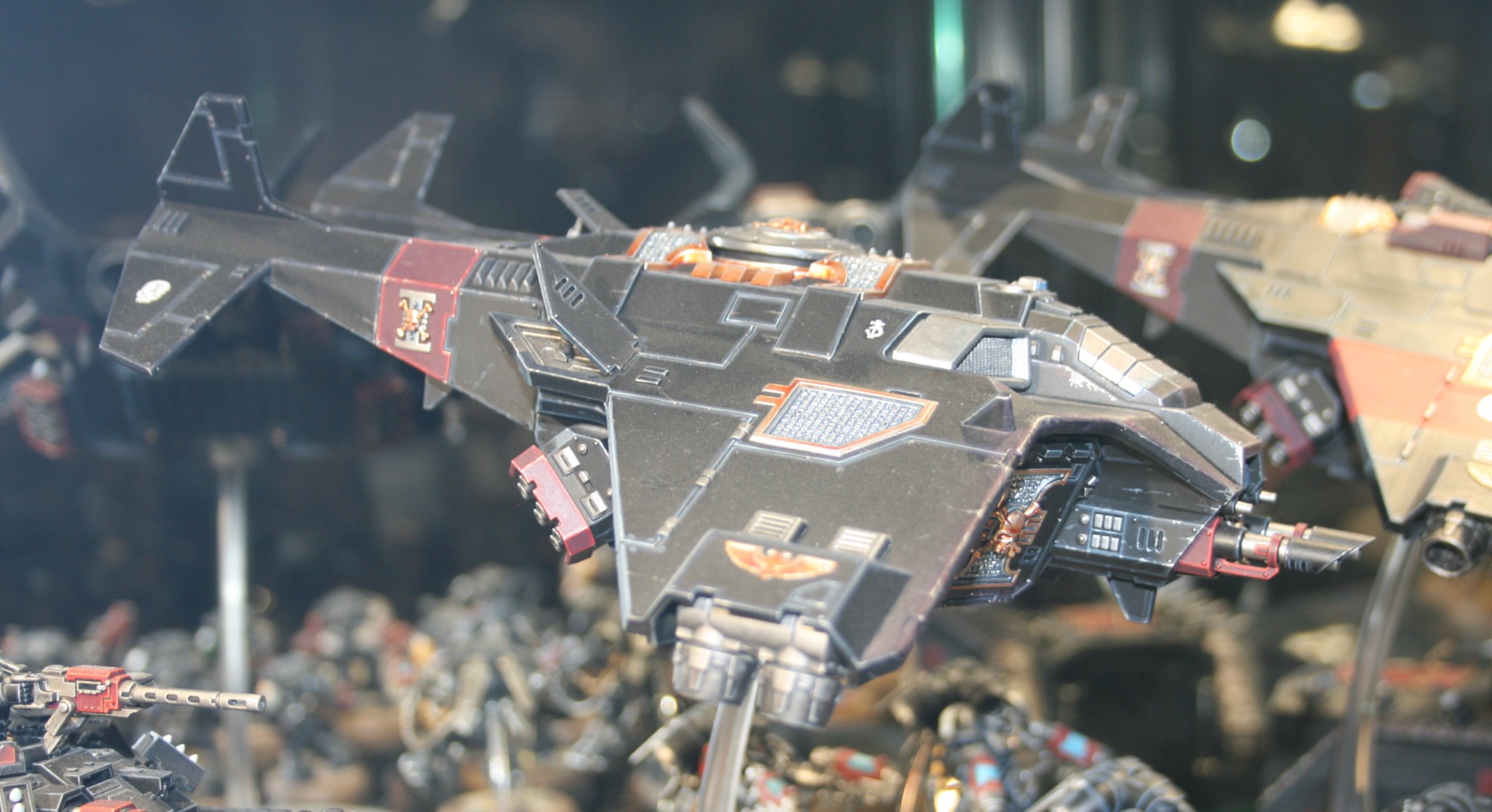
Blood Angels Legion Thunderhawk

Blood Angels Legion Thunderhawk
Blood Angels Legion Thunderhawk at Warhammer World

The Thunderhawk Gunship was a development of the later Great Crusade, designed to operate in atmosphere and void space as a flexible flying craft. It combines the roles of orbital troop lander, heavy gunship and medium bomber, and proved a highly successful addition to the fleets of the Legiones Astartes, scouring landing zones with its array of heavy weaponry before disgorging a payload of Space Marine infantry onto the battlefield. The Thunderhawk went on to become an icon of Astartes power in the air.

I took a very similar photograph when I visited Warhammer World in 2023.

Thunderhawk Miniatures Gallery.

Dark Angels Death Wing Land Raider Crusader

This Dark Angels Death Wing Land Raider Crusader was in the displays at Warhammer World.

The Land Raider Crusader is a variant of the standard Land Raider Phobos used by the Space Marines and the Inquisition. The Land Raider Crusader is rearmed to provide short-ranged, anti-infantry assault support for Astartes offensives. The Land Raider Crusader is intended to be an assault-based variant of the Land Raider that is a linebreaker without peer. The Crusader can smash through enemy formations, shrugging off small arms fire in order to disgorge a squad of Space Marines into the heart of the foe. In place of Lascannons, the Crusader is armed with Hurricane Bolters that cut down the first line of defenders before an assault is launched. A hull-mounted twin Assault Cannon adds to its formidable anti-infantry firepower, its Frag Assault Launchers suppressing the foe while the tank closes in. The Crusader also boasts an improved transport capacity by reclaiming the space normally given over to the Land Raider Phobos’ bulky las-power generators.

Retreat from Kitzu VII

This diorama was one of the displays at Warhammer World.

Responding to reports of alien-worshipping cults rising on Kitzu VII, Kayvaan Shrike leads his Raven Guard to reinforce the planet’s Imperial defenders. Upon arrival, the Space Marines discover a world already overrun by Tyranid monstrosities. Determined to salvage something from the disaster, Shrike’s warriors hunt down and kill several of the evolved xenos beasts, harvesting bio-samples for future study. In danger of being surrounded and devoured, the Space Marines stage a fighting retreat across the Celestrus macro-viaduct, their Stormraven gunship moving to extract them.

Many of the Tyranid miniatures were from the (dismantled) Valedor diorama. The Valedor diorama showcased Eldar defending again the Tyranid hordes.

On the dying world of Duriel, once the glittering capital of the Valedor system, the forces of the Eldar Craftworld Iyandem attempt to halt the advance of the Tyranid Hive Fleet Kraken.

Jagdpanzer 38(t) “Hetzer”

The Tank Museum’s Jagdpanzer 38(t) was built by BMM in late 1944. It came to The Tank Museum in 1951 along with a large number of captured German vehicles.

The Jagdpanzer 38 (Sd.Kfz. 138/2), originally the Leichter Panzerjäger 38(t), known mostly post-war as Hetzer, was a German light tank destroyer of the Second World War based on a modified Czechoslovakian Panzer 38(t) chassis. Today they are popularly known as Hetzers, but this name was far less common at the time.

The Jagdpanzer 38(t)’s 75mm PaK 39 gun was powerful and effective against all Allied tanks, although its thin armour meant it was very vulnerable to their return fire.

Most Jagdpanzer 38(t)s were used by anti-tank companies in infantry divisions. These units had very few other vehicles and limited mobility. Crews would hide and camouflage their Jagdpanzers then use them to ambush advancing Allied tanks.

Jagdpanzer 38s first entered service in July 1944 and would eventually be assigned to a number of units, including infantry, Panzerjäger and Volksgrenadier divisions. BMM and Škoda continually modified and improved the Jagdpanzer 38 during production of the more than 2,800 vehicles built. Owing to the ease of production and high operating rates, the Jagdpanzer 38 came to serve as Germany’s main tank destroyer in the latter period of the war, making an important contribution on both the Eastern and Western Fronts.