Marauder Destroyer Bomber at Warhammer World

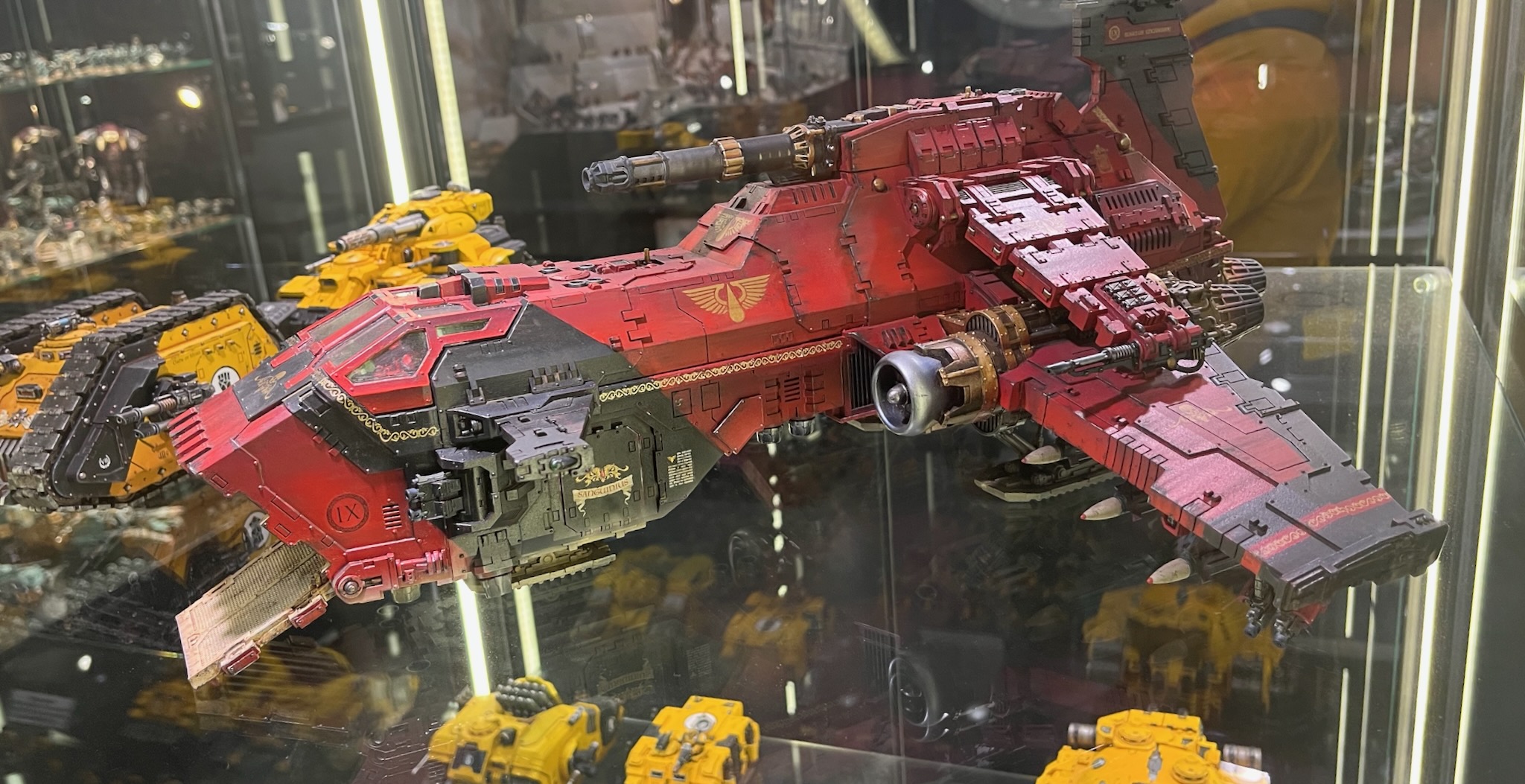
This huge Forge World Imperial Navy Marauder Destroyer Bomber was on display at Warhammer World.

Marauder Destroyer Bomber at Warhammer World

The Marauder Destroyer variant was developed during the second war for Armageddon after heavy losses in the Naval airforces. Orkish dominance of the skies over certain areas of Armageddon forced the few remaining Marauders to be refitted to operate at night, flying at extremely low level where they could evade detection. Their new heavier weapon payload made anything which got in the way seriously regret it!

This is a really nice model, I really like the paint job on this. I would like to be able to paint like this if I could. I certainly don’t have both the skills and the airbrush to make this happen.

More photographs of the Marauder Destroyer Bomber.

I have some Aeronauticus Imperialis Marauder Bombers on the workbench.

German Panther Tank

This massive German Panther Tank was on display at Bovington.

The Panther is the common name of a medium tank fielded by Nazi Germany in World War II that served from mid-1943 to the end of the European war in 1945. It was intended as a counter to the T-34, and to replace the Panzer III and Panzer IV; while never replacing the latter, it served alongside it as well as the heavier Tiger tanks until the end of the war. 

The Panther’s excellent combination of firepower, mobility, and protection served as a benchmark for other nations’ late war and immediate post-war tank design, however despite being a technologically sophisticated vehicle, the Panther’s technical design had a very limited influence on postwar tank development.

After the war, France was able to recover enough operable vehicles and components to equip the French Army’s 503e Régiment de Chars de Combat with a force of 50 Panthers from 1944 to 1952, with about a dozen remaining in use by that time. These remained in service despite being partially replaced by French-built ARL 44 heavy tanks.

I have been thinking about some post-1945 games, and a force of French Panther tanks supported by Chaffee and Shermans.

The last ‘production’ Panthers were produced at the factory by German staff just after the end of World War II under the supervision of the Royal Electrical and Mechanical Engineers (REME) using available components. 9 Panthers and 12 Jagdpanthers were produced and shipped back to Britain for post-war trials. A complete Panther (this tank) and a complete Jagdpanther produced this way are now at the Bovington.

I have a few 15mm models of this tank on the workbench.

Alarielle the Everqueen at Warhammer World

Alarielle the Everqueen

Reborn from the land she loved in a soaring crescendo of hope, fury, loss and exhilaration, Alarielle the Everqueen is an ancient and powerful being. She is the goddess of life magic; where she treads, atop her immense wardroth beetle, new blooms scream forth in a riot of colour, strength and passion. She scatters soul amphorae across the Mortal Realms, each containing magical pollens that can coax new sylvaneth from the ground, or choke her enemies. The only match for the courage she instils in her allies is the hatred she feels for her foes – Alarielle the Everqueen burns with a fierce need for vengeance, and her enemies would do well to run.

Battlefleet Gothic

These beautifully painted Battlefleet Gothic models were in the display cabinets at Warhammer World.

I never got into Battlefleet Gothic as I much preferred using the GZG Full Thrust rules for spaceship battles. I also used MicroMachines Star Trek ship models.

There were some nice models for Battlefleet Gothic and as with many games that Games Workshop have produced over the years it’s a pity that it got retired.

French Renault FT-17

The Renault FT or Automitrailleuse à chenilles Renault FT modèle 1917, inexactly known as the FT-17 or FT17, was a French light tank; it is among the most revolutionary and influential tank designs in history.

Renault FT-17

The FT was the first operational tank with an armament in a fully rotating turret, and its configuration with the turret on top, engine in the back and the driver in front became the conventional one, repeated in most tanks until today; at the time it was a revolutionary innovation.

Copies and derivative designs were manufactured in the United States (M1917 light tank), in Italy (Fiat 3000), and in the Soviet Union (T-18 tank).

France still had several thousand First World War Renault FT tanks in 1940. Over 500 of them were still in service in independent bataillons de chars de combat (BCC) tank battalions in the front lines. Although adequate for infantry support, they were totally outclassed by German tanks in a mobile battle.

It is one of my favourite tanks, I have always had a fondness for this little tank, probably as a result of making that Matchbox plastic kit of the Renault and the Char B1 when I was young.

There was a nice looking Renault FT-17 at the Bovington Tank Museum.

The tank appears to have been part of the Imperial War Museum collection after the First World War and arrived at the Tank Museum as part of an exchange of exhibits in 1965. The tail skid turned up about 20 years later, having been discovered in a store at IWM Duxford.

More photographs of the Renault FT-17 at Bovington.

As I am creating an Early War French army I got some of these little tanks for Flames of War.

Solar Auxilia Aurox Armoured Transport

The Aurox Armoured Transport is an armoured troop transport tank primarily used by various arms of the Imperial Army to carry veteran grenadier units to battle or to protect their commanders while dictating the course of battle.

A further variant of the Aurox is used by the Solar Auxilia, re-fitted for extreme environmental conditions.

Liche Priest on Necrolith Bone Dragon

This Liche Priest on Necrolith Bone Dragon was in the display cabinets at Warhammer World.

Liche Priest on Necrolith Bone Dragon
Liche Priest on Necrolith Bone Dragon at Warhammer World

Only the most prestigious priests can harness the undying will of a fearsome Necrolith Bone Dragon, much less ride such a behemoth into battle. These reanimated wyrms descend upon the living, given unnatural flight by skeletal wings, before lashing out with wicked claws and jagged fangs. Those who survive must contend with clouds of seething dust and desiccating smog, for a dragon’s breath is lethal even in death.

Carden Loyd Carrier Mark VI MT9909 E61

This Carden Loyd Carrier Mark VI MT9909 E61 was on display at the Tank Museum at Bovington.

Carden Loyd Carrier Mark VI MT9909 E61

The Carden Loyd tankettes were a series of British tankettes of the period between the World Wars, the most successful of which was the Mark VI, the only version built in significant numbers.

Carden Loyd Carrier Mark VI MT9909 E61

It became a classic tankette design worldwide, was licence-built by several countries and became the basis of several designs produced in various countries.

A tankette is a tracked armoured fighting vehicle that resembles a small tank, roughly the size of a car. It is mainly intended for light infantry support and scouting. Colloquially it may also simply mean a small tank. Several countries built tankettes between the 1920s and 1940s, and some saw limited combat in the early phases of World War II. The vulnerability of their light armour, however, eventually led armies to abandon the concept

Italy bought a number of Carden Loyd Mark VIs, built a few licence copies designated CV-29, and then developed this design further into the L3/35 tankette.

Imperial Fists Mastodon Heavy Assault Transport

This Imperial Fists Mastodon Heavy Assault Transport was in the displays at Warhammer World.

Imperial Fists Mastodon Heavy Assault Transport

The Mastodon was one of the heaviest assault transports in the arsenal of the Legiones Astartes during the Great Crusade, and is still found in the armouries of the Space Marine Chapters of the 41st Millenium. Its cavernous assault bay, capable of housing almost half a Company, is protected both by thick layers of ceramite armour as well as crackling void shields. It also mounts a fearsome siege melta array, allowing it to breach even the most formidable defences with ease, as well as an array of secondary weaponry intended to defend the vehicle as it approaches its target. Unleashed only against the most fearsome of enemy redoubts, there are few obstacles that can stay the wrath of this relic of the Imperium’s bloody birth.

Imperialis Militia Carnodon Battle Tank

This Imperialis Militia Carnodon Battle Tank was on display at Warhammer World.

Imperialis Militia Carnodon Battle Tank

The Carnodon is a versatile medium battle tank which acted as the lynchpin for many of the storied successes of the Imperial Army during the Great Crusade. As a premier mobile fire platform, it was regularly adapted to combat a wide variety of foes and respond to any number of battlefield conditions. During the early years of the Great Crusade, it rapidly became a byword for conquest amongst the Expeditionary fleets, a legacy which led to the production of the dedicated Imperial battle tanks of latter-days. As the Great Crusade moved ever outwards and supply of the Aurox chassis peaked, it is thought that many Carnodon tanks entered a strategic reserve and were distributed to Crusade muster worlds behind the front lines; with over two hundred thousand examples thought to have been stored pending secondary mobilisation in the warrens under the world of Tallarn.