There’s slightly bittersweet news for Warhammer 40,000 fans today, as some long-serving miniatures will be retiring from the range – both classic Space Marines, and a selection of Forge World kits.
I do accept the retirement of Forge World resin models, those where models have been replaced by plastic kits, or those where the models are no longer in the codex or the rules. That I get.
What makes me a little saddened and disappointed was this comment in the article:
There will still be Forge World units for Warhammer 40,000, but the focus for them will be on the really big stuff – like Titans, and other kits that we can’t reasonably produce at that scale (yet!). When we add new units in future, they will almost always be in plastic – and there are a lot of plastic kits on the way over the next few years!
I like the idea of new plastic kits, but where I think they are missing the trick is to use Forge World not only to produce those big kits (that they won’t do in plastic) but to produce two types of kits that would enhance and expand the Warhammer 40000 game.
The first of these is new units, those that add real variety to the armies you can field. A past example of that was the Grot Mega Tank. Another example was the Grot Tanks.These were not in the main Ork Codex, but certainly added something different to an Ork army. I liked how there were not just four models in the pack, but the way the models were designed, you could build them in a variety of ways.
I guess the reasoning here is not just about the range of models, but the need to provide rules for these types of models as well.
The second kind of model I think they should produce are variant units. I have in my own collection for example the Ork Halftrakk which is a variant Trukk. I think there could be a range of variant models that would enable for some armies a more varied and cosmopolitain look. This would be critical for some armies, such as Orks, but also Genestealers, Chaos, Tyranids, and others.
Reflecting on Orks, I would like to see a much wider range of buggies for example different kinds of Snazzwagons. I like what Forge World did in the past with the Battlewagon (now the Bonebreaka).
I did like the Imperial variants that Forge World produced as well. I much prefer my Forge World Razorback compared to the plastic kit at the time.
I guess though that Forge World will still be making new resin models for The Horus Heresy. Though this will mean Imperial (and Traitor) units only and not Xenos stuff like Orks!
The Rhino is the most widely used armoured personnel carrier in the Imperium. Based on ancient STC technology, the fundamental design is robust, reliable, and easy to maintain, with an adaptive power plant that can run off a wide variety of fuels.
I bought the plastic Deimos Pattern Rhino when it came out in the summer, you can see the workbench for that Rhino here. I was lucky enough to get a second Rhino for a Christmas present. The model has many more parts and is a more detailed kit than the original plastic Rhino kit that came out in the 1980s. I constructed the model to the instructions, though I left the tracks off to paint separately. I gave the model an undercoat of Citadel White Scar. I gave the model a couple of light coats of Daemonic Yellow. I also painted the bolter and exhausts with Leadbelcher. I then shaded the model. For the next stage I used some Citadel Layer Yriel Yellow. I took a large brush and gave the model, what I would call, a heavy drybrush. I then did some more drybrushing.
The next stage was to affix the tracks to the Rhino.
With the tracks for the Rhino I gave them a spray of Mechanicus Standard Grey, this was followed by a heavy drybrush of Gorthor Brown. The tracks, once dry, had a wash of Agrax Earthshade Shade. After painting and shading them, I drybrushed them lightly, first with Leadbelcher. I then did a very light drybrush with Terminatus Stone.
The tracks were removed from the sprue and using superglue they were attached to the Rhino.
You have to be careful when attaching these, as they are specific to each side of the Rhino, but they do attach to the Rhino quite easily.
The Focke-Wulf Fw 190 Würger (“Shrike”) was a German single-seat, single-engine fighter aircraft designed by Kurt Tank at Focke-Wulf in the late 1930s and widely used during World War II. Along with its well-known counterpart, the Messerschmitt Bf 109, the Fw 190 became the backbone of the Jagdwaffe (Fighter Force) of the Luftwaffe.
The twin-row BMW 801 radial engine that powered most operational versions enabled the Fw 190 to lift larger loads than the Bf 109, allowing its use as a day fighter, fighter-bomber, ground-attack aircraft and to a lesser degree, night fighter.
The Fw 190 entered Luftwaffe service in August 1941 and quickly proved to be a formidable opponent for Allied aircraft. It was faster, more manoeuvrable, and had a heavier armament than the Spitfire V, which was the RAF’s main frontline fighter at the time. The Fw 190 also had a longer range, which allowed it to escort bombers deeper into enemy territory.
The introduction of the Fw 190 forced the RAF to upgrade its fighter fleet. The Spitfire IX, which entered service in July 1942, was a much-improved version of the Spitfire V and was finally able to match the Fw 190 in terms of performance. The arrival of the Spitfire IX helped to turn the tide of the air war in the Allies’ favour.
The Fw 190 continued to be used by the Luftwaffe until the end of the war. It was a versatile and effective aircraft that played a major role in the conflict.
One of the more unusual roles for the Fw 190 was as part of the twin-aircraft drone combination, code-named mistletoe or Mistel. A single engine fighter was mounted on top of a twin engine bomber, and on lining up with the target the fighter detached itself, leaving the bomber, packed with explosives, to impact the target.
Cosford’s Fw 190 is a unique survivor of a Mistel combination. Surrendered in Denmark in May 1945, the Fw 190 was part of a combination with a Junkers Ju 88, and assigned to a unit which trained Mistel crews. Flown to Germany as a twin combination, the Fw 190 was then split from its Ju 88 in order to be ferried to the UK for examination. The Ju 88 half never reached the UK, and it is assumed it was scrapped.
I had been thinking about getting the Mekyboy Workshop kit for a while. So on a shopping trip to my local games shop I decided to make an impulse purchase and buy the box. Well it was nearly 30% cheaper than on the GW site.
Having cleaned the plastic parts I gave them a Corax White undercoat. I then started painting the basecoat across the scrap piles and barricades using a combination of Base and Contrast Citadel paints. I continued to paint the different barricades, using, as before, Base and Contrast paints. Having finished the base coat on pile of scrap 3, I gave it a wash using Citadel Agrax Earthshade Shade.
I then did some additional shading using Citadel Nuln Oil Shade.
This Peerless Armoured Car was on display at the Tank Museum at Bovington.
The (original) Peerless Armoured Car was an armoured car that was used by the British Army during the First World War. Sixteen American Peerless trucks were modified by the British to serve as armoured cars. These were relatively primitive designs with open backs, armed with a Pom-pom gun and a machine gun, and were delivered to the British Army in 1915.
In 1919 a new design was built. it was based on the chassis of the Peerless three-tonne lorry, with an armoured body built by the Austin Motor Company.
The Peerless lorry was a relatively slow and heavy vehicle but was reckoned to be tough, with solid rubber tyres and rear-wheel chain drive. The armour for the vehicle produced by the Austin company was based on an earlier design created for the Russian Army.
The most common variant was a twin-turret design fitted with two machine guns. However, a number of other variants were developed, including a vehicle armed with a 3-inch (76 mm) gun and an anti-aircraft variant armed with a 13-pound 6cwt AA gun.
The car had a crew of four .The Peerless Armoured Car was used in a variety of roles, including reconnaissance, escort duty, and direct fire support. It was used by the British Army in the Russian Civil War.
The Peerless Armoured Car was a relatively successful design for its time. It was well-protected and reliable, and it was able to carry a significant amount of firepower. However, it was also slow and heavy, which limited its usefulness in some roles. The Peerless Armoured Car was eventually replaced by more modern designs in the 1920s.
Poor off-road performance hampered the vehicle but it still saw considerable service, notably in Ireland. A few were still in service with the British at the start of the Second World War. Seven were in service with the Irish National Army during the Irish Civil War and used by the Irish Defence Forces up until 1932.
This photo appeared in the Sunday Independent on 13 August 1922, with the caption: “A Dangerous Corner – This photograph was taken in one of the towns captured during the past week by the National Army. It shows an amoured car “manoeuvring for position” at the end of a street facing the post office. Irregulars occupy the further end of the street, and are being quickly dislodged by infantry supported by the armoured car.”
Peerless Armoured Car in Cork in 1922 – National Library of Ireland on The Commons [No restrictions]These armoured cars would have been used in the world of A Very British Civil War. They would also make ideal vehicles for the concept of the 1919 British Revolution I talked about in this blog post.
If there had been a British Revolution in 1919, the Peerless Armoured Cars would have likely been used to suppress the uprising. The cars were well-protected and armed with machine guns, making them ideal for use against rioters and rebels. They would have been deployed to key locations around the country, such as government buildings, military bases, and communication hubs. The cars would have also been used to patrol the streets and to provide support to police forces.
The use of Peerless Armoured Cars would have likely been controversial. Some people would have argued that the cars were necessary to protect the country from chaos and anarchy. Others would have argued that the cars were a symbol of government oppression. The use of the cars would have likely exacerbated tensions between the government and the people, and it could have led to further violence.
Ultimately, the outcome of a British Revolution in 1919 is impossible to say. However, the use of Peerless Armoured Cars would have likely played a significant role in the conflict.
Next week you will be able to pre-order theVindicator Siege Tank plastic kit for The Horus Heresy.
Lay waste to enemy fortifications and pulverise whole squads of Astartes with salvos of shells spat from the hull-mounted demolisher cannon of the Vindicator Siege Tank.
I do like this model, but of course I already have its larger brother the Typhon heavy siege tank, so not sure I need another siege tank for my Imperial Fists.
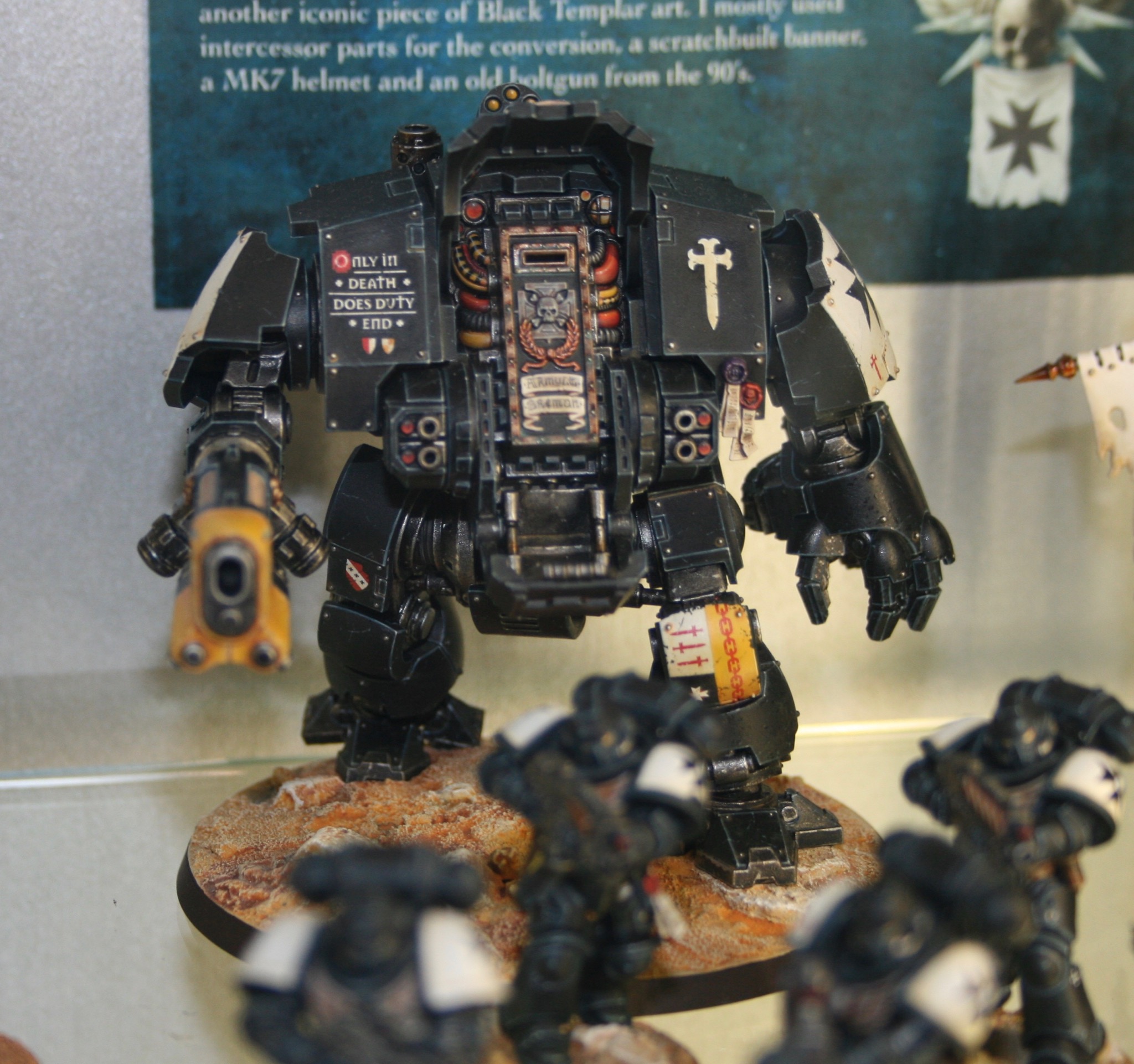
This Black Templars Primaris Redemptor Dreadnought was on display at Warhammer World.
Redemptor Dreadnoughts are giant, powerful war machines that are used by the Adeptus Astartes, the Space Marines of the Imperium of Man. They are larger and more heavily armed than traditional Dreadnoughts, and they are equipped with a variety of advanced technologies that allow them to operate with surprising dexterity and speed, even though their pilots are entombed in cybernetic sarcophagi.
Redemptor Dreadnoughts are armed with a variety of powerful weapons, including a heavy flamer, an onslaught gatling cannon, and a macro plasma incinerator. These weapons can tear through enemy armour and flesh with ease, making Redemptor Dreadnoughts a fearsome sight on the battlefield.
In addition to their firepower, Redemptor Dreadnoughts are also protected by thick armour that can withstand heavy fire. This makes them ideal for spearheading assaults or holding the line against enemy attacks.
Redemptor Dreadnoughts are piloted by Astartes who have been mortally wounded in battle. These warriors are entombed in cybernetic sarcophagi that keep their bodies alive and allow them to continue fighting for the Emperor. The neural links that connect the pilot to the Dreadnought allow them to control the machine with surprising dexterity and speed, even though they are unable to move their own bodies.
Redemptor Dreadnoughts are a valuable asset to any Astartes force. They are powerful, versatile, and deadly, and they can turn the tide of any battle. Redemptor Dreadnoughts are a testament to the Adeptus Astartes’ dedication to never give up, no matter the cost. These mighty war machines are a symbol of hope for the Imperium, and they continue to fight for the Emperor even after their pilots have been mortally wounded.
Operation Sea Lion was the code name for Nazi Germany’s planned invasion of the United Kingdom during the Battle of Britain in World War II. The operation was never launched, as the German Luftwaffe failed to achieve air superiority over the Royal Air Force (RAF).
The plan for Operation Sea Lion was developed in the summer of 1940, after the German victory in the Battle of France. Hitler believed that Britain would be forced to surrender if it was invaded. The German army would land on the south coast of England and quickly overwhelm the British forces.
The invasion was scheduled to take place in September 1940. However, the Luftwaffe was unable to achieve air superiority over the RAF. The RAF Fighter Command fought a series of decisive battles against the Luftwaffe, and by the end of September, the Germans were forced to postpone Operation Sea Lion indefinitely.
The failure of Operation Sea Lion was a major turning point in the war. It showed that the British were not going to surrender without a fight, and it gave the Allies time to build up their forces for the eventual invasion of Europe.
Landing between Dover and Hythe, German troops push inland supported by the Luftwaffe and the impregnable panzers, and strike out towards London. The British, desperate to defeat the invaders, rally and prepare for a crucial confrontation at Maidstone. Realistic, carefully researched and superbly written, Invasion is a classic of alternate history and a thought-provoking look at how Britain’s war might have been.
There was one section which caught my eye
…the men of Infanterie Regiment Grossdeutschland, several hundred of whose members were trained to ride in the remarkable Fieseler Storch monoplane which could deliver five assault troopers at a time on landing strips only a few yards in length.
Fieseler Fi 156 Storch at RAF Cosford.
The Fieseler Fi 156 Storch was a small German liaison aircraft built by Fieseler before and during World War II. It remains famous for its excellent STOL performance and low stall speed of 31 mph.
This got me thinking about a possible gaming scenarios of the Infanterie Regiment Grossdeutschland flying in during Operation Sealion.
Airfield Attack
In an attempt to capture an airfield intact, the Infanterie Regiment Grossdeutschland fly into an RAF airfield in their Fieseler Storch aircraft. Their plan to take the airfield so that the Luftwaffe can fly in more troops and supplies.
During the Second World War in 1941, Crete was invaded by German airborne forces while it was being held by Greek, British, and Commonwealth forces. The Allied land forces failed to recognize the crucial significance of the airfields and therefore did not defend them sufficiently, which enabled the German invasion to succeed largely. As a result, the German paratroop and glider forces were able to capture the RAF base at Maleme with significant casualties. The Germans were subsequently reinforced by air from behind Allied lines, ultimately resulting in the loss of the entire island and substantial Allied casualties in what was later known as the Battle of Crete.
You can imagine a similar scenario here during Operation Sealion.
The airfield is poorly defended, RAF personnel and a few armed guards.
Once taken, the Germans need to hold the airfield against attempts by local British forces (regular army or even Home Guard) to retake the airfield, so that the Luftwaffe can fly in reinforcements and much needed supplies.
You could create a turn based narrative, for scoring points. The more turns the Germans hold the airfield for, the more points they get.
Taking Dover Castle
The outbreak of the Second World War in 1939 saw the tunnels converted first into an air-raid shelter and then later into a military command centre and underground hospital.
In an attempt to decapitate the British command, the Infanterie Regiment Grossdeutschland fly onto Dover Castle in their Fieseler Storch aircraft. Their plan to take the castle, capture the bunkers and disruptBritish command and control during the German invasion.
Dover Castle is well defended and if the Germans are successful in taking the castle, then they can expect a British counter-attack to try and retake it.The Castle is defended by regular British army forces.
Landing on the Mall
The Mall is a tree-lined road in London that runs from Buckingham Palace to Trafalgar Square. It is a popular tourist destination and is often used for ceremonial events, such as royal weddings and parades. The Mall was originally built in the 18th century as a fashionable promenade. It was later redesigned in the early 20th century to create a grand processional route in honor of Queen Victoria. The Mall is now lined with trees and has a number of important landmarks, including Admiralty Arch, the Victoria Memorial, and St. James’s Palace.
The Infanterie Regiment Grossdeutschland fly into London in their Fieseler Storch aircraft and land on the Mall.
Now they land in central London to capture key objectives, or even planning to capture high profile prisoners.
From here they can get to 10 Downing Street, Buckingham Palace, the Ministry of War, Horse Guards, BBC Broadcasting House and other key strategic targets.
Another idea is for the The Infanterie Regiment Grossdeutschland fly into London in their Fieseler Storch aircraft and land on the Mall. They then need to prepare the Mall as a makeshift runway for Junkers Ju52 transports bringing in reinforcements and supplies.
Junkers Ju52/3M (CASA 352L) at RAF Cosford.
The Ju 52 is a three-engined, all-metal monoplane that was first flown in 1932. It was used by the German Air Force during World War II and is still in use today by a number of civilian operators. The Ju 52 is known for its ruggedness and reliability, and it has been used in a variety of roles, including passenger transport, cargo transport, and military transport.
The Mall is 930 metres long and 36 metres wide. The Junkers Ju52 had a wingspan of 29 metres, but only needs a landing strip of 457 metres. It can also take off in just over 600 metres. It would be a tight fit, but the ability to land a transport in the heart of London would make it much easier to both reinforce an invasion force, but also to take away any prisoners.
There are potentially lots of other ideas for scenarios for the Infanterie Regiment Grossdeutschland and their Fieseler Storch aircraft during Operation Sealion, which I might explore in another blog post.
The Messerschmitt Me 410 Hornisse (Hornet) was a German heavy fighter and Schnellbomber (fast bomber) used by the Luftwaffe during World War II. It was developed from the Me 210, which had been plagued by problems with stability and handling. The Me 410 addressed these issues with a new wing design, a longer fuselage, and more powerful engines. It was also armed with a more powerful armament than the Me 210.
This Messerschmitt Me 410 Hornisse was on display at RAF Cosford.
The Me 410 entered service in 1943 and was used in a variety of roles, including fighter, bomber, reconnaissance, and night fighter. It was most effective in the fighter role, where it was used to escort bombers and attack enemy fighters. The Me 410 was also used to attack ground targets, including tanks and troop concentrations.
The Me 410 was a capable aircraft, but it was not without its flaws. It was relatively slow for a heavy fighter, and it was not as manoeuvrable as some of its contemporaries. However, it was well-armed and had a long range, making it a valuable asset to the Luftwaffe.
The Me 410 was produced in a number of variants, including the Me 410A, Me 410B, and Me 410C. The Me 410A was the basic variant, armed with two 20mm MG 151 cannons and four 7.92mm MG 17 machine guns. The Me 410B was a bomber variant, armed with a bomb load of up to 2,200 pounds. The Me 410C was a night fighter variant, armed with a radar and a 30mm MK 108 cannon.
The Me 410 was used in combat until the end of World War II. It was a successful aircraft, and it played a significant role in the Luftwaffe’s war effort.
My latest model for my Imperial Fists Horus Heresy force is the Typhon Heavy Siege Tank.
The Typhon Heavy Siege Tank was released as a plastic kit for The Horus Heresy. I’ve always liked the Forge World resin model and so was pleased to get one of the new plastic kits for my Imperial Fists force.
It was then onto shading the model. I used some Citadel Reikland Fleshshade Shade, aiming to achieve the same result I got with my first Deimos Pattern Rhino.
This time though, compared to some of my other models I went with an initial lighter shade, with the intention to add more later.
I gave the main weapon a wash of Agrax Earthshade Shade.
I also shaded the gun shield with Citadel Reikland Fleshshade Shade.