Warbringer Nemesis Titan

This is the Warbringer Nemesis Titan on display at Warhammer World.

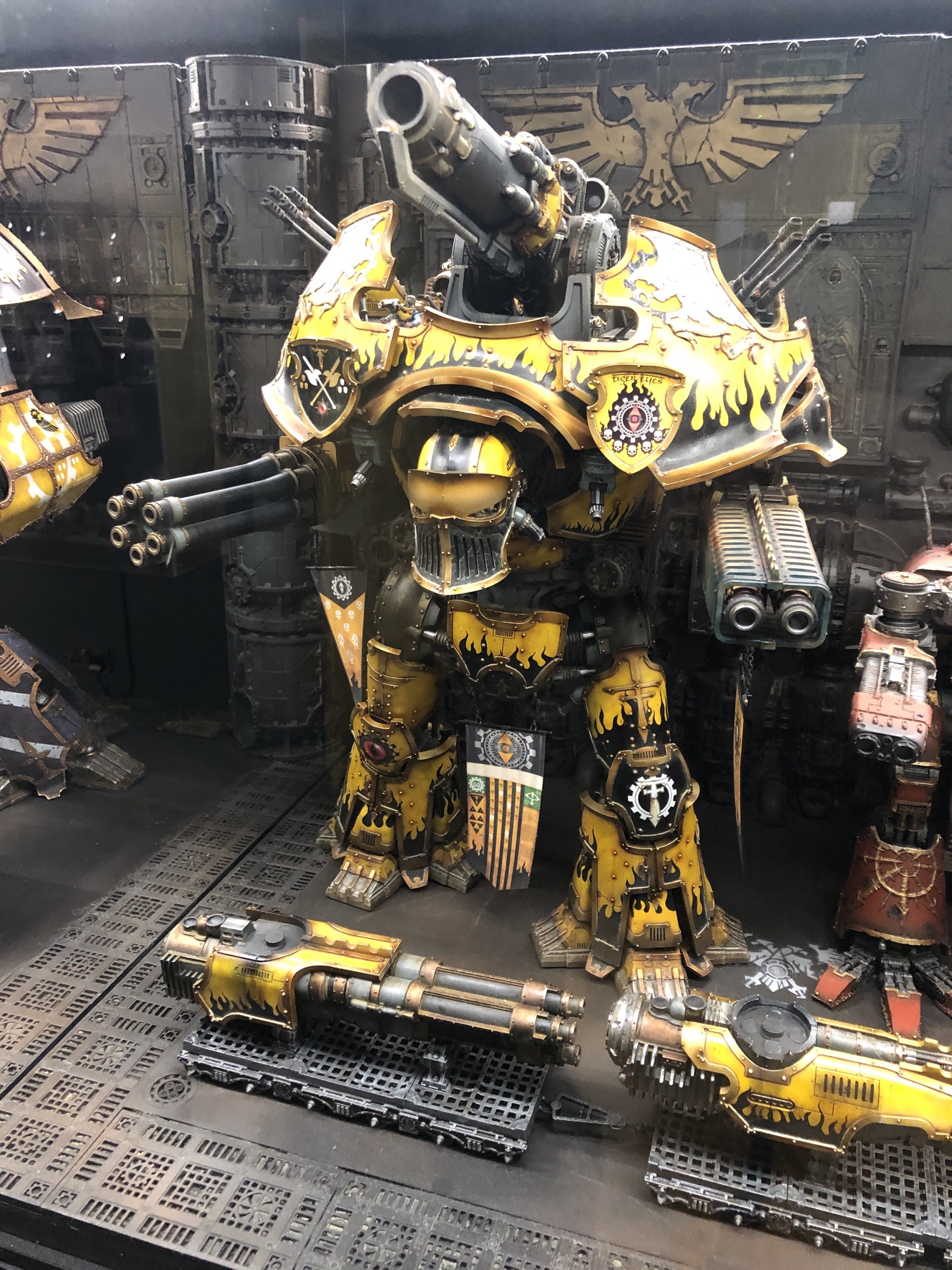
The Warbringer Nemesis Titan serves the Collegia Titanica in the role of heavy fire support. It mounts a single Warlord-scale weapon on its upper carapace and Reaver-scale weapons on its arms – sacrificing the speed, armour and manoeuvrability of a conventional Battle Titan in favour of firepower far in excess of its size. Though rare and specialised, the Warbringer Nemesis is a sight to inspire dread in all but the most battle-hardened enemy princeps.

Warlord Battle Titan

There was some (huge) magnificent 40K scale Warlord Titans on display at Warhammer World.

The Warlord appears to be the most common class of Battle Titan in use by the Titan Legions of the Imperium of Man, and many Adeptus Mechanicus Forge Worlds field their own patterns of this class.

Another excellent Warlord Titan.

I sometimes think I would like to get a Forge World Titan, but then I think they are quite expensive (usually in excess of £1000) but would I have the skills to make and paint one, would I have the time? Probably not. So it can remain a dream and I can admire those that are on display at Warhammer World.

Warlord Battle Titan Miniatures Gallery

Challenger CR 1 Main Battle Tank

At the back is a Challenger CR 1 Main Battle Tank.

Challenger CR 1 Main Battle Tank

Prototype of British main battle tank developed in the 1980s, crew of 4, powered by Rolls-Royce Meteor CV12 diesel engine. The production Challenger 1 was fitted with Chobham armour and armed with a 120mm gun and two machine guns.

Duxford failed to acquire a main production run vehicle (the Duxford vehicle is not fitted with Chobham armour, nor does it carry a TOG – thermo optic guidance – box) because all such vehicles were sold to Jordan and the MOD refused to save any vehicles for the nation, stating Treasury guidelines to maximise receipts from the sale of end of service items, which is a pity.

In the foreground is a Springer All-Terrain Vehicle. The Springer is an all-terrain vehicle developed for the UK Army by UK-based Enhanced Protection Systems (EPS). Supporting British troops in Afghanistan, the new vehicle fleet of 75 vehicles was delivered to the army in summer 2009 at a cost of $10.3 million.

Solar Auxilia Basilisk

This Solar Auxilia Basilisk was on display at Warhammer World.

Solar Auxilia Basilisk on display at Warhammer World.

Many Solar Auxilia Cohorts maintain their own mobile artillery batteries, favouring a class ideally suited to their particular battle doctrines.

Firing from long distance, the Basilisk  can lay down a fearsome barrage ahead of the advancing ranks of the Solar Auxilia. Their hulls, derived from the Solar pattern Leman Russ, offer enhanced protection from enemy weapons and can equip a pintle-mounted weapon such as the ubiquitous multi-laser, adding a close quarters defence capability should enemy infantry advance too near.

Mastodon Heavy Assault Transport

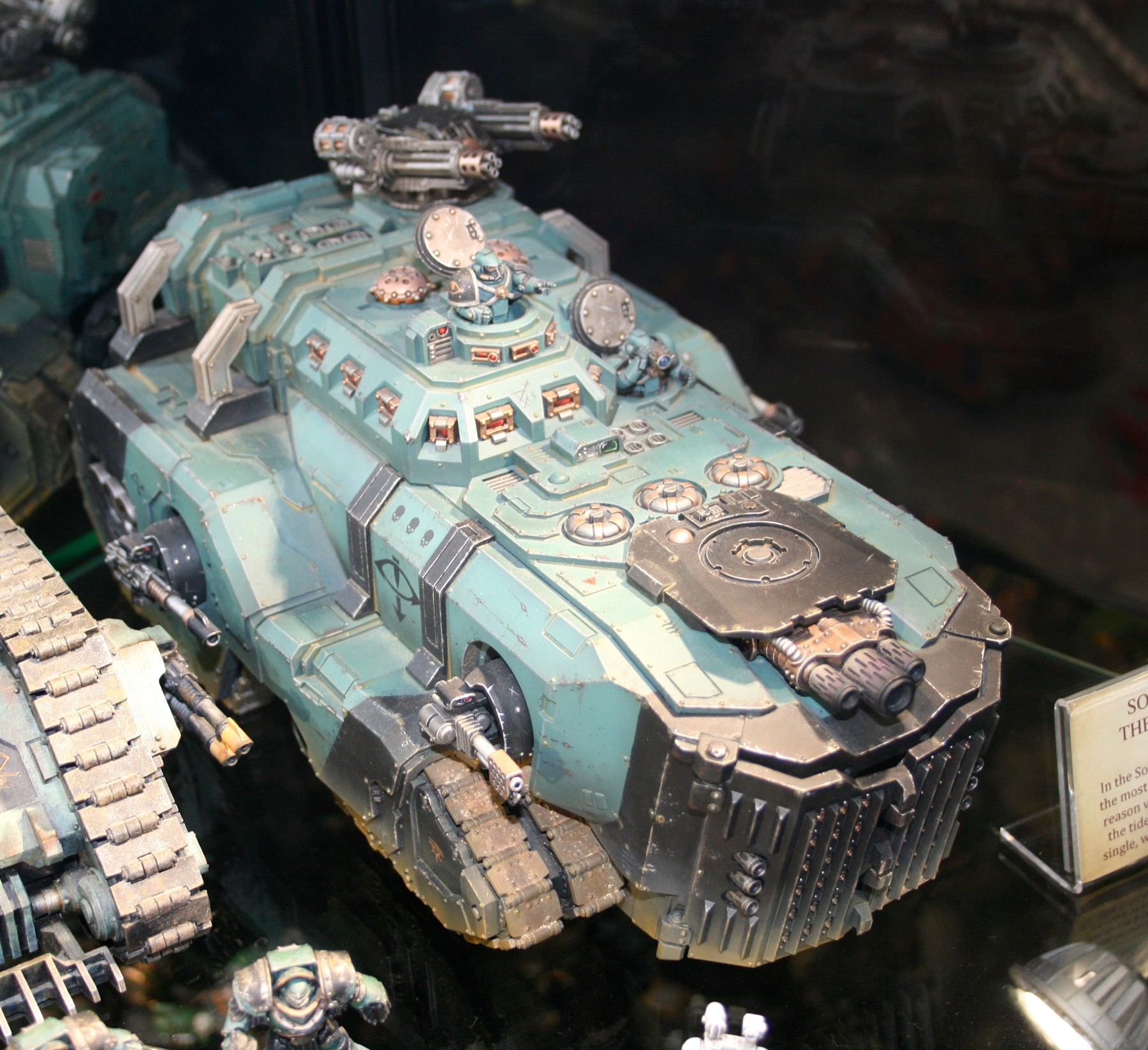
The Mastodon was one of the heaviest assault transports in the arsenal of the Legiones Astartes during the Great Crusade, and is still found in the armouries of the Space Marine Chapters of the 41st Millenium. Its cavernous assault bay, capable of housing almost half a Company, is protected both by thick layers of ceramite armour as well as crackling void shields. It also mounts a fearsome siege melta array, allowing it to breach even the most formidable defences with ease, as well as an array of secondary weaponry intended to defend the vehicle as it approaches its target. Unleashed only against the most fearsome of enemy redoubts, there are few obstacles that can stay the wrath of this relic of the Imperium’s bloody birth.

This Mastodon was on display at Warhammer World. The photograph belies the size of this thing which is huge, almost twice the size of a Land Raider.

Mastodon Heavy Assault Transport

The Mastodon is heavily armed and armoured, carrying 40 Space Marines, and even Dreadnoughts, safely to the heart of battle. Whilst embarked, the warriors within will defend their immense transport, turning the sponson weapons on any enemy brave or foolish enough to come close. It’s Siege melta array can easily destroy fortifications, and makes short work of armoured vehicles, whilst its Skyreaper Battery will tear through any airborne threat with ease.
Cruiser Tank Mk IIA CS (A10)

The Tank, Cruiser, Mk II (A10), was a cruiser tank developed alongside the A9 cruiser tank, and was intended to be a heavier, infantry tank version of that type. In practice, it was not deemed suitable for the infantry tank role and was classified as a “heavy cruiser”.

This A10 Close Support version was on display at the Tank Museum in Bovington.

Cruiser Tank Mk IIA CS (A10)

The CS (Close Support) version of the Mark II had a 3.7 in (94 mm) howitzer in the turret instead of the 2-pdr.

Aeronautica Imperialis Avenger Strike Fighter about to be released

We first saw the Avenger Strike Fighters in February 2020, which I did manage to blog about back then. I mentioned them again in my post about what I thought we might see next for Aeronautica Imperialis.

In this week’s preview from the Warhammer Community they are mentioned again, which means that they are going to be released imminently, I would have thought.

A new aircraft is swooping in for the Imperial Navy in the form of the Avenger Strike Fighter. Designed as a ground attack aircraft, the Strike Fighter’s main armament is its massive avenger bolt cannon – ideal for punching through the weaker top and side armour of enemy vehicles. Of course, such a big gun also makes it incredibly useful against enemy air targets too!

I thought one line of this was interesting…

So does the comment “ideal for punching through the weaker top and side armour of enemy vehicles” mean nothing more for a game which does not include ground vehicles…

But will it mean something more in the future?

Who knows?

Tyranids

The Tyranids are an extragalactic composite species of hideous, insectoid xenos that is actually a space-faring ecosystem comprised of innumerable different bioforms which are all variations on the same genetic theme.

At Warhammer World there are some beautiful Tyranid models in the display cabinets.

Here are a couple of Maleceptors.

The Maleceptor is a living vessel for the Hive Mind. Warp energy spears from its eyeless cranium to vaporise anything in its path, and those with minds strong enough to survive its keening psychic screams are laid low by its powerful talons.

Here is a Tyranid Harpy.

Harpies are monstrous bioforms that fly with a deftness and agility unattainable by even the most sophisticated fighter-craft. As they soar overhead, they rain clusters of living bombs onto prey worlds and spit death from their forelimbs. A mean looking vicious  beast.

More photographs of Tyranids from Warhammer World, GamesDay and Simon’s collection.

Messerschmitt Me 410 Hornet

Messerschmitt Me 410 Hornet

The Messerschmitt Me 410 Hornisse (Hornet) was a German heavy fighter and Schnellbomber used by the Luftwaffe during World War II.

Though an incremental improvement of the Me 210, it had a new wing plan, longer fuselage and engines of greater power. The changes were significant enough for the aircraft to be renamed the Me 410.

Messerschmitt Me 410 Hornet

The last in a series of twin engined ‘destroyers’ manufactured by Messerschmitt, the Me410 was used by the Luftwaffe in a variety of roles.

Legio Custodes Coronus Grav-carrier

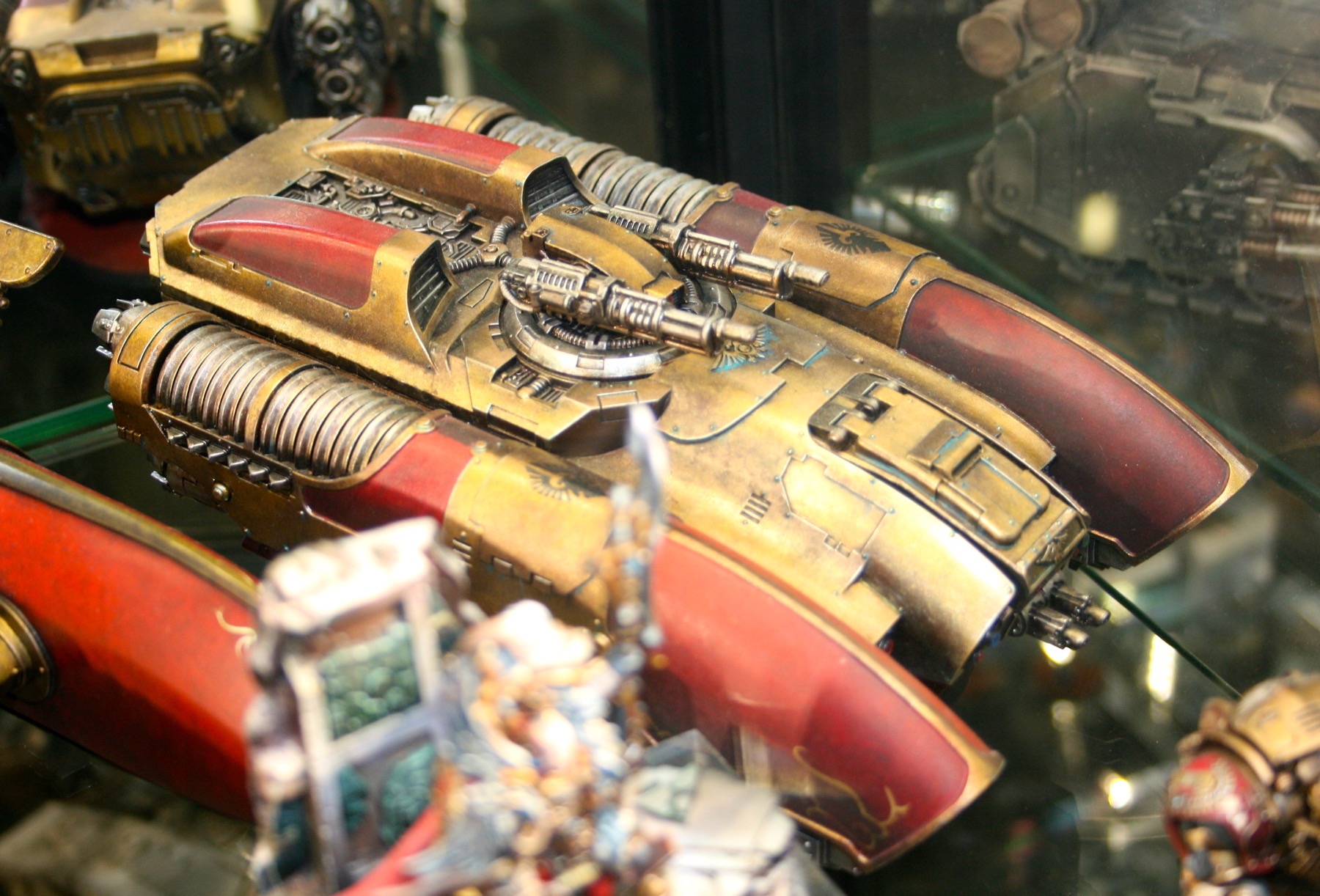
This beautifully painted Legio Custodes Coronus Grav-carrier was on display at Warhammer World.

Legio Custodes Coronus Grav-carrier

Armed with twin-linked Lastrum bolt cannon and Arachnus blaze cannon, the Coronus Grav-carrier is perhaps one of the most recognised vehicles used exclusively by the Legio Custodes. This heavily protected transport skimmer provides them with a degree of speed and agility unmatched by the grinding armour of others who fight in the name of the Emperor, allowing the Legio Custodes to deploy rapidly into a range of terrain whilst reducing the risk of being pinned down by enemy forces.

Principally used as a transport, the strikingly-designed Legio Custodes Coronus Grav-carrier served as the technological basis for the Pallas and Caladius grav-craft. While its primary function is transporting a unit of warriors into battle, its armaments – hull-mounted Lastrum bolt cannon and turret-mounted Arachnus blaze cannon – ensure that it is more than capable of mounting appropriately aggressive defenses.