Bravo November

This USAF Boeing Chinook front fuselage was on display at RAF London and painted to represent Bravo November.

Bravo November

Bravo November is the original identification code painted on a British Royal Air Force Boeing Chinook HC6A military serial number ZA718. It was one of the original 30 aircraft ordered by the RAF in 1978 and has been in service ever since. It has been upgraded several times in its history, now being designated as an HC6A airframe. It has seen action in every major operation involving the RAF in the helicopter’s 39-year service life. Since 1982 it has served in the Falkland Islands, Lebanon, Germany, Northern Ireland, Kurdistan, Iraq and Afghanistan. The aircraft has seen four of its pilots awarded the Distinguished Flying Cross for actions whilst in command of Bravo November.

It first came to the attention of the general public for its survival of the Falklands War. In April 1982 Bravo November was loaded, along with three other Chinooks, aboard the container ship MV Atlantic Conveyor bound for the Falkland Islands on Operation Corporate. Atlantic Conveyor was hit by an Exocet missile, destroying the vessel along with its cargo. Bravo November was on an airborne task at the time and managed to land on HMS Hermes, gaining the nickname The Survivor. It was the only serviceable heavy lift helicopter available to British forces involved in the hostilities.

Full history of Bravo November.

The actual Bravo November Chinook is now on display at RAF Cosford. 

Squat Prospectors

Announced today are some really nice Squat Prospectors.

Squat Prospectors

 These are the Ironhead Squat Prospectors – tough and resourceful miners out in the ash wastes who are more than capable of defending themselves from anyone that tries to take the treasures they dig up.

Squat Prospectors

Though designed for Necromunda, I do like these models. They really remind me of the original Squats.

Squat Prospectors

Thinking I might get a squad.


Painting the Morris CS9 Armoured Car

The Morris CS9/Light Armoured Car was a British armoured car used by the British Army in the World War II. The vehicle was based on a Morris Commercial C9 4×2 15-cwt truck chassis. On this chassis a rivetted hull was mounted with an open-topped two-man turret. The armament consisted of either Boys anti-tank rifle and Bren light machine gun or Vickers machine gun. 

I have the Bolt Action Morris CS9 Armoured Car resin kit. Having constructed the model and given it a white undercoat. I then gave the model a base coat of Cruiser Tank Green (700).

Another view.

I wasn’t too happy with it, so after a while I decided to give the model another basecoat of Army Green Spray from the Army Painter range.

The green is very similar. Then spray gave the model a smoother finish.

Once dry I masked the model with blu-tak. 

I tried to copy the camouflage pattern as shown in the 1940 photograph.

Morris CS9/Light Armoured Car

I then used a Humbrol Tank Grey 67 spray for the dark colour.

The other side.

The next stage will be painting the tyres and detailing.

British Aerospace Harrier GR9A

The Harrier II resulted from a collaborative partnership between McDonnell Douglas and British Aerospace to produce a second-generation Harrier based on the McDonnell Douglas AV-8B.

The project that eventually led to the AV-8B’s creation started in the early 1970s as a cooperative effort between the United States and United Kingdom, aimed at addressing the operational inadequacies of the first-generation Hawker Siddeley Harrier. 

Because of budgetary constraints, the UK abandoned the project in 1975. Following the UK’s withdrawal, McDonnell Douglas extensively redesigned the earlier AV-8A Harrier to create the AV-8B. While retaining the general layout of its predecessor, the aircraft incorporates a new, larger composite wing with an additional hardpoint on each side, an elevated cockpit, a redesigned fuselage and other structural and aerodynamic refinements. The aircraft is powered by an upgraded version of the Pegasus.

The UK, through British Aerospace, re-joined the improved Harrier project as a partner in 1981, giving it a significant work-share in the project. 

The Harrier II was derived from the AV-8B and incorporated an advanced wing design, improved avionics and increased bomb and missile-carrying capacity.

RAF variants started as the Harrier GR5, and were later upgraded as the GR7 and GR9. 

This Harrier GR9A was on display at RAF London.

Under the Joint Force Harrier organisation, both the RAF and RN operated the Harrier II under the RAF’s Air Command, including deployments on board the navy’s Invincible-class aircraft carriers. 

The Harrier II participated in numerous conflicts, making significant contributions in combat theatres such as Kosovo, Iraq, and Afghanistan. The type’s main function was as a platform for air interdiction and close air support missions; the Harrier II was also used for power projection and reconnaissance duties. The Harrier II served alongside the Sea Harrier in Joint Force Harrier.

The RAF used them for attack and close air support duties in conflicts such as Kosovo, Iraq, and Afghanistan.

There is also a BAe Harrier GR9A on display at RAF Cosford.

There is a BAe Harrier GR9A at the Imperial War Museum in London.

Revisiting the Ork Desert Fort

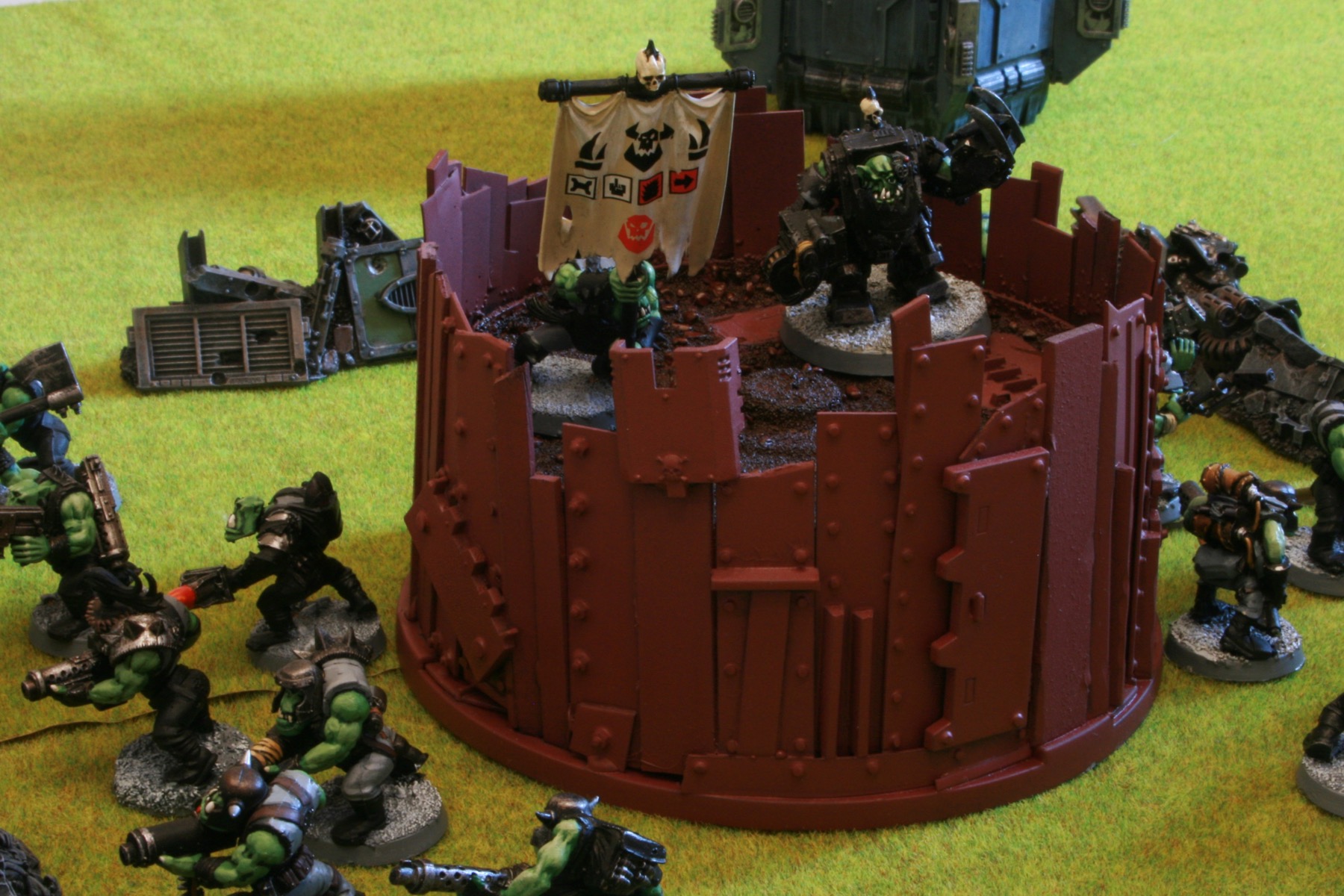
One of the things I liked about Cities of Death was the large Ork “town” which was there alongside the ruined Imperial Cities. I know I will never have the time, space or resources to make something similar, but I did like the concept and thought it would be nice to have some buildings for my Orks.

Many years ago I made an Ork Fort using a DVD-R spindle tub (remember those).

I used wooden sticks, plasticard, spare parts to add detail to the fort. For many years it was painted a rusty red colour, but I had never got round to finishing it off.

Getting it out I gave the model a spray of Citadel Zandri Dust.

The next stage will be to use a shade on the model.

See the workbench feature on the Ork Desert Fort.

C-130 Hercules

This C-130 Hercules cockpit was on display at RAF London.

First flown as a prototype for the United States Air Force in August 1954, the C-130 Hercules, as a troop transport, disaster relief and aerial tanker aircraft has been a mainstay of the RAF transport fleet since the late 1960s (along with those of many other air forces); it has seen extensive operational use including the Falklands, Iraq and Afghanistan.

I’ve always liked the concept of gaming scenarios which include the C-130 Hercules, probably down to the Raid on Entebbe, which of course has been the subject of many films.

There are plenty of 1/72 model kits of the Hercules, but for 15mm or 28mm games there is less or no choice.

There is a Hercules C-130K Mk3 on display at RAF Cosford.

Painting the Ruined Factorum

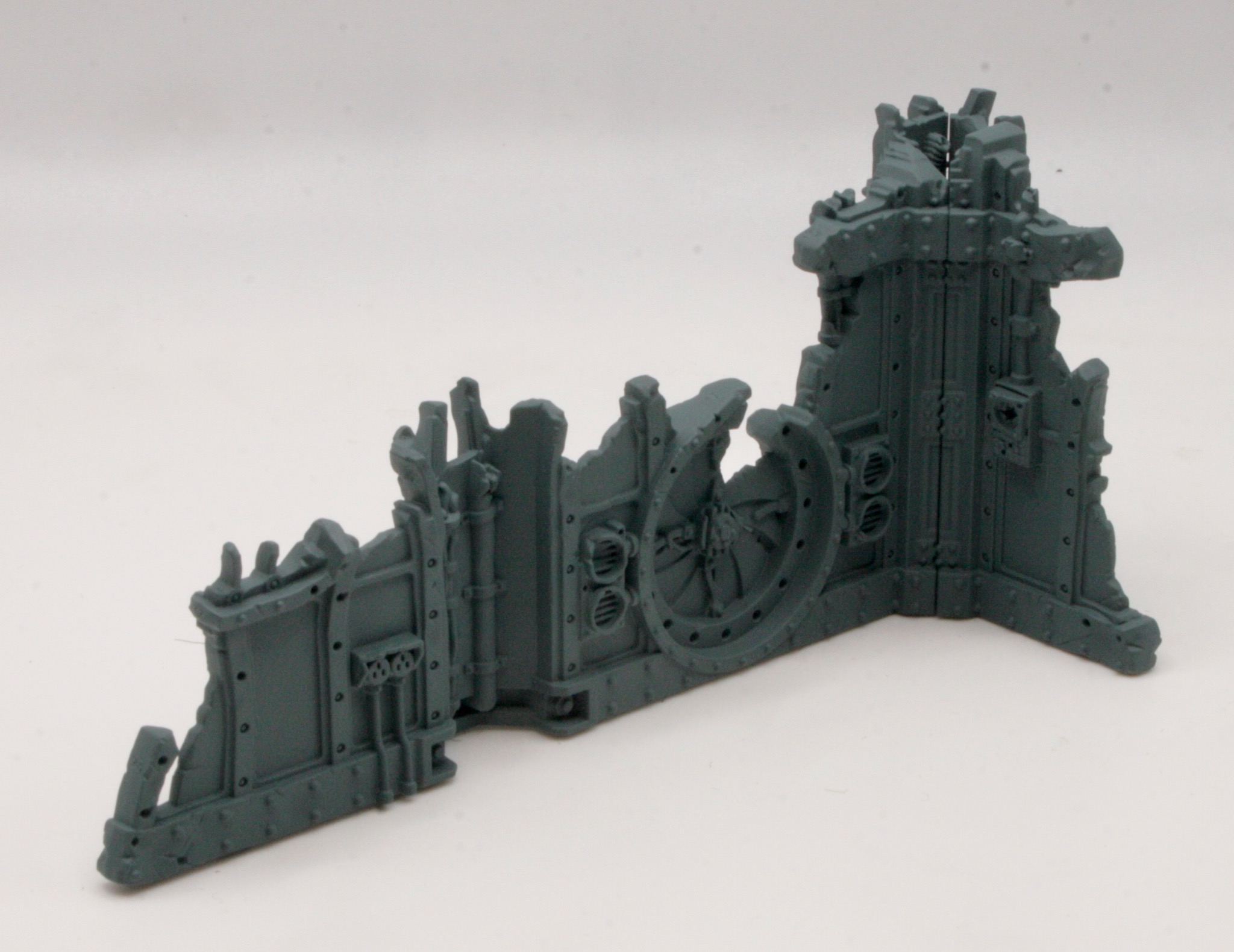
I bought an issue of the part work series Warhammer 40000 Imperium. I usually see the first few issues of part works in the newsagents or at WHSmith, so was interested to see they had issue #31 in stock. I haven’t really been paying attention to this series, however I thought I would see what was “free” with his issue and I was quite intrigued to see they had a Ruined Factorum sprue. So I bought it. The model has two pieces, a larger ruined building and a smaller ruined corner. They are easy to construct and I initially gave the model a white undercoat.

I then gave the model by a spray of Mechanicus Standard Grey Spray.

I used Humbrol Tank Grey 67 spray to give the underfloor a darker feel before giving the model a Mechanicus Standard Grey Spray.

Here is the smaller corner piece.

The next stage will be shading the model.

Buccaneer S2B

Buccaneer S2B XW547

Buccaneer S2B XW547 in Gulf War markings is on display at RAF London.

The Blackburn Buccaneer is a British carrier-capable attack aircraft designed in the 1950s for the Royal Navy (RN). Designed and initially produced by Blackburn Aircraft at Brough, it was later officially known as the Hawker Siddeley Buccaneer when Blackburn became a part of the Hawker Siddeley Group, but this name is rarely used.

Designed for the Royal Navy’s Fleet Air Arm as a carrier-borne attack aircraft, the Buccaneer S1 entered service in 1962.

As it proved to be underpowered, new production aircraft were fitted with Rolls-Royce Spey engines. The Buccaneer entered Royal Navy service in 1962.  The RAF adopted the Buccaneer in 1969 after the cancellation of TSR-2 and F111 long-range strike aircraft.

First deliveries of RAF Buccaneers were Fleet Air Arm aircraft, later aircraft were built specially for the RAF with larger fuel tanks, a strengthened undercarriage and provision to carry Martel anti-ship missiles.

The Buccaneer was originally designed in response to the Soviet Union’s Sverdlov-class cruiser construction programme. Instead of building a new fleet of its own, the Royal Navy could use the Buccaneer to attack these ships by approaching at low altitudes below the ship’s radar horizon. The Buccaneer could attack using a nuclear bomb, or conventional weapons.

The Royal Navy retired the last of its large aircraft carriers in 1978, moving their strike role to the British Aerospace Sea Harrier, and passing their Buccaneers to the RAF.

The ending of the Cold War led to a reduction in strength of the RAF, and the accelerated retirement of the remaining fleet, with the last Buccaneers in RAF service being retired in 1994 in favour of the Panavia Tornado.

There is a Hawker Siddeley Buccaneer S2B at Duxford.


Camouflaging the Bolt Action Home Guard Mark IV Tank

I am in the process of building a Bolt Action 28mm Home Guard force, I did want to add some armour to them with a Mark IV Male World War One tank put into service, even if it was merely as a mobile pillbox.

The Bovington Tank Museum has on display a Mark IV Male tank that was used just in this way. It was used in World War One and then presented to the Navy. When war broke out in September 1939, the Tank Mark IV (Male) number 2324 was refurbished for Home Guard duties.

Having constructed and undercoated the Mark IV Tank the next stage was a base coat of Army Green Spray from the Army Painter range.

Looking at the original photograph it was apparent that the Mark IV had a camouflage pattern that looked like the kind that was applied to early war British tanks.

Mark IV at HMS Excellent

I masked the Mark IV with blu-tak and duct tape.

I then used a Humbrol Tank Grey 67 spray for the dark colour.

I did the model in stages, mainly as I didn’t have enough blu-tak to do the model in one go.

I tried to copy the camouflage pattern as shown in the 1940 photograph.

This is the same view but with more spraying done.

The rear view. I am pleased with the way this turned out.

This is another view. the blu-tak did remove some of the base coat paint, so I will need to do some retouching up.

The next stage will be painting the tracks.