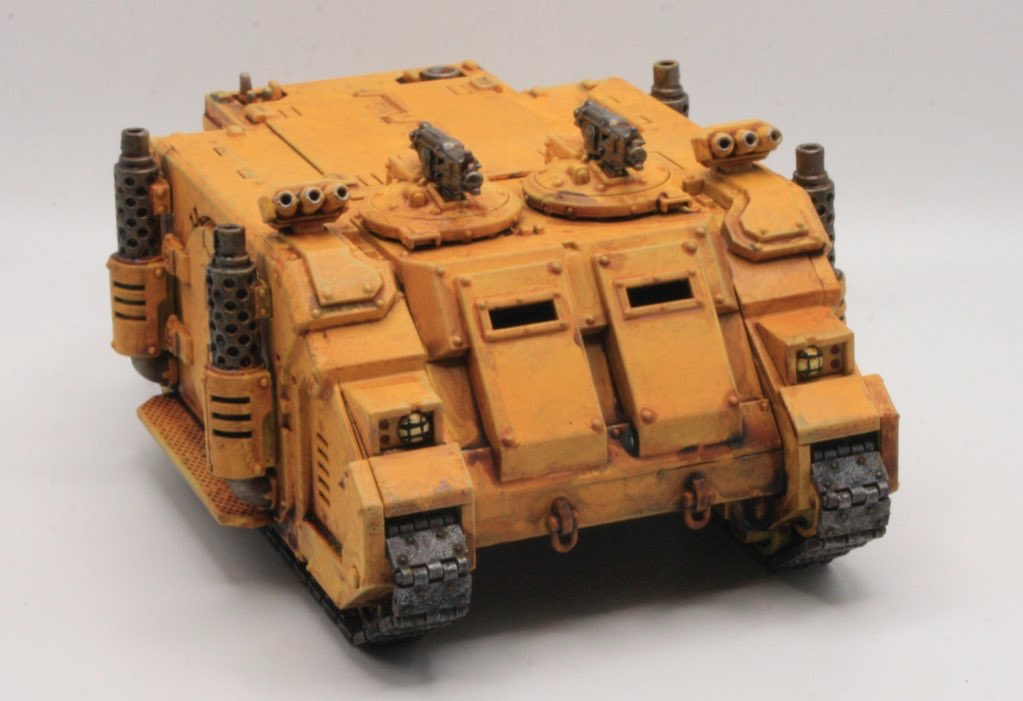
Making tracks with the Ork Looted Rhino

There are Orks who have looted Imperial weaponry. Not only can they use Space Marine weapons they can also borrow the transport.

A Looted Rhino is an Imperial Rhino armoured personnel carrier that has been looted from a previous battlefield by Ork Lootas and is now used as a transport for their WAAAGH!

I wrote about my Ork Looted Rhino and where I was in progressing it.

I was painting the tracks for my Repressor and Razorback when I realised I had three sets of tracks. It took me a while, before I realised that the tracks were for my Ork Looted Rhino. I actually thought I had affixed them, but obviously I hadn’t. 

I had painted the tracks on the sprues.

I had drybushed them with Leadbelcher.

I realised I had no idea how the different parts were affixed to the Rhino. I also had no idea where the kit instructions were. So, a quick Google search found some Rhino instructions. The tracks were marked L and R, which of course meant left and right. It was useful to see the instructions as there were seven parts for each track.

I snipped them off the sprues and affixed them to the Looted Rhino with superglue.

This is the underneath view.

They were relatively easy to fix, though they were a little tight fitting them under the fenders or mudguards.

I now need to touch them up where they joined the sprue. I will then do some additional weathering, using shades and drybrushing.

I started my Ork Looted Rhino many years ago, and the process I used is outlined on my workbench feature on the Looted Rhino.
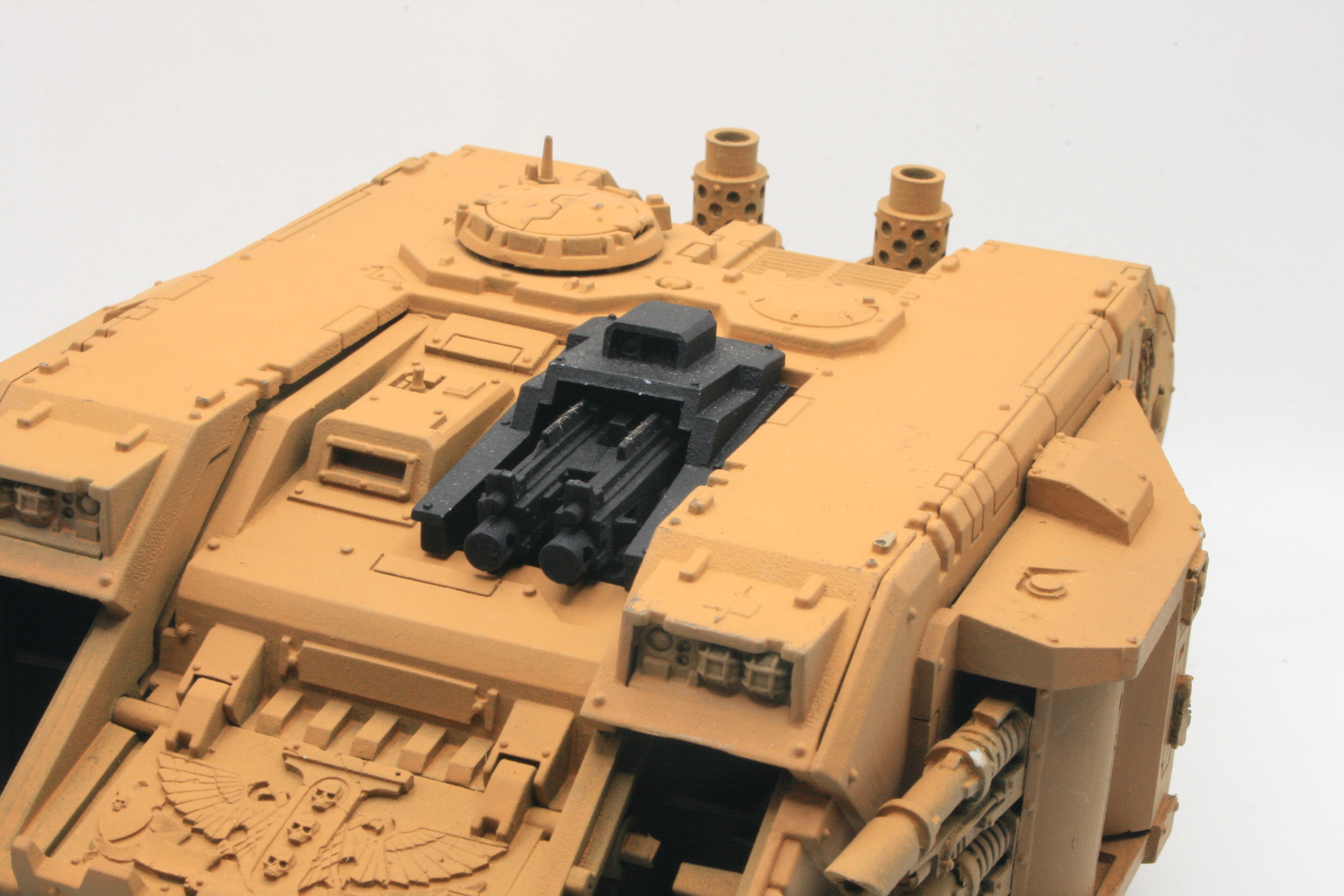


Found the missing part

The Land Raider is an Imperial main battle tank and troop transport which serves as the “armoured fist of the Space Marines.”The Land Raider’s heritage predates even the founding of the Imperium of Man, yet it remains the single most destructive weapon in the Adeptus Astartes’ arsenal. The Mark IIb Land Raider Phobos is one of the earliest marks of the standard pattern of Land Raider. The Mark IIb Land Raider Phobos is the only pattern of the standard Land Raider Phobos that uses the older armoured sponsons, as they do not allow the weapons they hold to fully rotate.

I got a Forge World MkIIB Land Raider and was originally painting it up as a Grey Knights Land Raider in desert camouflage.

I wrote up some reflections recently on my MkIIB Land Raider, on the current state of the painting and what I needed to do next.

I also noticed that there is a part missing the, the hull top front bolters. I will have to find where I put that piece.

Well I was pleased to find the missing parts and these have now been reunited with the Land Raider.

Forge World MkIIB Land Raider

Still got to decide what colour I will be painting the model.

See the full Mark IIb Land Raider workbench.

English Electric Lightning F.6

The English Electric Lightning is a British fighter aircraft that served as an interceptor during the 1960s, the 1970s and into the late 1980s. It remains the only UK-designed-and-built fighter capable of Mach 2.

The Lightning was designed, developed, and manufactured by English Electric, which was later absorbed by the newly-formed British Aircraft Corporation.

An English Electric Lightning Mk 1 was on display at Duxford.

Plastic Land Raider Proteus available to pre-order next week

Back in April I wrote after seeing the plastic Spartan Land Raider Assault Tank I did wonder if we would see a plastic Land Raider Proteus.

With the announcement of the plastic Spartan Land Raider Assault Tank it got me thinking, will we also a plastic Land Raider Proteus? It wouldn’t be too much of a step to have a plastic kit of this Land Raider? Essentially the Spartan is a stretched Land Raider.

After it was announced back in August, today we see that we are going to be able to pre-order the plastic Land Raider Proteus next week.

Land Raider Proteus

Before the Spartan Assault Tank there was one true king of armoured troop conveyance – the Land Raider. Many patterns of these lumbering tanks exist in Legion armouries, but none have the pedigree of the venerable Land Raider Proteus, which now returns to the Age of Darkness with a new plastic kit.

I do like this model and I am seriously considering getting one, depending on the price, to go with my Deimos-pattern Rhino.

So, now we are returning full circle to the original plastic Land Raider model which was released in 1988, well very close.

BAC Jet Provost T.5A

The BAC Jet Provost is a British jet trainer aircraft that was in use with the Royal Air Force (RAF) from 1955 to 1993. It was originally developed by Hunting Percival from the earlier piston engine-powered Percival Provost basic trainer, and later produced by the British Aircraft Corporation (BAC).

This BAC Jet Provost T.5A is on display at RAF London.

BAC Jet Provost T.5A

In addition to the multiple RAF orders, the Jet Provost, sometimes with light armament, was exported to many air forces worldwide. The design was also further developed into a more heavily armed ground attack variant under the name BAC Strikemaster.

There is also a BAC Jet Provost T.5A on display at RAF Cosford.

I need a new brush…

As I have been washing and shading some large models recently, such as the buildings I got in Warhammer Imperium and my Deimo-pattern Rhino I have realised that my mop brush is a little too small. I was finding that the wash or shade was getting patchy.

So I think I will go and get a bigger mop brush, not too big as it still has to fit into the pots of shade I have.

I will be using it on my Land Raiders, the Repressor, and the Munitorum Armoured Containers.

English Electric Canberra PR3

The English Electric Canberra is a British first-generation, jet-powered medium bomber. It was developed by English Electric during the mid to late 1940s in response to a 1944 Air Ministry requirement for a successor to the wartime de Havilland Mosquito fast bomber. Among the performance requirements for the type was an outstanding high-altitude bombing capability and high speed. These were partly accomplished by making use of newly developed jet-propulsion technology.

When the Canberra was introduced to service with the Royal Air Force (RAF), the type’s first operator, in May 1951, it became the service’s first jet-powered bomber.

In addition to being a tactical nuclear strike aircraft, the Canberra proved to be highly adaptable, serving in varied roles such as tactical bombing and photographic and electronic reconnaissance. Canberras served throughout the Cold War, in the Suez Crisis, Vietnam War, Falklands War, Indo-Pakistani wars, and numerous African conflicts. In several wars, each of the opposing sides had Canberras in its air force.

The Canberra served for more than 50 years with some operators. In June 2006, the RAF retired the last three of its Canberras 57 years after its first flight. 

Further work on my Grot Bomb Launcha

The Forgeworld Grot Bomb Launcha is probably one of my all time favourite models.  I have three of these, one is finished, the other two are a work in progress.

I found the chassis of one in of the boxes with my Land Raiders. Having painted the chassis with a spray of Citadel Zandri Dust, I used some other brown paints to paint the boxes on the chassis. I painted the exhausts and the rear deck with Leadbelcher. I then gave the model a wash using Citadel Shade Agrax Earthshade.

I then drybrushed the model with various shades of brown. I found the tracks. These had been undercoated black. I gave them a heavy drybrush of Gorthor Brown, followed by a lighter drybrush of Leadbelcher.

I also used Leadbelcher lightly on the motorcycle engine.

I had already painted the fuel tank.

More work to do.

Horus Heresy Predator available today

The new (plastic) model of the Predator is available today. This Predator is based on the Deimos Pattern Rhino.

Although not as fast as the Sicaran, the Predator is a reliable ‘everytank’ for the Legion on the go. Instead of a complicated custom chassis, it’s built on the shoulders of the Deimos Pattern Rhino, providing armies with a dependable armoured fighting vehicle that can be easily modified and repaired as necessary.

It was originally announced and previewed back in July.

I like the kit and retro yet modern look they have achieved with the kit. Well Forge World did do that ten years ago… This is of course a plastic version of that Forge World resin kit. The Forge World kit was of course inspired by the  original plastic Predator model which used the original Rhino model.

The kit comes with a range of weapon choices.

I might get one to add to my Rhino, but not today, as I promised myself I would finish the Rhino first (and it still needs some work).

Hawker P 1127 VSTOL Experimental Aircraft

This is the Hawker P.1127 VSTOL Experimental Aircraft, serial number XP831 (the first prototype), by Hawker Siddeley Aircraft Company Limited, British, 1960, on display at the Science Museum.

The Hawker P.1127 and the Hawker Siddeley Kestrel FGA.1 are the British experimental and development aircraft that led to the Hawker Siddeley Harrier, the first vertical and/or short take-off and landing (V/STOL) jet fighter-bomber.

Development began in 1957, taking advantage of the Bristol Engine Company’s choice to invest in the creation of the Pegasus vectored-thrust engine. Testing began in July 1960 and by the end of the year the aircraft had achieved both vertical take-off and horizontal flight. The test program also explored the possibility of use upon aircraft carriers, landing on HMS Ark Royal in 1963. The first three aircraft crashed during testing, one at the 1963 Paris Air Show.

Improvements to future development aircraft, such as swept wings and more powerful Pegasus engines, led to the development of the Kestrel. The Kestrel was evaluated by the Tri-partite Evaluation Squadron, made up of military pilots from the United Kingdom, the United States, and West Germany. Later flights were conducted by the U.S. military and NASA.

Related work on a supersonic aircraft, the Hawker Siddeley P.1154, was cancelled in 1965. As a result, the P.1127 (RAF), a variant more closely based on the Kestrel, was ordered into production that year, and named Harrier – the name originally intended for the P.1154 – in 1967. The Harrier served with the UK and several nations, often as a carrier-based aircraft.

P.1127 XP831 is on display at The Science Museum in London.