Returning to the Spanish Penisular War

I saw on the Twitter a link to a Radio 4 show, The Reunion, which brings together people from a common event or background. The most recent episode was about the Sharpe TV series.

It’s a great insight into the background of the making of the series, some of the challenges that the cast and crew faced.

It was a Napoleonic war drama to be shot in the Crimean Peninsula. But little did the producers know that they would be sending the cast and crew to film in a rapidly disintegrating Soviet Union.

Once in Crimea, the whole production faced near-starvation and danger around every corner as they set about creating one of Britain’s most successful and critically acclaimed 90s television programmes, Sharpe.

It was to go down in television folklore for its unique tales of mishaps and hardship. Renowned actor Paul McGann was originally cast to play the lead character, Sharpe. But only six weeks into filming he picked up a serious injury and had to pull out.

It left the production in chaos and saw one of the highest-ever insurance pay-outs for a television series.

Everyone packed up back to the UK with the future of the series left in suspense. That was until a relatively unknown actor called Sean Bean took on the part and the show was back on the road. The cast and crew headed back to Simferopol in Crimea (later to be nicknamed “simplyawful”) and filming resumed.

Sharpe became a six series hit across nearly 15 years, with viewing figures topping 10 million.

Our panel includes Sharpe’s author Bernard Cornwell, then-assistant producer Stuart Sutherland, one of the “chosen men” Jason Salkey who played one of Sean Bean’s right hand men, Michael Cochrane who played Colonel Sir Henry Simmerson across the entire series, and Diana Perez who played Ramona.

What I didn’t know, and was quite a surprise was that Paul McGann was originally cast as Sharpe. I thought I knew a lot about the series (I even have a book about the making of the series). However, I didn’t know that.

I do wonder how different the series would have been with Paul McGann in the lead role.

I really enjoyed the series when it was broadcast and though around thirty years old, is still great television. I also love the books as well.

It certainly has rekindled my interest in the subject matter, I re-watched an episode of Sharpe, thinking about re-reading the books, and looking back into my Flintloque collection and digging out my 25mm Napoleonic Rifles figures.

Finishing the construction

The Typhon is named for the ‘Great Beast’ of Terran myth, and lives up to its namesake in sheer brutal strength. Sharing a basic chassis with the Spartan Assault Tank, this heavy tank serves as a mobile gun-platform with enough power to operate a single massive piece of siege artillery – the dreadhammer cannon.

I’ve always liked the Forge World model and so was pleased to get one of the new plastic kits for my Imperial Fists force.

Having started constructing the model, I finished it off. Attaching the tracks to the hull was a lot easier than I thought it would be.

I have kept the tracks off, despite the instructions indicating they should be stuck on. These will be painted separately.

I still have to construct the sponson weapons, and I am still deciding which ones to attach to this beast.

The Typhon has four exhausts compared to the two on the Proteus Land Raider.

I decided to use the hull plates instead of the hull doors on the model.

I kept the dreadhammer siege cannon separate, and its accompanying armour shield. The instructions indicated that the weapon mounts should be stuck on once the weapon is in place. I decided that I would cheat slightly and affix the weapon mounts to the weapon.

These would then be painted Leadbelcher like the cannon.

This is how it is looking, a dry fit with the dreadhammer siege cannon in place.

The next stage will be a white undercoat.

See the workbench feature on the Typhon Heavy Siege Tank.

Mark V Tank

The British Mark V tank was an upgraded version of the Mark IV tank. It was first deployed in 1918, used in action during the closing months of World War I, and in the Allied intervention in the Russian Civil War on the White Russian side, and by the Red Army, after they were captured.

This Mark V Tank was in display at the Tank Museum in Bovington.

Mark V Tank

Although similar in appearance to earlier models the Mark V was a much better tank, more powerful and easier to drive. It was equipped with the new Ricardo six-cylinder engine and Wilson’s epicyclic steering system which meant that one man could handle all the controls, compared with four in the Mark IV.

Mark V Tank

Among the new features was a rear cab for the commander, complete with signalling apparatus and a rear machine-gun position. Our exhibit also carries an unditching beam, which was first introduced in the Mark IV. This would be used if the tank got stuck in mud – chained to the tracks it was drawn under the tank and gave it something solid to grip.

Mark V Tank

The Mark V is shown in the Markings of 8th (H) Battalion (No. H41), Tank Corps at the time of the Battle of Amiens (8 August 1918). Commanded by a young officer named Whittenbury this actual tank took part in the battle and its young commander was awarded the Military Cross.

More photographs of the Mark V at Bovington.

The last confirmed use of the Mk V in battle was by units of the Red Army during the defence of Tallinn against German forces in August 1941

In 1945, Allied troops came across two badly damaged Mk V tanks in Berlin. Photographic evidence indicates that these were survivors of the Russian Civil War and had previously been displayed as a monument in Smolensk, Russia, before being brought to Berlin after the German invasion of the Soviet Union in 1941.

Mark V Tank in Berlin 1945

Accounts of their active involvement in the Battle of Berlin have not been verified.

Mark V Tank in Berlin 1945

Source for Berlin Photographs.

Constructing the Typhon

The Typhon is named for the ‘Great Beast’ of Terran myth, and lives up to its namesake in sheer brutal strength. Sharing a basic chassis with the Spartan Assault Tank, this heavy tank serves as a mobile gun-platform with enough power to operate a single massive piece of siege artillery – the dreadhammer cannon. The Typhon was created to meet the demands of the Primarch Perturabo of the Iron Warriors, who sought a war engine that could rapidly deploy such fortress-breaking firepower to the battle line alongside his Legionaries. Though unsubtle in design, its overwhelming effectiveness is beyond question.

I’ve always liked the Forge World model and so was pleased to one of the new plastic kits for my Imperial Fists force.

The Typhon is an extended Land Raider, and as the model kit uses the core parts from the Proteus Land Raider, there are components within the kit which extends the sides, adds an extra wheel and track parts. There are also additional parts to widen the hull, as the Typhon is wider than the Proteus.

I can see why they did this, but it does make the construction of the kit more complicated then I think it needs to be. I think it would have been better to create completely new sprues with the bigger parts needed, rather than additional parts to widen the existing sprues. I think it potentially makes it a weaker model as a result. 

I remember when we first saw the Spartan (and the Typhon is basically a Spartan with a big gun) and I said when they announced  the plastic Spartan.

With the announcement of the plastic Spartan Land Raider Assault Tank it got me thinking, will we also a plastic Land Raider Proteus? It wouldn’t be too much of a step to have a plastic kit of this Land Raider? Essentially the Spartan is a stretched Land Raider.

What I didn’t realise (as I didn’t buy the Spartan at the time) was that literally what Games Workshop had done was create a kit which was a stretched extension kit for a kit they hadn’t released yet.

The Proteus Land Raider is the core of both the Spartan, the Typhon and (obviously) the Proteus. The Typhon comes with some additional sprues, which provides new side parts and the big gun. 

This was not quite the simple construction kit that it could have been. 

The first stage is to construct the track units, which have a fair few parts to them.

I did have one problem in that the polystyrene cement I was using wasn’t very effective. It was a replacement for a nearly empty bottle of my usual Humbrol polystyrene cement. I had constructed the track units, and then they fell apart on me. So I then re-glued the units with the Humbrol polystyrene cement which did work.

The internal hull components went together well, but I did think that they were difficult to stick (and keep) together.

The main weaponry, the dreadhammer siege cannon went together really easily.

Next step will be bringing all the parts together.

See the workbench feature on the Typhon Heavy Siege Tank.

de Havilland Tiger Moth

This de Havilland Tiger Moth was on display at RAF Cosford.

de Havilland Tiger Moth

The de Havilland DH.82 Tiger Moth is a 1930s British biplane designed and built by the de Havilland Aircraft Company.

de Havilland Tiger Moth

It was operated by the Royal Air Force (RAF) and other operators as a primary trainer aircraft.

In addition to the type’s principal use for initial training, the Second World War had RAF Tiger Moths operating in other capacities, including maritime surveillance and defensive anti-invasion preparations; some aircraft were even outfitted to function as armed light bombers.

It was in this capacity as a light bomber, I wrote a post about how the de Havilland Tiger Moth may have been used to fight German forces during Operation Sealion in what the British forces called Operation Banquet.

Operation Banquet was a British Second World War plan to use every available aircraft against the planned German invasion in 1940, the German code name was Operation Sealion.

More photographs of the de Havilland Tiger Moth at RAF Cosford.


Reinforcements have arrived

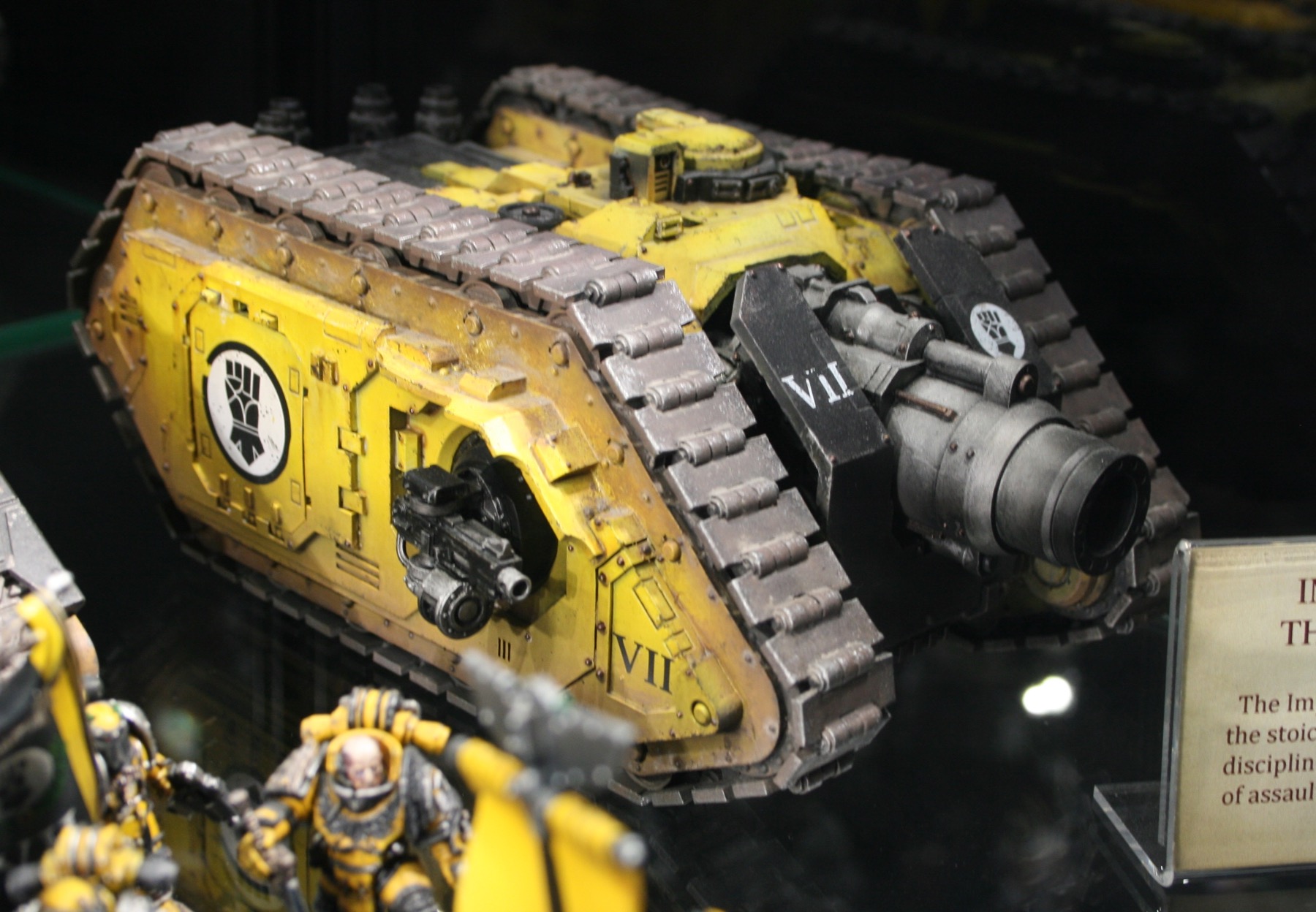
My latest model to hit the workbench is the Typhon Heavy Siege Tank.

Named for the ‘Great Beast’ of Ancient Terran myth, the immense Typhon Heavy Siege Tank was developed by the Mechanicum alongside the Spartan, with which it shares a basic chassis design. The Typhon’s primary armament is the massive Dreadhammer cannon, and was created in response to a request from the Primarch Peturabo, master of the Iron Warriors. He demanded a Legiones Astartes war engine that could rival the great batteries of the Imperial Crusade Army in firepower, but manoeuvre and deploy at the speed of a Space Marine force.

I’ve always liked the Forge World model and I took a photograph of this Imperial Fists painted model at Warhammer World on a visit a few years ago.

Typhon Heavy Siege Tank
Imperial Fists Typhon Heavy Siege Tank at Warhammer World

There are some great Horus Heresy models available and I am pleased to add this one to my collection.

I will be painting them the same way I painted my other Horus Hersey models.

Mark IX Tank

The Mark IX tank was a British armoured fighting vehicle from the First World War. It was the world’s first specialised armoured personnel carrier (APC).

During the first actions with tanks, it became clear that infantry often could not keep up with the tanks, It wasn’t that the soldiers were too slow, the early tanks themselves could only move at a walking pace, but because soldiers on foot remained vulnerable to enemy machine gun fire. In many actions, positions gained at great cost were immediately lost for lack of infantry to consolidate.

At the end of the Great War only three had been finished, out of a total ultimate production run of thirty-four, following an order for two hundred.

If there had been, as I discussed in an earlier blog post, an alternate timeline in which there was a revolution in Great Britain in 1919.

In Great Britain the government feared a bolshevik uprising and was quick to oppress any potential threat to the established order. One of the biggest areas for concern were the labour movements and trade unions. One strike in Glasgow in 1919 eventually resulted in a street battle between strikers and police, which was so bad, the army was called in. The “Battle of George Square”, also known as “Bloody Friday” and “Black Friday”, was one of the most intense riots in the history of Glasgow; it took place on Friday, 31 January 1919. Clashes between the City of Glasgow Police and protesters broke out, prompting the War Cabinet to make soldiers available to the civil power, to prevent the violence from escalating.

In another blog post I looked at other incidents that could have led to revolution.

On the August Bank Holiday that year, the government in London despatched warships to the northern city of Liverpool in an overwhelming show of force. Thousands of troops, backed by tanks, had been trying without success to suppress disorder on the streets.

If there has been such a conflict the Mark IX Tank, or APC I suspect would have been widely used to move troops around, and to protect them from attack

These metal monsters designed in an era when they didn’t really know what they were doing and there was a lot of trial and error. The Mark IX reminds us that the APC is as old as the tank.

More photographs of the Mark IX Tank.

Drybrushing the Deimos Pattern Rhino

The Rhino is the most widely used armoured personnel carrier in the Imperium. Based on ancient STC technology, the fundamental design is robust, reliable, and easy to maintain, with an adaptive power plant that can run off a wide variety of fuels.

I bought the plastic Deimos Pattern Rhino when it came out in the summer, you can see the workbench for that Rhino here.  I was lucky enough to get a second Rhino for a Christmas present. The model has many more parts and is a more detailed kit than the original plastic Rhino kit that came out in the 1980s. I constructed the model to the instructions, though I left the tracks off to paint separately. I gave the model an undercoat of Citadel White Scar. I gave the model a couple of light coats of Daemonic Yellow. I also painted the bolter and exhausts with Leadbelcher. I then shaded the model. For the next stage I used some Citadel Layer Yriel Yellow. I took a large brush and gave the model, what I would call, a heavy drybrush.

I then added some more Citadel Layer Yriel Yellow to the model.

I then gave the model a lighter drybrush of Citadel Layer Dorn Yellow.

See the workbench feature on the Deimos Pattern Rhino II.

Bristol Blenheim IV

The Bristol Blenheim is a British light bomber aircraft designed and built by the Bristol Aeroplane Company (Bristol) which was used extensively in the first two years of the Second World War, with examples still being used as trainers until the end of the war. It’s first flight was in 1935 and entered service with the RAF in 1937.

This Bristol Blenheim IV was on display at RAF Cosford.

As the Allied Ground and Air Forces faced defeat in May 1940 the RAF had to use its light bomber force in desperate daylight raids against German army bridgeheads in France and the Low Countries. The Blenheim Mk IVs and Fairey Battles used in these attacks suffered crippling losses. In fact no higher loss, in operations of a similar size, has ever been suffered by the Royal Air Force.

The Blenheim Mk IV, with its redesigned and longer nose, superseded the Blenheim I on the production lines in 1938.

The original short nose Blenheim Mk I had been developed from a civil aircraft and was one of the first new high performance monoplanes ordered under RAF Expansion Plans.

After the fighting in France was over Coastal and Bomber Command Blenheim Ivs began day and night attacks against German occupied ports and installations in frantic attempts to disrupt their invasion plans.

Blenheim IVs also served in North Africa and the Far East.