Missing in Action

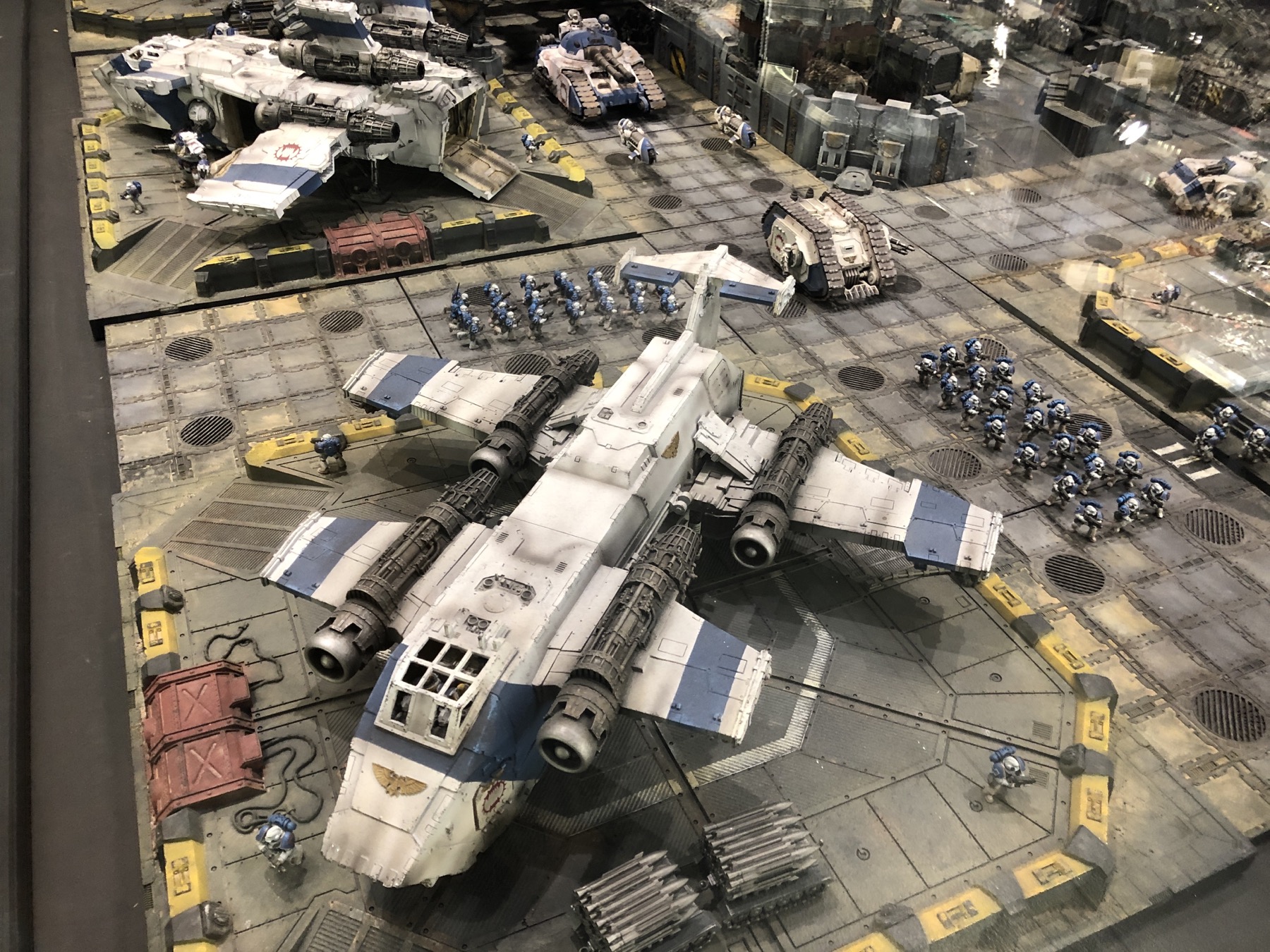
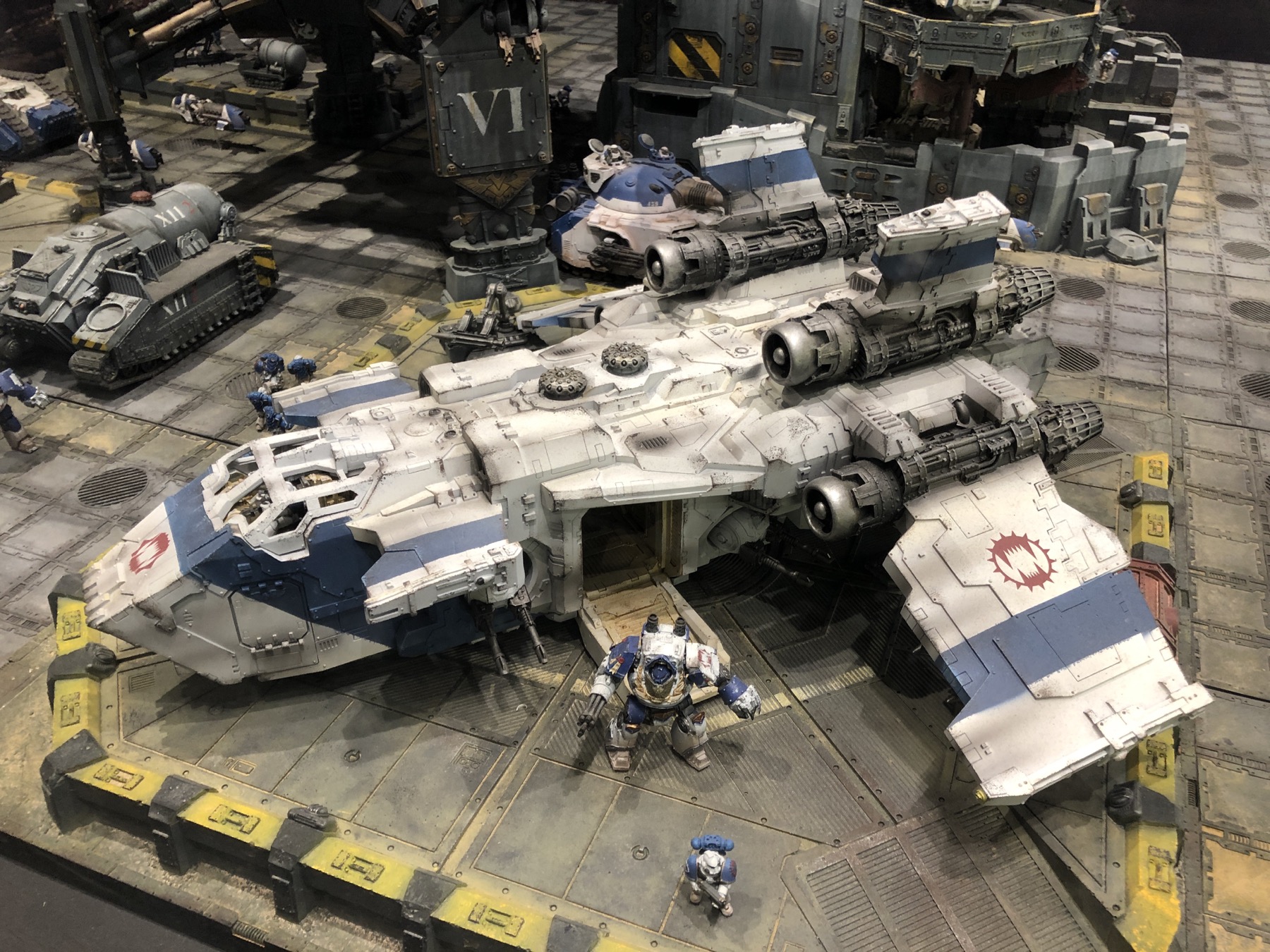
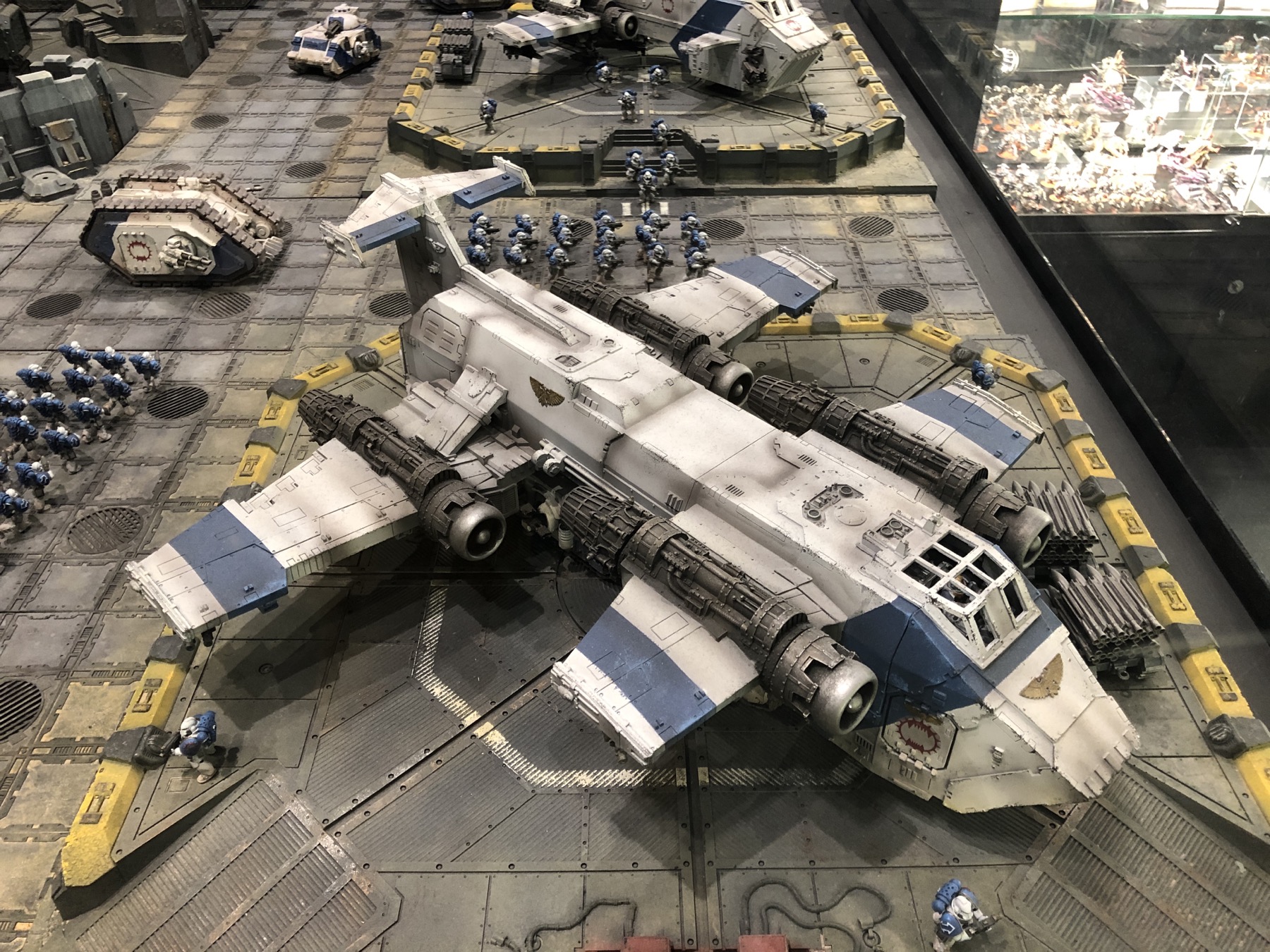
On my most recent visit to Warhammer World I noticed that the airfield, airport or Space Marine spaceport was no longer part of the exhibition.

This massive diorama was filled with Forge World Space Marine aircraft and other models.

Back then I did take some photographs of the diorama.

Fellblade Super Heavy Tank
Sokar pattern Stormbird.
Thunderhawk Transport

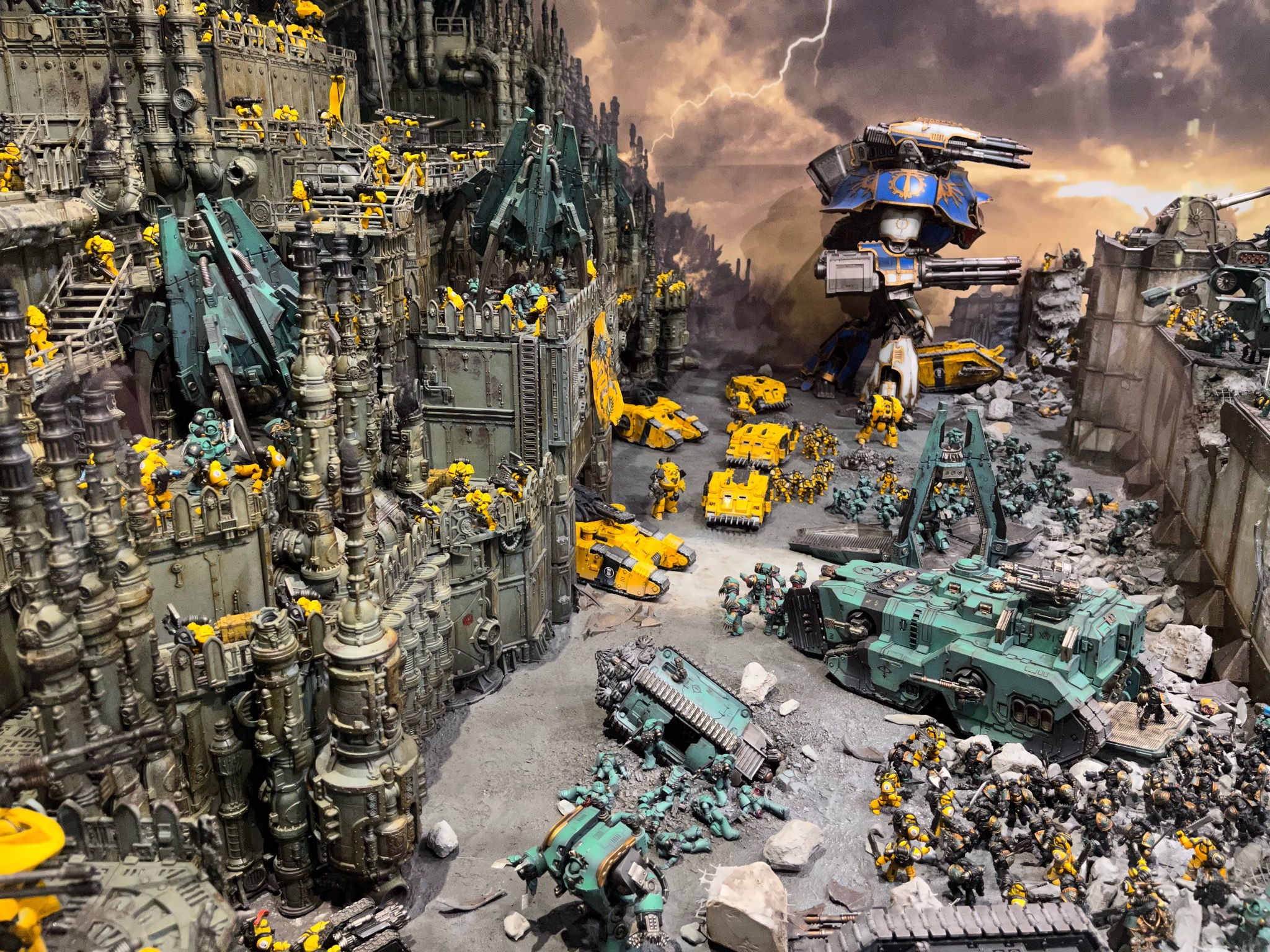
Though not entirely sure, I think the space now contains a Space Marine battle between the Imperial Fists and the Sons of Horus.

Painting the Typhon Yellow

My latest model for my Imperial Fists Horus Heresy force is the Typhon Heavy Siege Tank.

The Typhon Heavy Siege Tank was released as a plastic kit for The Horus Heresy. I’ve always liked the Forge World resin model and so was pleased to get one of the new plastic kits for my Imperial Fists force.

Having started constructing the model, I finished putting it together. The next stage was a white undercoat. I then gave the model a partial base coat of Army Painter Desert Yellow.

I then gave the model a base coat of Army Painter Daemonic Yellow.

I also gave the main weapon shield the same basecoat of Army Painter Daemonic Yellow.

This is the Typhon with the dreadnought siege weapon.

See the workbench feature on the Typhon Heavy Siege Tank.

V2 Ballistic Missile

The V2 was the world’s first long range guided ballistic missile. he missile, powered by a liquid-propellant rocket engine, was developed during the Second World War in Germany as a “vengeance weapon”, assigned to attack Allied cities as retaliation for the Allied bombings against German cities.

This V2 missile was on display at RAF Cosford.

It is one of several rockets prepared by the British with support from German troops during Operation Backfire. It so happened that this rocket was not launched during the Backfire tests. Operation Backfire was a military scientific operation during and after the Second World War that was performed mainly by British staff. The operation was designed to completely evaluate the entire V-2 rocket assembly, interrogate German personnel specialised in all phases of it and then to test and launch missiles across the North Sea.

More photographs of the V2 at RAF Cosford.

Underneath the Typhon

My latest model for my Imperial Fists Horus Heresy force is the Typhon Heavy Siege Tank.

The Typhon Heavy Siege Tank was released as a plastic kit for The Horus Heresy. I’ve always liked the Forge World resin model and so was pleased to get one of the new plastic kits for my Imperial Fists force.

Having started constructing the model, I finished putting it together. The next stage was a white undercoat.

I had planned to base coat the underneath of the model with with Citadel Zandri Dust in preparation for painting the the whole model yellow. However when visiting my FLGS, they had sold out of Zandri Dust spray. So I bought some Army Painter Desert Yellow Spray, along with can of Army Painter Daemonic Yellow.

I sprayed the model first with Desert Yellow spray.

This is designed to add shadow.

As well as the underneath of the model, I also sprayed the wheels and suspension.

I base coated the dreadnought siege weapon with Citadel Leadbelcher.

For the tracks, still on the sprue, I gave them a spray of Citadel Mechanicus Standard Grey.

See the workbench feature on the Typhon Heavy Siege Tank.

Mark V** Female Tank

When the Germans realised what a threat tanks could be they made their trenches wider to trap them; one answer to this was to build longer tanks and the Mark V was stretched by six feet to create the Mark V*. As an interim solution this was adequate but a further improved version, the Mark V** was designed for 1919.

This Mark V** Female Tank was on display at the Bovington Tank Museum.

The “Female” tank was a variation of the British heavy tank deployed during the First World War. It carried multiple machine guns instead of the mix of machine guns and cannons mounted on the “male” tank.

More photographs of the Mark V** Female Tank.

Typhon Sponson Weapons

My latest model for my Imperial Fists Horus Heresy force is the Typhon Heavy Siege Tank.

The Typhon Heavy Siege Tank was released as a plastic kit for The Horus Heresy. I’ve always liked the Forge World resin model and so was pleased to get one of the new plastic kits for my Imperial Fists force.

Having started constructing the model, I finished putting it together. The next stage was a white undercoat.

I realised I had forgotten to construct the sponson weapons, so I quickly put them together. There is quite a choice, I decided I would go with the lascannons.

See the workbench feature on the Typhon Heavy Siege Tank.

Junkers Ju88R-1

The Ju88 was the most versatile German combat aircraft in World War Two. It began life as a bomber, became a night fighter and intruder; undertook anti-shipping operations and flew long-range reconnaissance missions. It is one of the truly great multi-role combat aircraft.

This Ju88R-1 was a C-series night fighter with BMW 801 engines and was on display at RAF Cosford.

Junkers Ju88R-1

Deliveries of the first production aircraft took place in September 1939 and on the 26th it undertook its first operational mission against British shipping in the Firth of Forth. It was not until the Battle of Britain, however, that the Ju88A played a major role in German operations. At the time of the Battle of Britain the Ju88 was at the beginning of its service career and its remarkable adaptability, particularly as a night fighter, had still to be exploited by the Luftwaffe.

Junkers Ju88R-1

This aircraft is thought to have been built in mid–1942 as a model A bomber, before being converted to a model R–1 fighter in early 1943. It was flown to Scotland by its defecting crew in May 1943; two of the three crew on board (who may have been British agents) had taken the decision to defect after being ordered to shoot down a civilian BOAC Mosquito courier flight from Sweden to the UK.

Junkers Ju88R-1

The surrender of this aircraft was of great intelligence value at the time, as it was fitted with the latest UHF-band FuG 202 Liechtenstein BC A.I radar. The Ju 88R-1 was operated by the RAF’s No. 1426 (Enemy Aircraft) Flight and evaluated in depth by various British groups.

Junkers Ju88R-1

More photographs of the Junkers Ju88R-1.

Undercoating the Typhon

My latest model for my Imperial Fists Horus Heresy force is the Typhon Heavy Siege Tank.

The Typhon Heavy Siege Tank was released as a plastic kit for The Horus Heresy. I’ve always liked the Forge World resin model and so was pleased to get one of the new plastic kits for my Imperial Fists force.

Having started constructing the model, I finished putting it together.

The next stage was a white undercoat.

The main weapon was kept separate. So the hull actually is in this stage. It has a big hole in it.

The main dreadhammer siege cannon was kept separated as was the weapon armour shield, both were also undercoated.

The tracks I kept on the sprue for painting.

The next step will be a brown basecoat for the underneath of the model.

See the workbench feature on the Typhon Heavy Siege Tank.

Mark VIII “The International” Tank

This Mark VIII “The International” Tank was on display at Bovington Tank Museum. It is the last remaining survivor of the six Mark VIII tanks which were completed for Britain.

When the United States declared war on Germany in 1917 the US Army started to look at tanks. They favoured the American Renault as their light tank but used British Mark V and Mark V* tanks for their heavy battalion. However they had their own ideas on tank design and, in co-operation with the British Tank Corps came up with a new heavy tank design for 1919.

Mark VIII “The International” Tank

The Mark VIII tank also known as the Liberty or The International was an Anglo-American tank design of the First World War intended to overcome the limitations of the earlier British designs and be a collaborative effort to equip France, the UK and the US with a single heavy tank design.

Production at a site in France was expected to take advantage of US industrial capacity to produce the automotive elements, with the UK producing the armoured hulls and armament. The planned production levels would have equipped the Allied armies with a very large tank force that would have broken through the German defensive positions in the planned offensive for 1919. In practice manufacture was slow and only a few vehicles were produced before the end of the war in November 1918.

More photographs of the Mark VIII “International” Tank.

Many people have thought that the tank used in the Indiana Jones and the Last Crusade film was a Mark VIII. However that tank was specially created for the film, inspired though somewhat by the Mark VIII.

Tank from Indiana Jones and the Last Crusade

Mechanical effects supervisor George Gibbs said this movie was the most difficult one of his career. He visited a museum to negotiate renting a small French World War I tank, but decided he wanted to make one. The tank was based on the tank Mark VIII, which was thirty-six feet (eleven meters) long, and weighed twenty-five tons. Gibbs built the tank over the framework of a twenty-five ton excavator, and added 6.4 ton tracks, that were driven by two automatic hydraulic pumps, each connected to a Range Rover V8 engine. Gibbs built the tank from steel, rather than aluminum or fiberglass, because it would allow the realistically suspensionless vehicle to endure the rocky surfaces. Unlike its historical counterpart, which had only the two side guns, the tank had a turret gun added as well. It took four months to build, and was transported to Almería on a Short Belfast plane, and then a low loader truck.

There is a (similar) 28mm resin kit of this tank, called the Mark IX Beast. I did buy one from Empress Miniatures and even managed to build it and paint it.

Mark IX Beast

From Crimea with Love: Misadventures in the Making of Sharpe’s Rifles

After rediscovering Sharpe, I also saw that Jason Salkey, who played Private Harris has written a book about his experiences in making the series: From Crimea with Love: Misadventures in the Making of Sharpe’s Rifles.

In the summer of 1992, Jason Salkey was cast in a role that would change his life forever. Sharpe’s Rifles, a Napoleonic war drama, was to be shot in the Crimean Peninsula. Little did the producers know that they would be sending Jason and the crew to film in a rapidly disintegrating Soviet Union. There they faced near-starvation and danger round every corner as they set about creating one of Britain’s most successful and critically acclaimed television programmes.

From Crimea with Love documents the mishaps, blunders, incompetence and downright corruption that made Sharpe’s Rifles go down in British television folklore for its unique tales of hardship. Follow the cast through intense depravation and constant catastrophe until they become every bit the jaded, battle-hardened soldiers we saw on screen. Tapping into his diaries, photo journals and video log, Jason brings you an eye-opening, jaw-dropping insider’s account of one of the best-loved shows ever made.

I once met Jason at Salute, when it was at Kensington Town Hall.