An alternate SR-N1 Hovercraft

Back in January I wrote a piece about an idea I had for an alternate Desert Storm set in 1959.

The re-release of the Fairey Rotodyne reminded me of an idea I had for an alternative history background for gaming. The basic premise was a Desert Storm background but with 1950s tanks, aircraft, helicopters and VTOL craft like the Fairey Rotodyne.

My premise was that the British armed forced faced with a new threat would make use of aircraft such as the  Fairey Rotodyne.

I was reminded of this article following the announcement from Airfix that they are going to re-release their 1/72nd scale model of the SR-N1 Hovercraft.

Debuted in 1960, it hasn’t been seen in the range since the 1980s. 

SR-N1 Hovercraft

The SR-N1 was the first practical hovercraft and demonstrated the potential of air-cushioned transport.

On 11 June 1959, the SR.N1 performed its first flight in front of the public. The SR.N1 participated in the test programme for four years prior to its retirement, by which point it had served its purpose in successfully validating the concept and further hovercraft had been developed.

Now I actually remember building the Airfix kit, but I painted it up as a military version. I think it was all over black to be used by special forces.

Airfix on their site talk about the military application of the SR-N1.

The SR-N1 Hovercraft is an experimental machine with space for the pilot and his observer, although on demonstration it has carried 20 fully equipped soldiers. 

If I was to go down the Desert Storm 1959 idea, then I think I would get some SR-N1 hovercraft (well at least one) and build it as a troop carrier, or an armed version.

Tiny Drop Pods

Over on the Warhammer Community website we have seen a preview of some Drop Pods for Legion Imperialis.

Drop Pods for Legion Imperialis

The Legiones Astartes utilise a number of methods of deployment into hostile war zones – but none are more iconic than the Drop Pod assault. Each pod is a self-contained orbital descent capsule, launched from a spacecraft and searing through a planet’s atmosphere before retro jets fire to slow its descent just enough not to be obliterated upon impact with the surface. Upon landing, a deadly cargo of Space Marines charges directly into the heart of battle.

Though not entirely clear from the article, I think these are in fact plastic models.

There is also the intriguing final comment…

They’ll be available – much like Legions Imperialis itself – sooner than you think!

Typhon Heavy Siege Tank

This Typhon Heavy Siege Tank was on display at Warhammer World in the Battle of Signus Prime diorama.

Typhon Heavy Siege Tank

Named for the ‘Great Beast’ of Ancient Terran myth, the immense Typhon Heavy Siege Tank was developed by the Mechanicum alongside the Spartan, with which it shares a basic chassis design.

This is the Forge World resin version of the Typhon Heavy Siege Tank which was released and available before the current Horus Heresy plastic kit.

I really like this model and I think it is one of the better Land Raider variant designs.

I have the plastic kit version of the Typhon Heavy Siege Tank on my workbench.

Typhon Heavy Siege Tank Miniatures Gallery.

Epic Ork Great Gargant

I got this metal Epic Great Ork Gargant model when Space Marine came out in 1989. I have recently rescanned the original photograph.

It was an all metal kit, with the main body comprising three parts, with then  parts for the weapons (arms), feet, belly weapon and gunhead.

I really like this model and only really got it on the gaming table with Epic 40000. I know most Epic players don’t like Epic 40000, but it is my personal favourite of all the Epic games produced by Games Workshop.

I know there was a resin hybrid metal kit of this gargant, which didn’t get a wide retail release. This was a much easier kit to put together (and wasn’t as heavy, which I am not sure is a good or a bad thing.

I was disappointed with the metal Epic 4000o Ork Gargant, it never was as good as this one. It was also surprisingly more challenging to put together.

Of course with the focus on the Horus Heresy, we’re not going to see a Legion Imperialis version of the Ork Great Gargant. I would really like to see a modern version of this model. We know Forge World in the past may have produced something like this, though they never did for Epic, they have done retro versions of the Space Marine Land Raider and Rhino.

Type 95 Ha-Go light tank

The Type 95 Ha-Gō was a light tank used by the Empire of Japan during the Second Sino-Japanese War, at Nomonhan against the Soviet Union, and in the Second World War. It proved sufficient against infantry but, like other light tanks, was not designed to combat other tanks.

This one was on display at Bovington.

The French Fourth Republic used leftover Japanese military equipment from the Japanese invasion of French Indochina. An ad-hoc unit of French and Japanese armour including the Type 95 Ha-Go light tank called the ‘Commando Blindé du Cambodge’ was created and this unit participated in the early stages of the First Indochina War

BMP-1

The BMP-1 is a Soviet amphibious tracked infantry fighting vehicle. This one was on display in the Cold War Exhibition at RAF Cosford.

The BMP-1 was the first mass-produced infantry fighting vehicle (IFV) of the Soviet Union. The Russian BMP-1 went into production in the early 1960’s and marked an important departure from previous armoured personnel carriers. Not just an infantry carrier, it provided a measure of combat capability with the vehicle. Its high mobility, effective anti-tank weapons combined with its armoured protection made it a significant addition to Soviet battlefield forces.

This is a Czechoslovak licence produced variant.

There was an ex-Iraqi model on display at Duxford.

More photographs of the Cosford BMP-1.

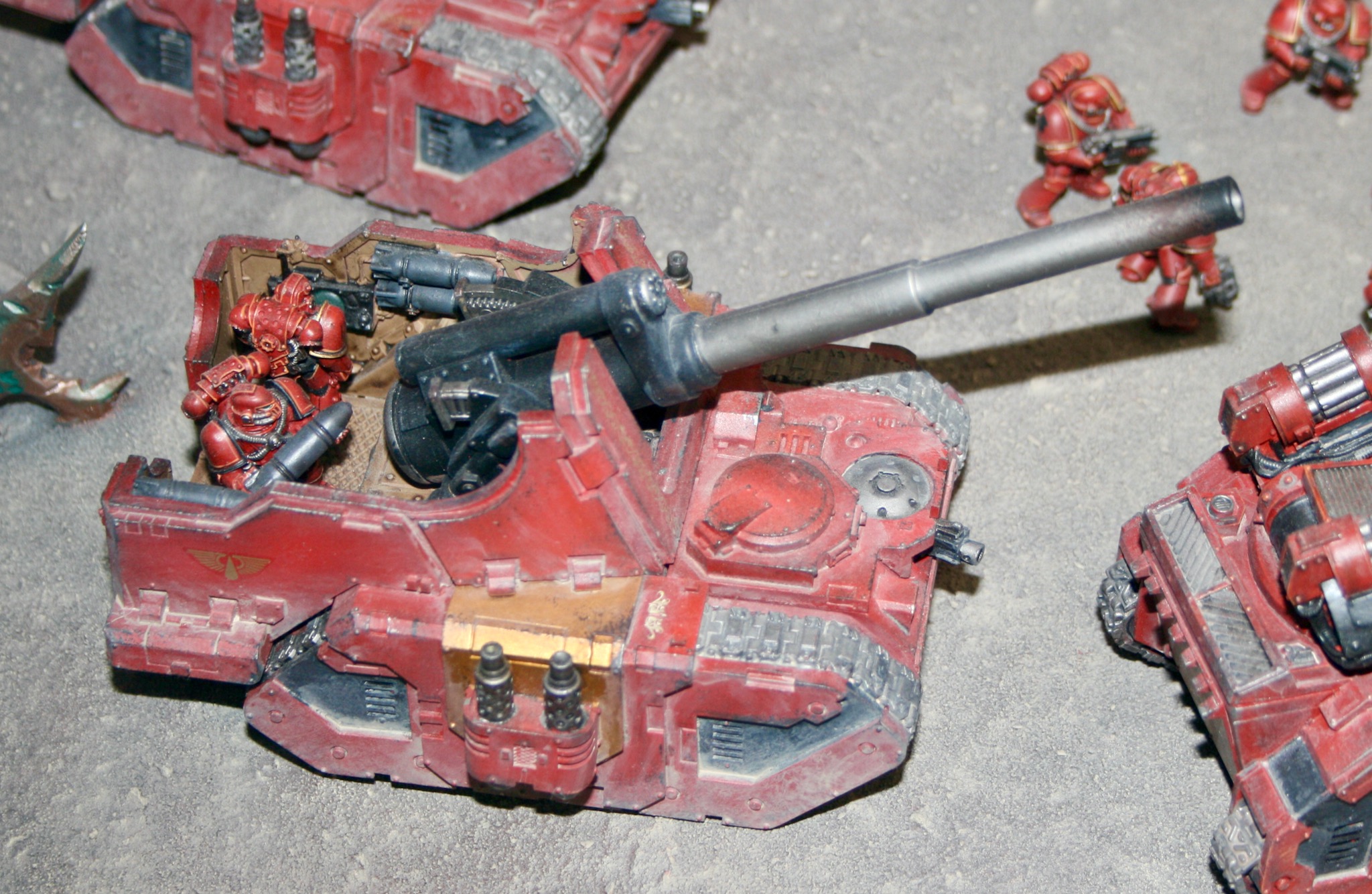
Legion Basilisk

This Legion Basilisk was at Warhammer World in the Battle of Signus Prime diorama.

Legion Basilisk

The Legion Basilisk was a common variant of the standard Imperial Army Basilisk Self-Propelled Artillery Tank that was used by the Space Marine Legions during the Great Crusade and Horus Heresy eras of the late 30th and early 31st Millennia.

The long-range Basilisk, Medusa Siege Tank, and the Deimos Whirlwind were some of the most common artillery units deployed by the Legiones Astartes.

In the late 41st Millennium the various Chapters of the Adeptus Astartes no longer make use of long-range artillery tanks, instead using the Whirlwind Multiple Missile Tank almost exclusively as their ranged artillery support.

Cruiser Tank Mk IIA CS (A10)

The Tank, Cruiser, Mk II (A10), was a cruiser tank developed alongside the A9 cruiser tank, and was intended to be a heavier, infantry tank version of that type. In practice, it was not deemed suitable for the infantry tank role and was classified as a “heavy cruiser”.

Cruiser Tank Mk IIA CS (A10)

This A10 Close Support version was on display at the Tank Museum in Bovington. Rear view of the tank.

Cruiser Tank Mk IIA CS (A10)

Another post on the A10 from a previous visit to Bovington.