Imperial Guard Regimental Advisors

I have been revising and editing a fair few pages of my blog after changing hosts, as well as converting the gallery and workbench pages to the blog.

One of the blog posts I edited was this one on the Imperial Guard Regimental Advisers from May 2009

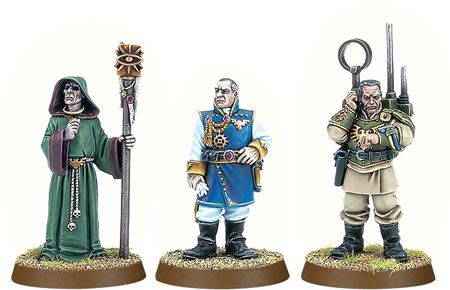
Officer of the Fleet

There are some really nice Imperial Guard releases in May from Games Workshop. As well as the nice plastic Valkyrie, one other release is looking like a possible purchase, the Imperial Guard Regimental Advisors.

The commander of an Imperial Guard army is assisted by a host of orderlies, adjutants, aides de camps and specialist advisors from outside the regiment who are able to liaise with other elements of the battle group.

This blister contains three metal Imperial Guard Advisors, including: an Officer of the Fleet, a Master of Ordinance and an Astropath.

I am thinking they might make good characters for the Warhammer 40K role-playing game or as part of an Inquisitorial retinue.

Ah as I read the blog post I thought those are really nice miniatures, I doubt they are available now, or they will got for a pretty penny on eBay. As with a lot of legacy classic models I park that idea and move on.

So I was pleasantly surprised when looking through a box of unpainted models to find I had in fact bought the Imperial Guard Regimental Advisers blister and had all three models.

Well pleased.

Tallarn Stormlord

Tallarn Stormlord from Warhammer World

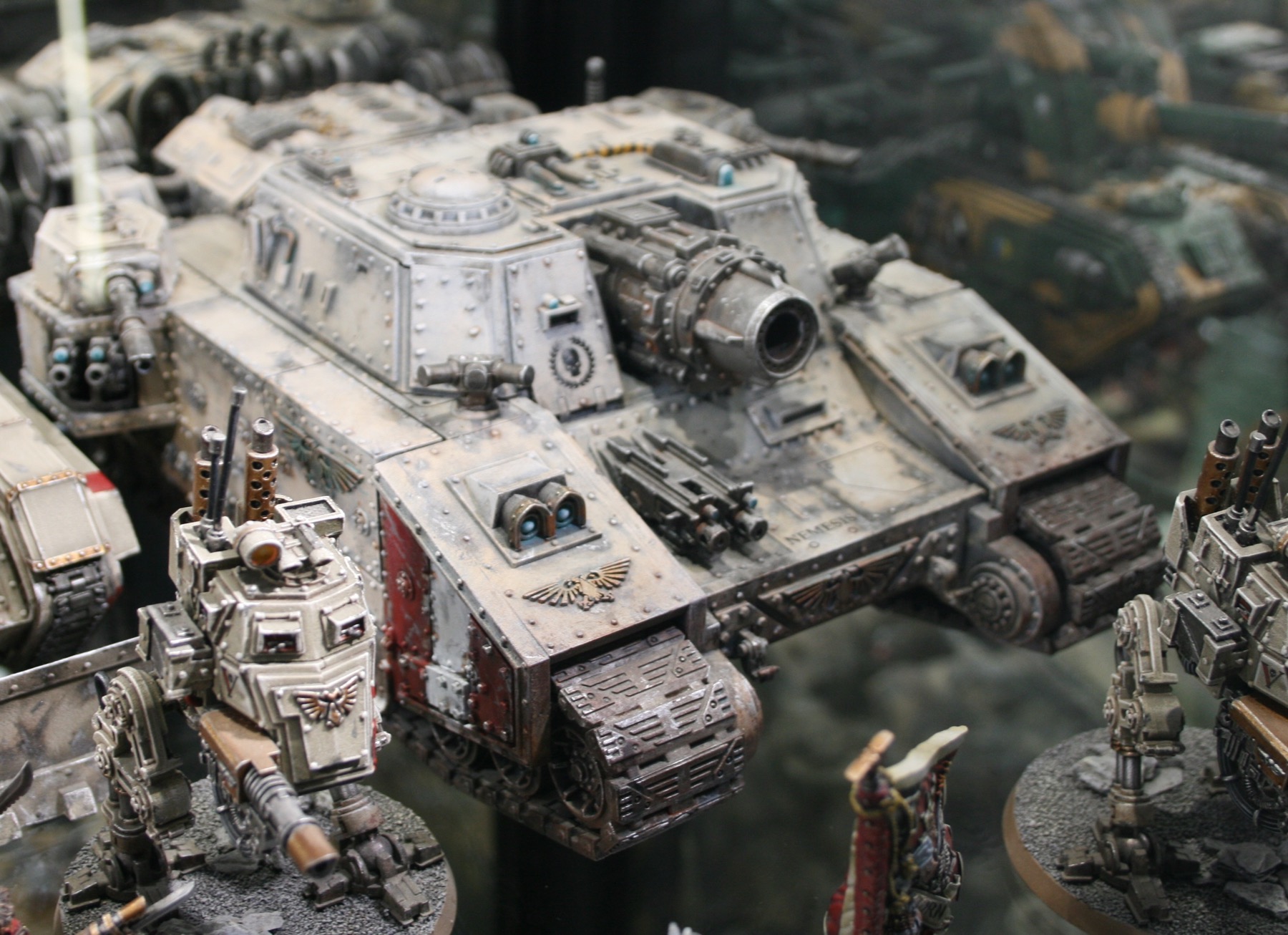
The Stormlord is a super-heavy main battle tank and variant of the Shadowsword tank-hunter and Titan-killer tank used by the forces of the Astra Militarum. The Stormlord replaces the Volcano Cannon of the Shadowsword with a Vulcan Mega Bolter. By removing the large capacitors and generators required for the Volcano Cannon to operate, extra space has been opened up near the rear of the vehicle which allows the Stormlord to carry up to 40 infantrymen as an open-topped armoured transport.

Leman Russ Vanquisher

The Leman Russ Vanquisher is a variant of the Astra Militarum’s primary main battle tank, the Leman Russ.

Leman Russ Vanquisher
Leman Russ Vanquisher at Warhammer World

The Leman Russ Vanquisher variant differs from the standard pattern Leman Russ in that its main weapon is a Vanquisher Cannon, as opposed to the Battle Cannon. The Leman Russ Vanquisher is a much rarer and more advanced variant of the standard Leman Russ as the long-barrelled Vanquisher Cannon mounted on the Leman Russ Vanquisher is capable of firing powerful anti-tank shells. In addition, there is a Storm Bolter mounted co-axially to the main cannon.

Leman Russ Vanquisher Gallery

Kettenkrad

The Kettenkrad SdKfz 2 started its life as a light tractor for airborne troops. The vehicle was designed to be delivered by Junkers Ju 52 aircraft, though not by parachute. The vehicle had the advantage of being the only gun tractor small enough to fit inside the hold of the Ju 52, and was the lightest mass-produced German military vehicle to use the complex Schachtellaufwerk overlapped and interleaved road wheels used on almost all German military half-tracked vehicles of World War II.

This Kettenkrad is on display at the Bovington Tank Museum.

Kettenkrad SdKfz 2

Banehammer at Warhammer World

The Banehammer is a super-heavy vehicle used by the Imperium, a close cousin to the venerable Shadowsword and Baneblade.

Banehammer
Banehammer at Warhammer World

It is unknown when the Banehammer was first created but it has had much use, especially during the recent Tyrannic Wars. The vehicle is primarily used by Imperial Guard commanders to halt massed enemy advances.

The Banehammer replaces the Baneblade’s Battle Cannon with a Tremor Cannon, which launches projectiles which bury themselves and detonate only after traveling some distance. On detonation, the shell releases a huge shock wave, liquefying the nearby ground and forcing enemy infantry and vehicles to literally crawl their way through or risk the consequences.

I initially confused this Banehammer with the Doomhammer. The Doomhammer is a similar Super Heavy Tank which was created from the necessity for Titan-killing vehicles during the thousand-year-long siege of Ordana. During the siege, many commanders requested Shadowswords to combat the large number of heavy armour in the form of Titans and tanks from a renegade forge world. The only way the Imperium could maintain the war effort was to retrofit their Banehammers with magma cannons.

Vostroyan Imperial Guard Tanks

The Vostroyan Firstborn is the name given to the Militarum Regimentum of the Astra Militarum that originates from the industrial Hive World of Vostroya located near the Halo Stars in the Segmentum Obscurus. The Vostroyan regiments have served the Emperor for countless centuries, though in truth they fight to absolve themselves of a terrible shame incurred by their ancestors over ten millennia ago when, during the dark days of the Horus Heresy, Vostroya failed in its duty to the Emperor of Mankind.

These Chimera and Leman Russ models were on display at Warhammer World.

Imperial Guard Armoured Steel Legion Sentinel

The Sentinel is a one-man, all-terrain, lightweight, bipedal combat walker that is used by the various regiments of the Astra Militarum. The Sentinel is most favoured when Imperial Guard patrols must move across rough terrain that would completely immobilise heavier vehicles. Sentinels achieve a perfect balance of robustness and mobility, able to negotiate terrain that would immobilise heavier battle tanks and armoured vehicles whilst still able to face down fire that would shred ranks of infantry.

Vostroyan Imperial Guard Tanks

The Vostroyan Firstborn is the name given to the Militarum Regimentum of the Astra Militarum that originates from the industrial Hive World of Vostroya located near the Halo Stars in the Segmentum Obscurus. The Vostroyan regiments have served the Emperor for countless centuries, though in truth they fight to absolve themselves of a terrible shame incurred by their ancestors over ten millennia ago when, during the dark days of the Horus Heresy, Vostroya failed in its duty to the Emperor of Mankind.

These Chimera and Leman Russ models were on display at Warhammer World.

Vostroyan Imperial Guard Chimera

The Chimera is an Infantry Fighting Vehicle, an infantry transport designed to transport men to where they need to be, then provide support fire and cover behind its armor.

Vostroyan Imperial Guard Chimera

The Leman Russ is the main battle tank of the Astra Militarum, and is also the most widely deployed tank in the Imperium. The tank is named after the Space Wolves Primarch, Leman Russ. Far from a sophisticated vehicle, the Leman Russ was designed and built with reliability and versatility in mind. It can survive the worst the galaxy can throw at it, and can run on almost any combustible liquid fuel.

Vostroyan Imperial Guard Leman Russ Demolisher 


Colouring the PzKpfw II

The Panzer II was the common name for a family of German tanks used in World War II. The official German designation was Panzerkampfwagen II (abbreviated PzKpfw II). Although the vehicle had originally been designed as a stopgap while more advanced tanks were developed, it nonetheless went on to play an important role in the early years of World War II, during the Polish and French campaigns. By the end of 1942 it had been largely removed from front line service, and production of the tank itself ceased by 1943.

This one was on display at the Bovington Tank Museum.

PzKpfw II

When they first appeared, in 1936, the Panzer IIs were regarded as platoon commander’s tanks. They were also employed to give fire support to the Panzer I in combat with enemy tanks. However by 1940 they had been outclassed and were relegated to the reconnaissance role. This exhibit, an Ausfuhrung (or Model) F featured improved armour and was introduced in 1941.

This tank was captured by British forces in North Africa but it is shown in the markings of 1st Panzer Division at the time of the invasion of France in June 1940.

That was something I didn’t know until a few years ago that the German tanks in 1940 were painted grey and brown, I had always thought they were just grey. I personally blame Matchbox  for this.

Matchbox Panzer II box art

It was only after Blitzkrieg was released back in 2010 by Battlefront that I noticed the grey and brown camouflage scheme.

As recently as ten years ago the overwhelming consensus regarding early war German AFV paint schemes was that they were all painted in uniform overall panzer grey (Dunkelgrau – RAL 7021 – formerly RAL 46). However, in 2002 Tom Jentz and Hilary Doyle published an article based on primary sources stating all German vehicles at the beginning of World War II were painted in a two tone camouflage scheme of panzer grey with one third of the vehicle painted in a disruptive pattern of dark brown (Dunkelbraun – RAL 7017 – formerly RAL 45). The order to move to an overall panzer grey scheme was not signed until the end of July 1940.

Back in 2011, I blogged about finding the 15mm Zveda plastic model kit.

Though you can buy a resin version of the Pz II I was plesantly surprised to find a plastic 1/100th scale kit of the Pz II in a model shop for just £1.25. Bargain!

Made my Zveda, a Russian firm… I did manage to pick up three of them. I am going to make them up as PzKpfw IIs for the Western Desert.

Note that the cover art of the box is all grey too… but by the time of the invasion of Russia, all German tanks were grey.

Orc Boar Riders and Goblins

This lovely photograph classic Orc Boar Riders and Goblins with Trolls and Snotlings in support. Check out the liberal use of Goblin Green and the amazing Snotling Pump Wagon.

Orc Boar Riders  and Goblins with Trolls and Snotlings in support. Check out the liberal use of Goblin Green and the amazing Snotling Pump Wagon.
Orc Boar Riders and Goblins with Trolls and Snotlings in support. Check out the liberal use of Goblin Green and the amazing Snotling Pump Wagon.

It was originally published in 1992, that’s quite some time ago. At this time I had “gone off” Warhammer but it had become, for me, looking slightly silly and the models appeared to be “unrealistic”. Come on how realistic are snotlings in the first place… I think a contributing factor as well was that Games Workshop were getting quite “strict” about their games, and the creativity we had seen in the earlier days was getting lost to “follow the army list to the letter”. I liked having fun, I think you can still have fun with games, but the models still need to look good.

Snotling Pump Wagon, still probably my favourite model of all time!

Visit the Orcs and Goblins Miniatures Gallery.