Sopwith 5F.1 Dolphin

The Sopwith 5F.1 Dolphin was a British fighter aircraft manufactured by the Sopwith Aviation Company. It was used by the Royal Flying Corps and its successor, the Royal Air Force, during the First World War. The Dolphin entered service on the Western Front in early 1918 and proved to be a formidable fighter. The aircraft was not retained in the postwar inventory and was retired shortly after the war.

The Dolphin’s unusual wing arrangement gave its pilot an excellent view. It was heavily armed with up to four guns. Many pilots removed one or both Lewis guns from the top wing. No. 87 Squadron repositioned them on the lower wings outside the aircrew arc to increase the volume of fire when ground strafing.

This Sopwith 5F.1 Dolphin was on display at RAF London.

This example is a composite reconstruction with original tail surfaces, fuselage frame parts and nose cowlings from three separate aircraft. Its identity comes from the original Sopwith built rear fuselage section, from an aircraft built in 1918 and probably used by a training unit.

Obi-Wan Kenobi Official Teaser Trailer

Like this, looking forward to this.

I enjoyed both the Book of Boba Fett and the Mandalorian on Disney+.


Royal Aircraft Factory B.E.2b

This replica Royal Aircraft Factory B.E.2b was at RAF London.

Royal Aircraft Factory B.E.2b

The Royal Aircraft Factory B.E.2 was a British single-engine tractor two-seat biplane designed and developed at the Royal Aircraft Factory. Most of the roughly 3,500 built were constructed under contract by private companies, including established aircraft manufacturers and firms new to aircraft construction.

Early versions entered squadron service with the Royal Flying Corps in 1912 and the type served throughout the First World War. Initially used as a reconnaissance aircraft and light bomber, some examples modified as single-seat night fighters destroyed German airships.

The B.E.2b was a very stable aircraft. On 26 April 1915, 2nd Lt William Barnard Rhodes-Moorhouse attacked Courtrai Railway Station, Cambrai, Northern France flying B.E.2b No 687. Dropping a 100lb bomb he was fatally wounded by ground fire but managed to fly home, being awarded the first Victoria Cross awarded for an aerial action.

Royal Aircraft Factory B.E.2b

The detailed replica at RAF London was mostly built under contract at the former RAF Museum facility at Cardington in 1983-88. It incorporates a few original B.E.2a fittings and the correct original propeller, and carries the markings of the aircraft in which 2nd Lt Rhodes-Moorhouse won his VC.

Painting Big Tiny Planes

I have been working on my Grot Bommers for Aeronautica Imperialis. 

The Grot Bommers are one of my favourite planes from Aeronautica Imperialis. 

The diminutive Gretchin have long been enthusiastic supporters of Ork aviation, whether gleefully pushing bombs out of open bays, crawling into tight spots to fix engines, or acting as spotters and even gunners on ork planes. It doesn’t take long before they become obsessed with flying just like their bigger kin, begging for their own turn on the control stick. Some enterprising Ork meks decided this arrangement could be mutually beneficial, and created guided missiles that could be flown like a tiny, gretchin-sized airplane. Fitted with a short-burn rocket engine and stuffed with unstable explosives, some rabid grots are happy to climb aboard just for the (short-lived) thrill of speed and freedom. They’re loaded into the wings of specially-fitted Grot Bommers, and launched in support of the Air Waaagh!

Having constructed the models I gave them a white undercoat. This was then followed by a base coat of Blood Angels Red contrast paint.

I did quite a thick coat, though reading round the use of contrast paints, two or more thinner coats would have been better. Something to do in the future with future models and contrast paints. I am even tempted to repaint my Adeptus Astartes flyers.

After touching up bits of the model that I had missed, I then gave the models a drybrush of Astorath Red dry paint to bring out the highlights and this actually toned down some of the dark patches I had by using the contrast paint.

I am liking progress so far.

Avro 504K

The first 504 arrived in 1913. They were the basis for five night-fighter squadrons.

The Avro 504 was a First World War biplane aircraft made by the Avro aircraft company and under licence by others. Production during the war totalled 8,970 and continued for almost 20 years, making it the most-produced aircraft of any kind that served in any military capacity during the First World War. More than 10,000 were built from 1913 until production ended in 1932.

The 504 was the first British aeroplane to strafe troops on the ground as well as the first British aircraft to make a bombing raid over Germany.It was also the first Allied aeroplane to be downed by enemy anti-aircraft fire.

This 504K was at RAF London and is restored from two other planes, the wings came a Avro 548A.

The 504K was a training version of the 504 produced in 1918.

Painting Tiny Planes

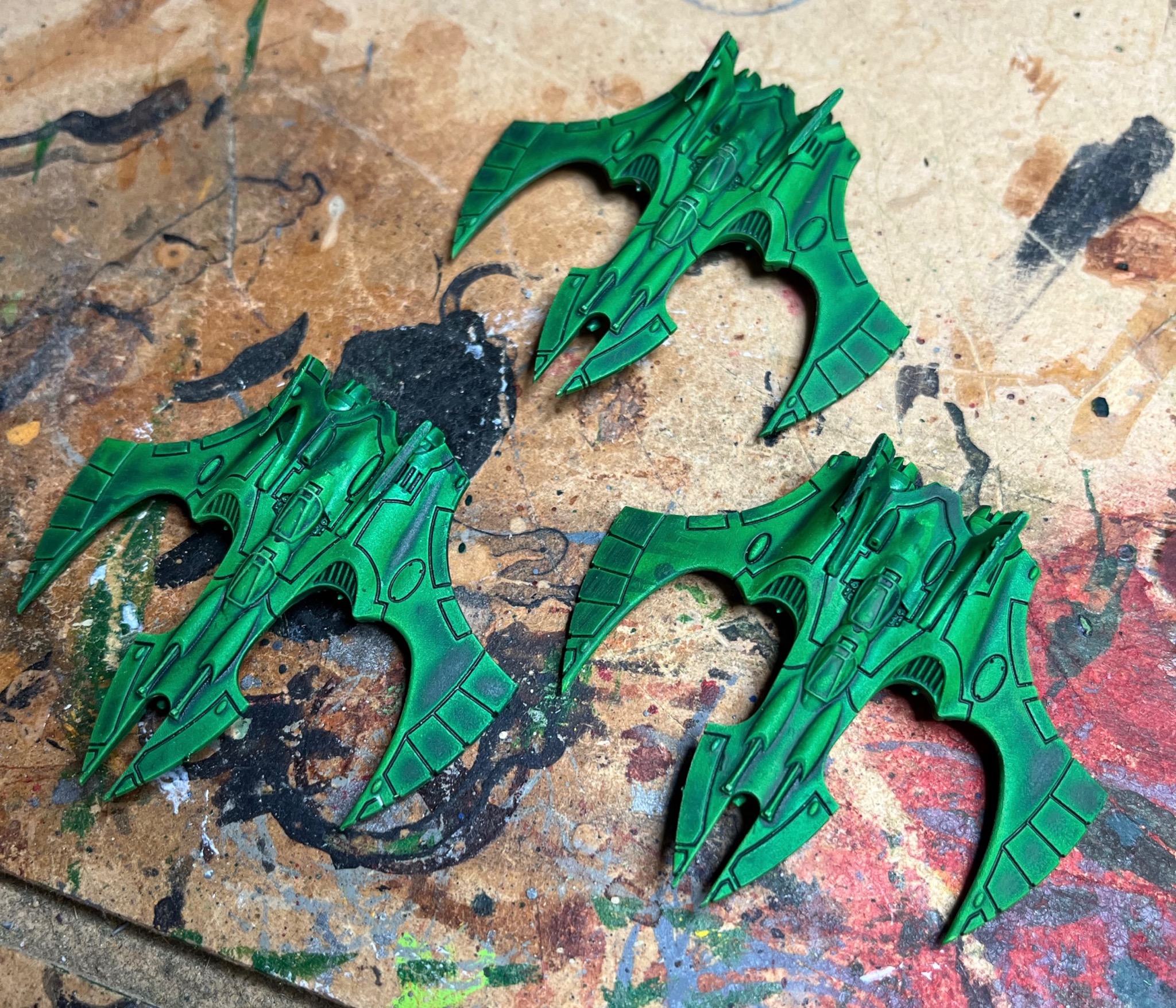
I did some more painting of my Asuryani Flyers.

These are the Asuryani Flyers (though I think of them as Eldar Flyers) that came with the Wrath of Angels boxed game.

You get three Nightwing fighters, in the Wrath of Angels boxed game, you also get three Phoenix Bombers.

I had given the models a base coat of Ork Flesh contrast paint. After touching up bits of the model that I had missed, I then gave the models a drybrush of a green dry paint to bring out the highlights.

Blériot XXVII

When I visited the RAF London Museum I nearly bypassed the Great War hangar, I didn’t have a huge amount of time and didn’t think I could see everything. In the end I did go into the hangar and I am glad I did. There was a great selection of aircraft on display and I really enjoyed walking around and looking at the planes.

The first of the planes was the Blériot XXVII, built for speed, this streamlined single-seat racing monoplane had a rotary engine and shared many features of other Blériot monoplanes.

The Blériot XXVII on display at RAF London was built in 1911 and later in 1914 it was put into storage.

It was flown again in 1936 and underwent further restoration in 1963 and 1974.

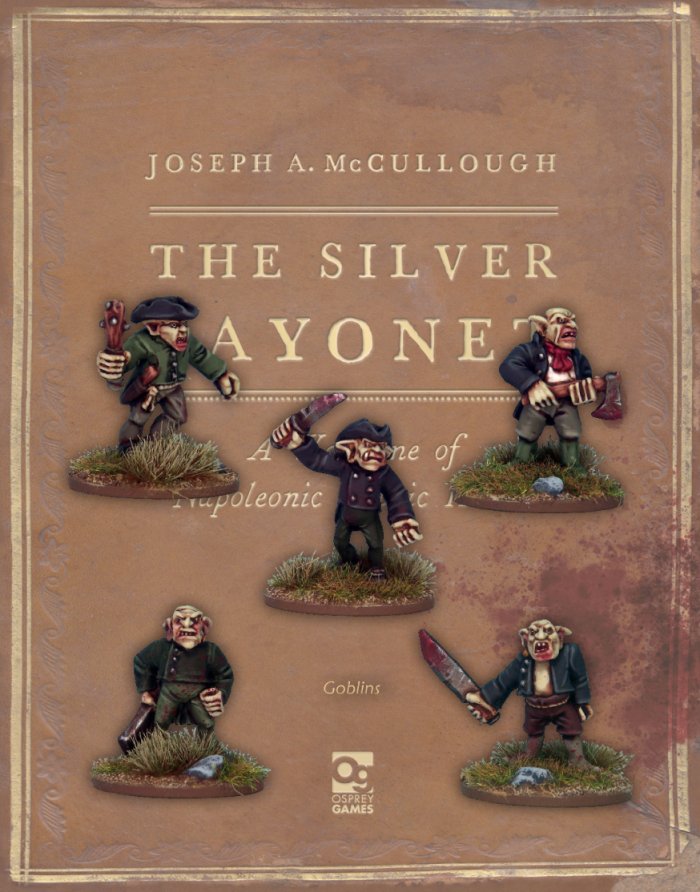
Silver Bayonet Goblins

In the most recent copy of Wargames Illustrated the advert for figures for The Silver Bayonet caught my eye, specifically the goblins.

The term goblin is loosely applied to a large group of wingless, ‘trickster’ fairies, and each nation has their own varieties and terms. While these creatures are small, and physically weak, they are also tough, hard-to-kill, and capable of huge amounts of mischief. One of the worst features of goblins is that their existence seems completely at-odds with technology, and their mere presence causes technology to fail. This, unfortunately, includes firearms.

These figures remind me of the goblins from Harry Potter, I think they could be used as proxies for them as well.

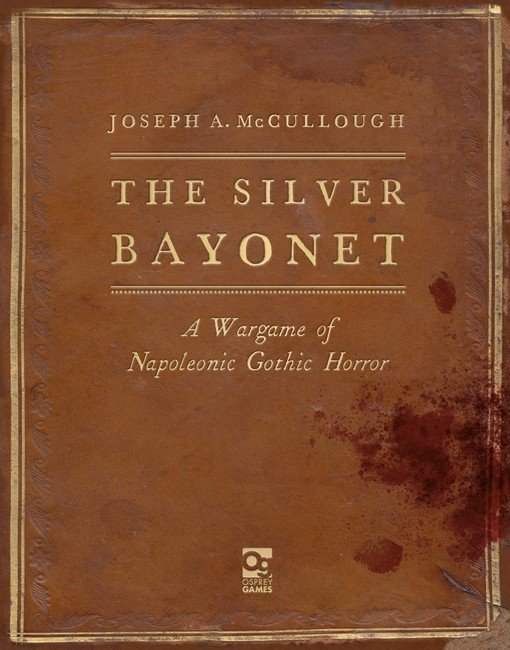
The Silver Bayonet is a gothic horror Napoleonic era game.

As the wars of Napoleon ravage Europe, chaos and fear reign and the darkness that once clung to the shadows has been emboldened. Supernatural creatures – vampires, werewolves, ghouls, and worse take advantage of the havoc, striking out at isolated farms, villages, and even military units. Whether they are pursuing some master plan or simply revelling in their newfound freedom is unknown. Most people dismiss reports of these slaughters as the rantings of madmen or the lies of deserters, but a few know better…

I like the cover of the rules, very nicely done.

The Silver Bayonet is a skirmish wargame of gothic horror set during the Napoleonic Wars. Each player forms an elite band of monster hunters drawn from the ranks of one of the great powers. Riflemen, swordsmen, and engineers fight side-by-side with mystics, occultists, and even those few supernatural creatures that can be controlled or reasoned with enough to make common cause. The game can be played solo, co-operatively, or competitively, with players progressing through a series of interlinked adventures with their soldiers gaining experience and suffering grievous wounds, and their units triumphing… or falling in the face of the shadows. It is a game of action and adventure, where musket and sabre meet tooth and claw.

I always liked Flintloque, which was a fantasy Napoleonic game, so can see why this appeals to me as well. Might see if I can get a copy of The Silver Bayonet rules.

I have a few unpainted human Napoleonic figures, so thinking that this might make for a good scenario for a few games.

Short Sunderland MR5

This Sunderland was on display at RAF London.

The Short S.25 Sunderland was a British flying boat patrol bomber, developed and constructed by Short Brothers for the Royal Air Force (RAF).

It entered service in June 1938 and was the first British flying boat to have power-operated gun turrets as part of its defensive armament. This strong protective armament resulted in the Germans giving it the nickname ‘Flying Porcupine’.

I enjoyed walking through the Sunderland and it is an impressive plane.

By the start of World War Two in September 1939 three squadrons had been equipped with the Sunderlands. Seven hundred and forty-nine Sunderlands were built, and they served throughout the war. The final Coastal Command Sunderland operational mission was in June 1945 over four weeks after the German surrender. Long-range Sunderland operations also took place overseas from bases in Africa and the Far East.

Post-war the type took part in the Berlin Airlift carrying 4920 tonnes (4847 tons) of freight. During the Korean War Sunderlands based in Japan undertook nearly 900 operational sorties totally over 13350 hours of flying. The Sunderland finally retired from RAF service in 1959 when the last aircraft were scrapped at RAF Seletar, Singapore.

The Sunderland’s design was so good that it remained in front line service for over twenty years. It was also the last flying-boat operated by the Royal Air Force.

Developed in parallel with the civilian S.23 Empire flying boat, the flagship of Imperial Airways, the Sunderland was developed specifically to conform to the requirements of British Air Ministry Specification R.2/33 for a long-range patrol/reconnaissance flying boat to serve with the Royal Air Force (RAF).

There is also a Short Sunderland at Duxford.