Westland Sea King HAR3

This Westland Sea King HAR3 was on display at RAF London.

Westland Sea King HAR3

Originally designed for anti-submarine warfare, the Westland Sea King was adapted for long-range RAF search and rescue duties as the Sea King HAR3, serving in the UK and Falkland Islands.

Westland Sea King HAR3

The Westland WS-61 Sea King is a British licence-built version of the American Sikorsky S-61 helicopter of the same name, built by Westland Helicopters.  Powered by two Rolls Royce Gnome gas turbines, deliveries began in 1978, replacing the Whirlwind HAR10 and Wessex HAR2 in providing search and rescue cover for both military and civilian personnel across the UK.

Sea Kings were fitted with highly advanced search and navigation equipment and operated in all weathers both day and night.  Final RAF aircraft retired 2015, replaced by private contract civilian helicopters in the SAR role. The Royal Navy retired their Sea Kings in 2018.

There was also a Westland Sea King on display at Duxford.

Humber Light Reconnaissance Car MkIIA

This Humber Light Reconnaissance Car MkIIA was on display at RAF London.

Humber Light Reconnaissance Car MkIIA

Designed as a scout car for the British Army Reconnaissance Corps, the Humber Light Reconnaissance Car (LRC) was also used by the RAF Regiment.

During the second world war the Humber LRC was used in North West Europe to capture airfields and act as a liaison for fighter bomber squadrons.

After the war finished, the Humber LRC continued in service and was deployed to Aden, Iraq and the Suez Canal.

See the Humber Light Reconnaissance Car Miniatures Gallery, where there are some 15mm Flames of War models of the Humber LRC.

Humber Light Reconnaissance Car

The Mid-War Monsters are back

We are seeing the return of the Mid-War Monsters for Flames of War. Though we’re not seeing new models (yet) we are seeing a re-release of the original monsters.

I like my TOG tanks, which I got when the Mid-War Monsters were originally released.

Though I still haven’t finished them, as you can see on the workbench.

The Tank, Heavy, TOG 2 was a prototype British super-heavy tank design produced in the early part of the Second World War in case the battlefields of northern France turned into a morass of mud, trenches and craters as had happened during the First World War.

In the end it never went into production, but as part of the Flames of War Mid-War Monsters range you can buy it and use it in alternate history games. I liked the concept and the model on the Flames of War website is quite inspiring.

Hopefully they are popular enough, that we get to see more of them, maybe some Early-War Monsters and some Late-War Monsters as well.

Red Arrows Folland Gnat

This Folland Gnat was at RAF London.

The Folland Gnat is a British compact swept-wing subsonic fighter aircraft that was developed and produced by Folland Aircraft. Envisioned as an affordable light fighter in contrast to the rising cost and size of typical combat aircraft, it was procured as a trainer aircraft for the Royal Air Force as well as by export customers, who used the Gnat in both combat and training capacities.

The single-seat Gnat F1 fighter was the forerunner of the two-seat Gnat T1 trainer which achieved fame with the ‘Red Arrows’ aerobatic team. Its aerobatic qualities led to the formation of the Yellowjacks aerobatic team in 1964, leading to the foundation of the world famous Red Arrows the following year. The team flew their red Gnats for fourteen years until they were replaced by the British Aerospace Hawk at the end of the 1979 season.

Several other Air Forces were attracted to the idea of a low-cost fighter. Finland purchased thirteen Gnat F1s, some of these being converted for reconnaissance work, whilst India bought forty.

There are two Folland Gnat planes at RAF Cosford.

Got a copy

Managed to get a copy of the Aeronautica Imperialis Companion.

The perfect addition to your games of airborne combat in the 41st Millennium is here in the form of Aeronautica Imperialis – Companion. This expansion collects new rules, aircraft, and factions, along with existing content previously found within White Dwarf magazine, allowing you to field squadrons from the Necrons, Asuryani, and Adeptus Astartes. Experience a deeper dogfighting experience with detailed expanded damage rules, new Ace abilities, and the challenges of limited ammunition. Novice and experienced commanders alike can use these rules to revolutionise their Aeronautica Imperialis games across a suite of new matched play scenarios.

I had planned to buy it from my local gaming shop, but they didn’t get any in. I had also tried a gaming shop in Birmingham, but I was a week early. I tried a few retail branches of Games Workshop as well, but they weren’t stocking it or had sold out (I didn’t ask). I did consider ordering it online, but at both full price and having to pay P&P I was a little hesitant.

In the end I managed to pick up a copy from Dark Sphere in London. Excellent.

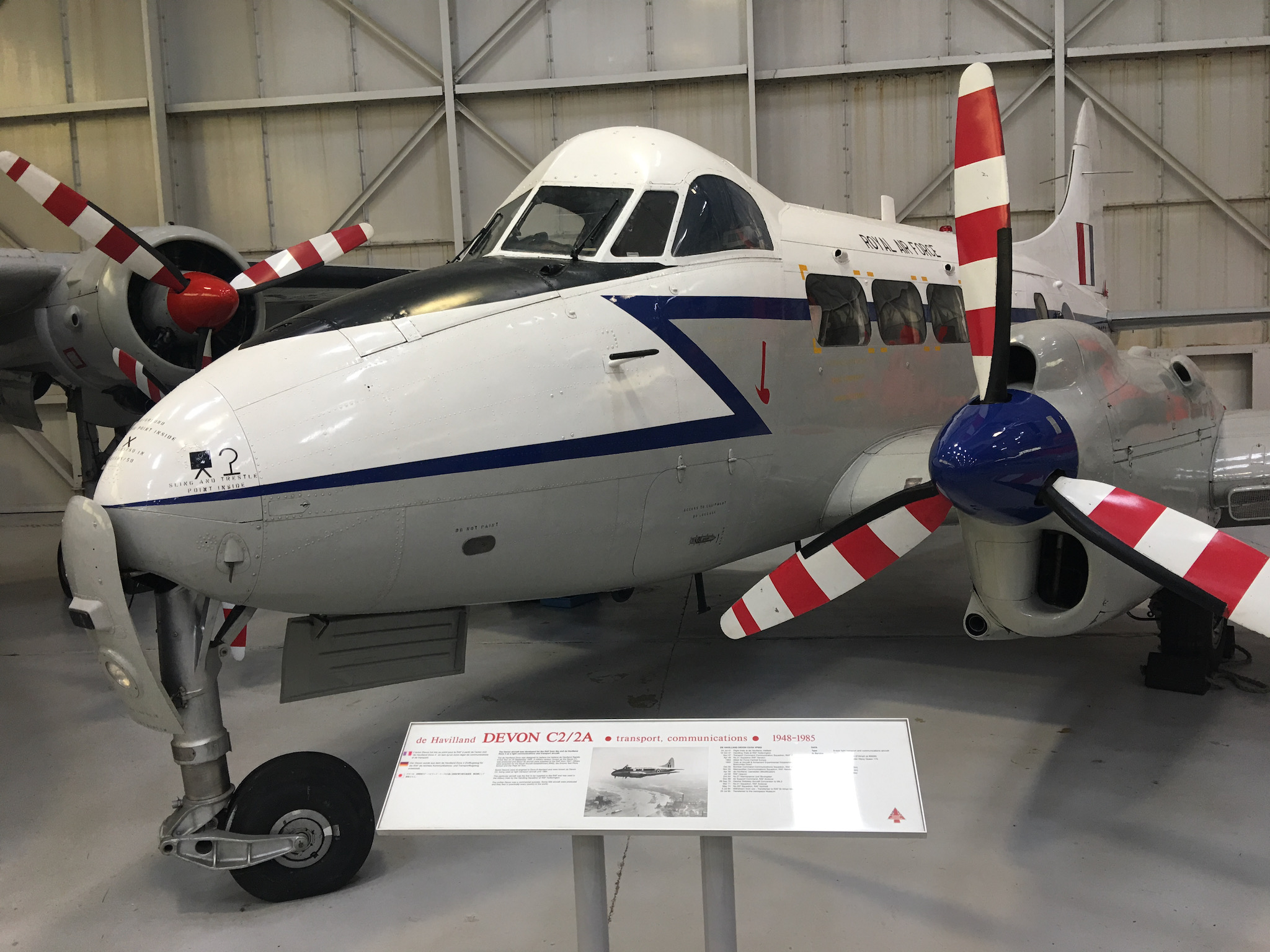
de Havilland Devon C.2

This de Havilland Devon C.2 was on display at RAF Cosford.

The De Havilland Devon was a military version of the de Havilland Dove short-haul airliner, one of Britain’s most successful post-war civil designs.

The de Havilland DH.104 Dove was a British short-haul airliner developed and manufactured by de Havilland.  The Dove was a popular aircraft and is considered to be one of Britain’s most successful postwar civil designs, in excess of 500 aircraft being manufactured between 1946 and 1967. Several military variants were operated, such as the Devon by the Royal Air Force and the Sea Devon by the Royal Navy, and the type also saw service with a number of overseas military forces.

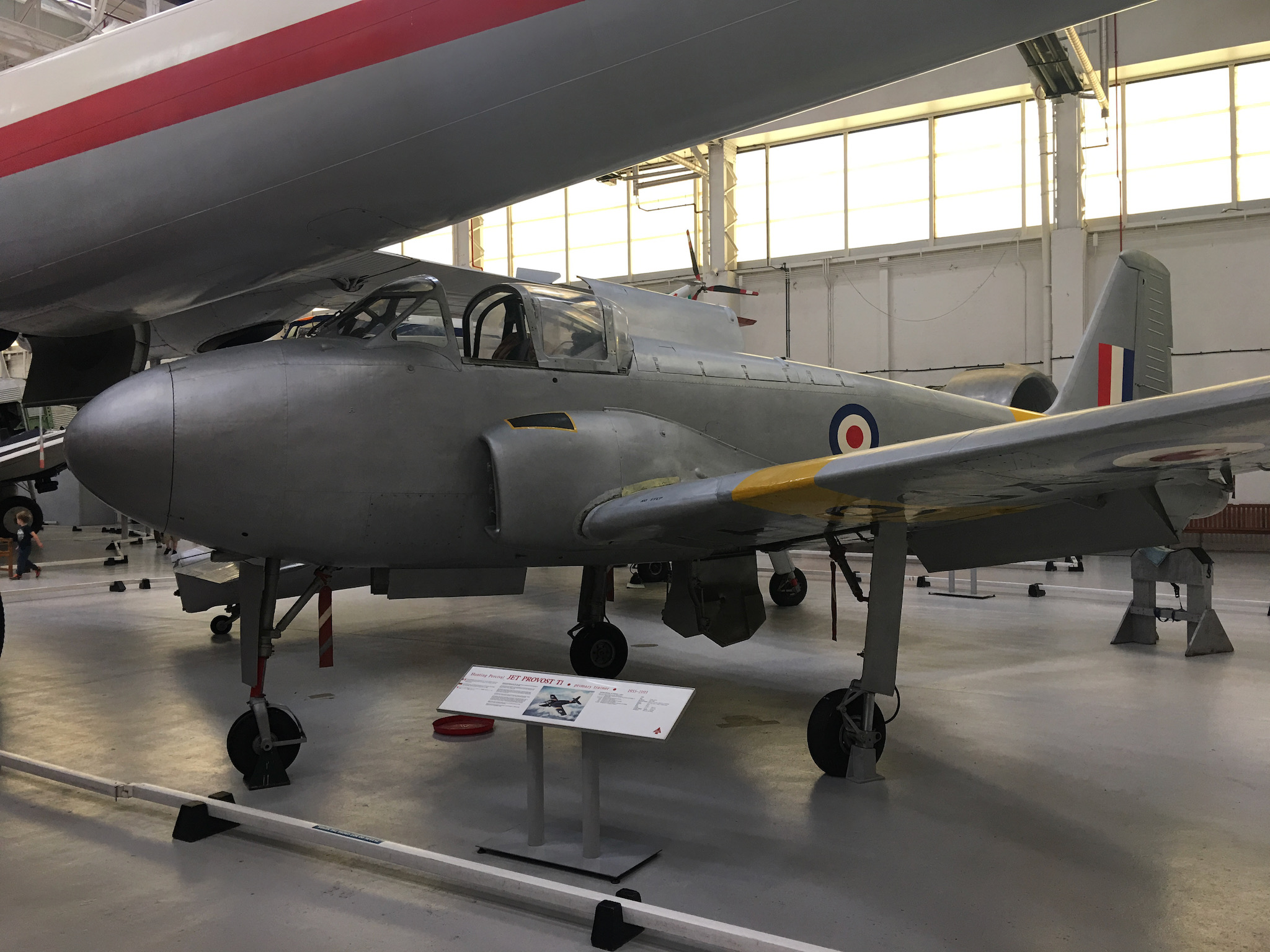
Jet Provost T1

This Jet Provost T1 is on display at RAF Cosford.

Jet Provost T1

The Hunting Percival Jet Provost was initially developed as a jet engine modification of the piston-engine Percival P.56 Provost, retaining to original wing structure mated to a new fuselage. It was built as a private venture by Hunting Percival Aircraft Limited at Luton Airport.

V2 Missile

This V2 missile was on display at RAF Cosford.

V2 Missile

It is one of several rockets prepared by the British with support from German troops during Operation Backfire. It so happened that this rocket was not launched during the Backfire tests. Operation Backfire was a military scientific operation during and after the Second World War that was performed mainly by British staff. The operation was designed to completely evaluate the entire V-2 rocket assembly, interrogate German personnel specialised in all phases of it and then to test and launch missiles across the North Sea.

The V2 was the world’s first long range guided ballistic missile. he missile, powered by a liquid-propellant rocket engine, was developed during the Second World War in Germany as a “vengeance weapon”, assigned to attack Allied cities as retaliation for the Allied bombings against German cities.

Avro Vulcan

The Avro Vulcan is a jet-powered tailless delta wing high-altitude strategic bomber, which was operated by the Royal Air Force (RAF) from 1956 until 1984.

Avro Vulcan

XM598 is at RAF Cosford. Completed on 30 August 1963, it was delivered to 12 Squadron at RAF Coningsby on 4 September. Was the originally designated bombing aircraft for Black Buck 1, but which had to turn back minutes into the flight. Withdrawn with disbandment of 44 Squadron, the last bomber unit, on 21 December 1982. Performed its last flight on 20 January 1983, being delivered to Aerospace Museum Cosford

XJ824 is on display at Duxford.