Deimos Vindicator Laser Destroyer

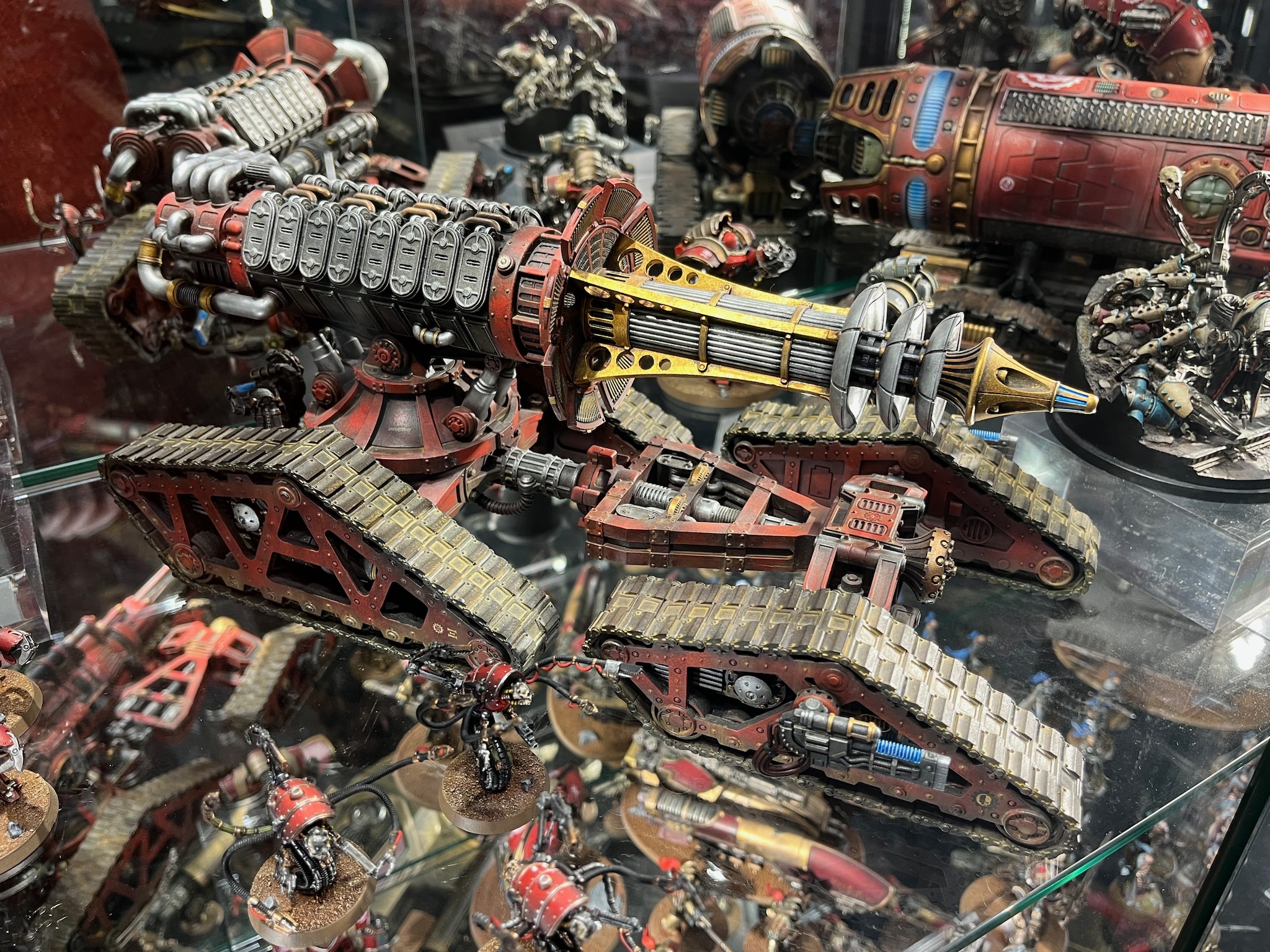
This Legiones Astartes Ultramarines Deimos Vindicator Laser Destroyer was on display in the cabinets at Warhammer World.

The Vindicator laser destroyer array is a devastating weapon, capable of unleashing a torrent of laser energy that can tear through the armor of even the heaviest enemy vehicles. It was first fitted to the heavily armored Deimos pattern Vindicator chassis during the dark days of the Horus Heresy, when several Legions fielded this variant as a mainline battle tank. The Vindicator laser destroyer proved itself to be an able tank hunter, time and again destroying enemy tanks and other armored vehicles with ease.

After the Horus Heresy, the Vindicator laser destroyer array remained in service with Space Marine Chapters. It is still used today, and remains one of the most feared anti-tank weapons in the Imperium’s arsenal. Vindicator laser destroyer arrays are often deployed to support infantry units, providing them with the firepower they need to break through enemy armor and fortifications.

General Aircraft Hamilcar and Light Tank Mk VII Tetrarch

This General Aircraft Limited Hamilcar and Light Tank Tetrarch combination were on display at the Tank Museum. Though only a section of the Hamilcar fuselage remains and was on display.

General Aircraft Limited Hamilcar and Light Tank Mk VII Tetrarch

The Tetrarch light tank was a British tank produced in the late 1930s and used during World War II. It was the latest in a line of light tanks built by Vickers-Armstrongs for the British Army and featured a 2-pounder gun, an improvement over its predecessor, the Light Tank Mk VIC.

The Tetrarch was a relatively small and lightweight tank, making it ideal for airborne operations. In June 1942, the Tetrarch was attached to the 1st Airborne Division as an air-portable light tank to support British airborne forces. The tanks were transported and landed in General Aircraft Hamilcar gliders, which were specially designed for the task.

The Tetrarch played an important role in several airborne operations during World War II. In June 1944, approximately twenty Tetrarchs were used during Operation Tonga, the British airborne landings in Normandy. The Tetrarchs provided valuable fire support to the British paratroopers as they landed and fought their way inland.

General Aircraft Limited Hamilcar and Light Tank Mk VII Tetrarch

The General Aircraft Limited Hamilcar was a large British military glider produced during World War II to carry heavy cargo, such as the Tetrarch or M22 Locust light tank. It was used only three times, all in support of British airborne forces.

The Hamilcar first saw action in June 1944, when approximately thirty were used to carry Ordnance QF 17 pounder anti-tank guns, transport vehicles, and Tetrarch light tanks into Normandy during Operation Tonga. In September 1944, a similar number of Hamilcars were used to transport anti-tank guns, transport vehicles, and supplies for airborne troops during Operation Market Garden. They were used a third and final time in March 1945 during Operation Varsity when they transported M22 Locust light tanks and other supplies.

The Hamilcar was successful in all three operations, although its slow speed and large size made it an easy target for anti-aircraft fire, resulting in a number of gliders being damaged or destroyed.

Legion Imperialis Land Raiders

We have seen a preview of the forthcoming Legion Imperialis Land Raiders.

Legion Imperialis Land Raiders
These look really nice and looking forward to getting some to paint.

I actually thought we had seen these already. I suspect that might be more down to the fact that when Space Marine and Epic 40000 were released the Land Raider was in those initial releases. Looking back at the (delayed) forthcoming Legions Imperialis boxed set, I see and realise now, that Land Raiders are not part of that set.

So will we see a Typhon Heavy Siege Tank as well now?

Ultramarines Xiphon Pattern Interceptor

This Xiphon Pattern Interceptor flown by the Ultramarines was on display at Warhammer World.

Ultramarines Xiphon Pattern Interceptor

With unparalleled speed and manoeuvrability, the Xiphon pattern Interceptor saw increasing service in the Legiones Astartes during the dark days of the Horus Heresy.

Based on ancient designs, the void and atmospheric craft carried heavy armaments into battle, allowing it to destroy both air and ground targets with apparent ease. Its pair of twin-linked lascannon and Xiphon rotary missile launcher combined with the Interceptor’s speed and agility to make it a deadly opponent from which the enemies of Mankind could not hide.

Xiphon Pattern Interceptor in the Miniatures Gallery

XM598 Vulcan Bomber

XM598 Vulcan Bomber

XM598 is at RAF Cosford. Completed on 30 August 1963, it was delivered to 12 Squadron at RAF Coningsby on 4 September. Was the originally designated bombing aircraft for Black Buck 1, but which had to turn back minutes into the flight.

Withdrawn with disbandment of 44 Squadron, the last bomber unit, on 21 December 1982. Performed its last flight on 20 January 1983, being delivered to Aerospace Museum Cosford.

XM598 Vulcan Bomber

Another photo of XM598.

XJ824 is on display at Duxford.

Mark IIb Land Raider

This Mark IIb Land Raider was on display at Warhammer World in the Battle of Signus Prime diorama.

This is one of my favourite Forge World models.

The Mark IIb Land Raider Phobos is one of the earliest marks of the standard pattern of Land Raider, and it still bears similarities to both the Land Raider Proteus and the Spartan Assault Tank that served as the models for the design. The Mark IIb Land Raider Phobos is the only pattern of the standard Land Raider Phobos that uses the older armoured sponsons, as they do not allow the weapons they hold to fully rotate. This pattern of Land Raider is mostly extinct within Space Marine Armouries, having been replaced with newer marks and patterns of the standard Land Raider Phobos. However, some Chapters may still possess one or two as treasured relics of their ancient past.

MkIIb Land Raider Miniatures Gallery.

My own MkIIb Land Raider on the workbench. When I first started putting this force together I knew that if I was going to get a Land Raider it would have to be the Forgeworld MkIIB Land Raider.

Sadly the model is now no longer available from Forge World.

Valentine Bridgelayer

This Valentine Bridgelayer was on display at the Tank Museum at Bovington.

Valentine Bridgelayer

The Valentine Bridgelayer was a British armoured bridgelayer tank based on the Valentine Infantry Tank MK II. It was turretless and fitted with a 10-meter (33 ft) long, 2.90-meter (9 ft 6 in) wide Class 30 (capable of bearing 30 long tons (34 short tons)) scissors bridge. The bridge could be deployed in 2.5 minutes and could carry a wide range of vehicles, including tanks, trucks, and artillery.

The Valentine Bridgelayer was first produced in 1942 and saw action in North-West Europe, Italy, Burma, and Manchuria. It was a valuable asset to Allied forces, allowing them to quickly and safely cross rivers, streams, and other obstacles.

The Valentine Bridgelayer was a well-designed and reliable vehicle. It was based on the proven Valentine tank chassis, which was known for its durability and ease of maintenance. The scissors bridge was also a very effective design, and it was able to withstand a great deal of weight.

The Valentine Bridgelayer was a vital piece of equipment for Allied forces during World War II. It helped them to overcome a variety of obstacles and to achieve victory.

Here are some additional facts about the Valentine Bridgelayer:

    • It was the first British armoured bridgelayer to be produced in large numbers.
    • It was used by a variety of Allied forces, including the British, Canadians, Americans, and Soviets.
    • The Valentine Bridgelayer was a very versatile vehicle. It could be used to cross a variety of obstacles, including rivers, streams, ditches, and craters.
    • It was also used to support infantry operations and to provide cover for engineers.

The Valentine Bridgelayer was a highly successful vehicle, and it played an important role in Allied victory during World War II.