Cruiser, Mk IV (A13)

This Cruiser, Mk III (A13) was on display at Bovington Tank Museum. This example was built in 1939 by Nuffield Mechanisation & Aero Ltd and was used for development of the improved turret armour for the Cruiser IV. It retains this revised turret which is why at first glance it looks like a Cruiser IV.

This vehicle is one of the 65 Cruiser IIIs delivered between December 1938 and November 1939. It was apparently retained to prove the attachment of armour plates on the turret in fulfilment of the Cruiser IV’s armour specification (30mm), which is the configuration in which it survives. It was held by the School of Tank Technology until 1949, when it transferred to the Tank Museum. It is painted to represent a vehicle commanded by Ron Huggins (who later volunteered at the Tank Museum) of 10th Royal Hussars – a part of 1st Armoured Division, which served in western France in June 1940.”
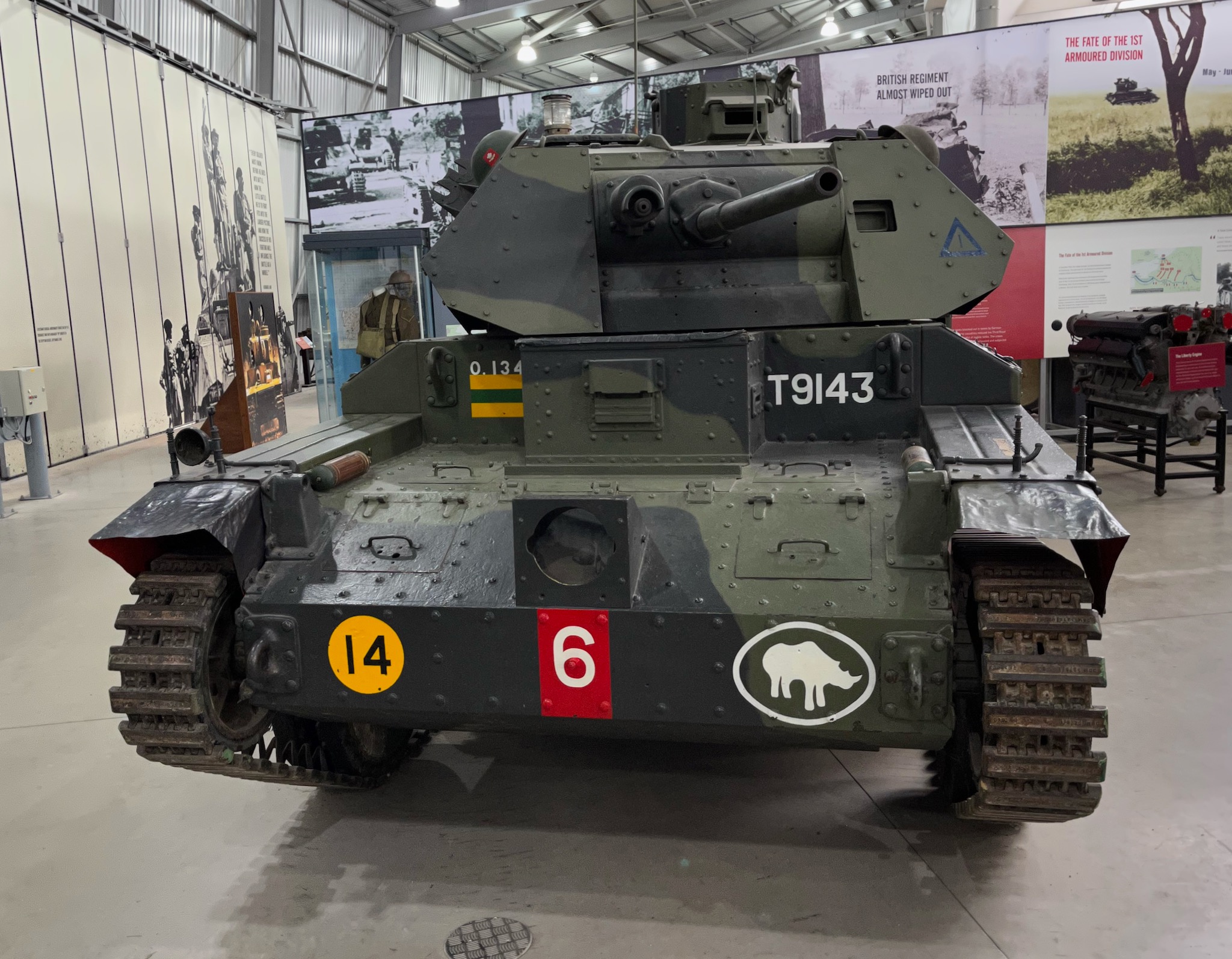
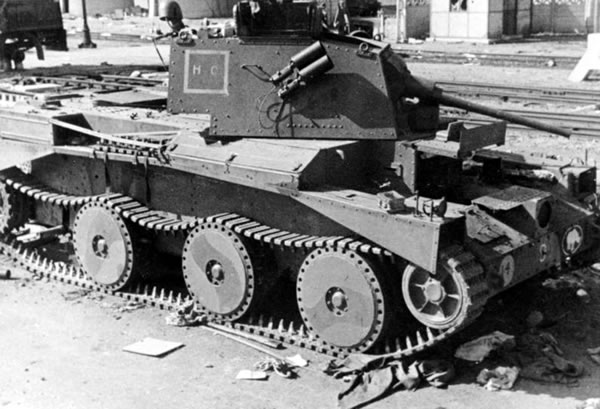
The Tank, Cruiser, Mk III (A13) was a British cruiser tank of the Second World War. It was the first British cruiser tank to use the Christie suspension system which gave higher speeds and better cross-country performance, previous models of cruiser tanks having used triple wheeled bogie suspension. Like most British cruisers, the A 13 was fast but under-armoured and proved unreliable mechanically. Most were lost in the French campaign in 1940, but a few were used in Greece and the North African campaign in 1940-41.

As you can see in this photograph the Mk III had a slab sided turret.
I have had a 15mm model of the tank for sometime. Don’t remember the manufacturer, though I think it may be an old SDD Miniatures model. It’s made of metal and is quite well detailed. After cleaning the model I gave it a white undercoat.
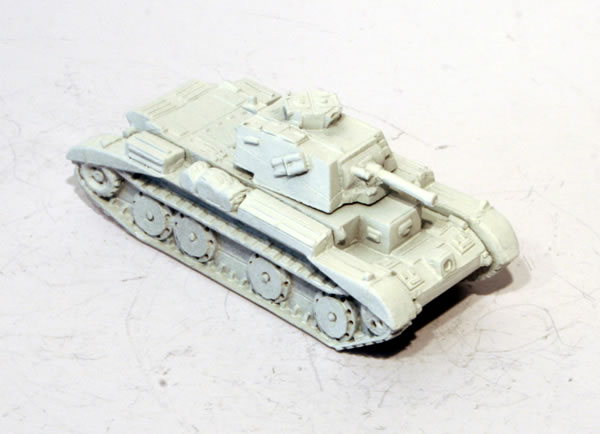
See the full workbench feature on the A13.


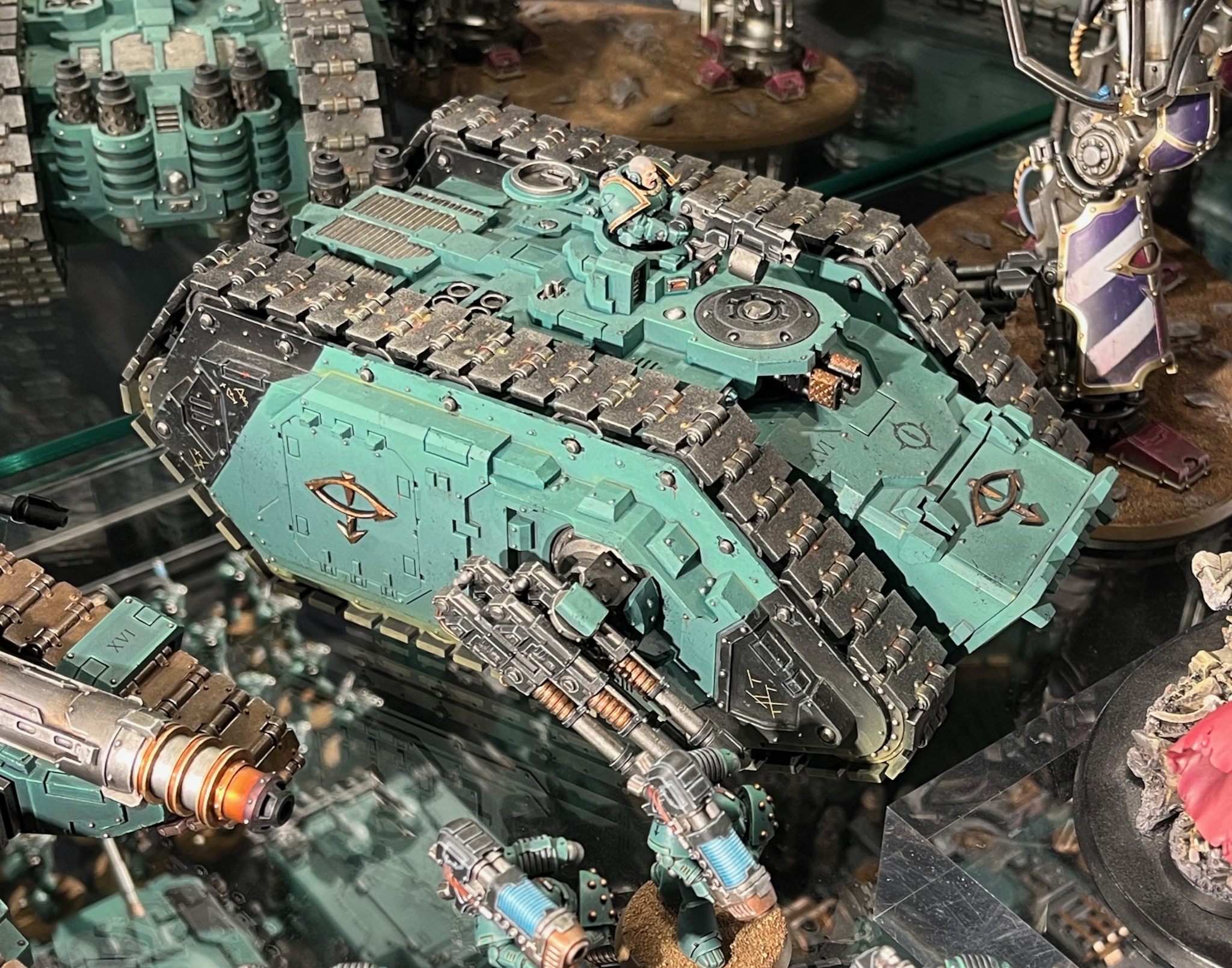
Sons of Horus Spartan Assault Tank

The Spartan Assault Tank also known as the Land Raider Spartan, this armoured carrier was designed to punch through the most overwhelming enemy defences and deliver a knock-out blow of massed Astartes infantry.

It became a common assault vehicle during the Great Crusade, where its nigh-impervious chassis could shrug off regular anti-tank weapons as it ferried up to 26 Legionaries – or 13 Terminators – into the fray, with a surprising turn of speed for its size.

These Sons of Horus Spartan Assault Tanks were on display at Warhammer World.

Land Raider Spartan Assault Tank Miniatures Gallery.

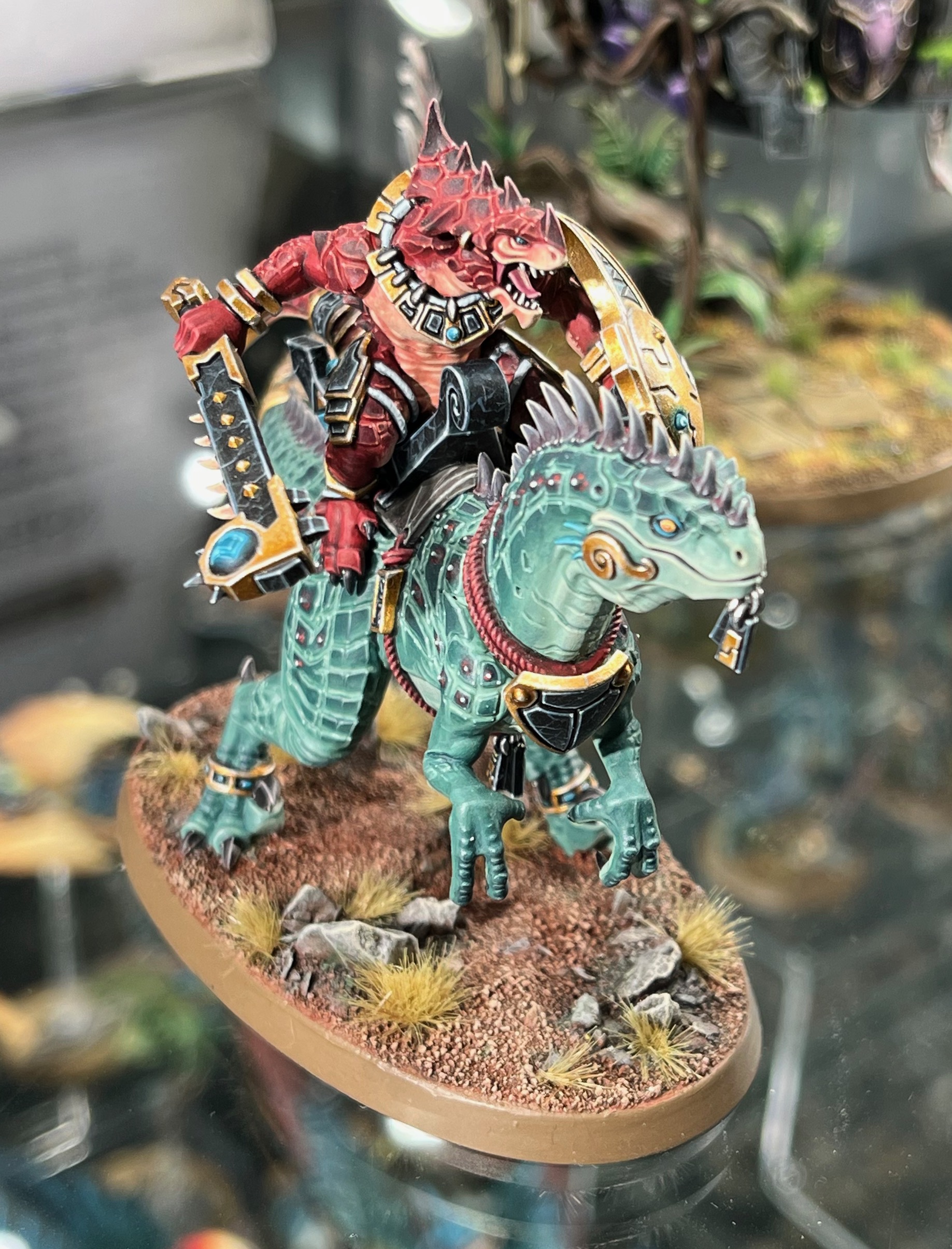
Aggradon Lancer armed with a Barbed Celestite Club

Aggradon Lancer armed with a Barbed Celestite Club

Aggradon Lancers are among the most aggressive cavalry known to the Mortal Realms, for their fearsome scaled steeds only become swifter and more ravenous as battle-frenzy overtakes their senses. A charge of Aggradon Lancers can collapse entire battlelines in a storm of predatory violence, riders and mounts alike lashing out with savage force and overwhelming ferocity.

PzKpfw II

The Panzer II was the common name for a family of German tanks used in World War II. The official German designation was Panzerkampfwagen II (abbreviated PzKpfw II). Although the vehicle had originally been designed as a stopgap while more advanced tanks were developed, it nonetheless went on to play an important role in the early years of World War II, during the Polish and French campaigns. By the end of 1942 it had been largely removed from front line service, and production of the tank itself ceased by 1943.

This one was on display at the Bovington Tank Museum.

Panzer II tank

When they first appeared, in 1936, the Panzer IIs were regarded as platoon commander’s tanks. They were also employed to give fire support to the Panzer I in combat with enemy tanks. However by 1940 they had been outclassed and were relegated to the reconnaissance role. This exhibit, an Ausfuhrung (or Model) F featured improved armour and was introduced in 1941.

This tank was captured by British forces in North Africa but it is shown in the markings of 1st Panzer Division at the time of the invasion of France in June 1940.

Another photograph of the Panzer II.

That was something I didn’t know until a few years ago that the German tanks in 1940 were painted grey and brown, I had always thought they were just grey. I personally blame Matchbox  for this.

Matchbox Panzer II box art

It was only after Blitzkrieg was released back in 2010 by Battlefront that I noticed the grey and brown camouflage scheme.

As recently as ten years ago the overwhelming consensus regarding early war German AFV paint schemes was that they were all painted in uniform overall panzer grey (Dunkelgrau – RAL 7021 – formerly RAL 46). However, in 2002 Tom Jentz and Hilary Doyle published an article based on primary sources stating all German vehicles at the beginning of World War II were painted in a two tone camouflage scheme of panzer grey with one third of the vehicle painted in a disruptive pattern of dark brown (Dunkelbraun – RAL 7017 – formerly RAL 45). The order to move to an overall panzer grey scheme was not signed until the end of July 1940.

Back in 2011, I blogged about finding the 15mm Zveda plastic model kit.

Though you can buy a resin version of the Pz II I was plesantly surprised to find a plastic 1/100th scale kit of the Pz II in a model shop for just £1.25. Bargain!

Made my Zveda, a Russian firm… I did manage to pick up three of them. I am going to make them up as PzKpfw IIs for the Western Desert.

Note that the cover art of the box is all grey too… but by the time of the invasion of Russia, all German tanks were grey.

Sons of Horus Typhon Heavy Siege Tank

This Sons of Horus Typhon Heavy Siege Tank was on display at Warhammer World.

Sons of Horus Typhon Heavy Siege Tank

Named for the ‘Great Beast’ of Ancient Terran myth, the immense Typhon Heavy Siege Tank was developed by the Mechanicum alongside the Spartan, with which it shares a basic chassis design.

The Typhon’s primary armament is the massive Dreadhammer cannon, and was created in response to a request from the Primarch Peturabo, master of the Iron Warriors. He demanded a Legiones Astartes war engine that could rival the great batteries of the Imperial Crusade Army in firepower, but manoeuvre and deploy at the speed of a Space Marine force.

More photographs of the Typhon Heavy Siege Tank.

Slann Starmaster

Slann Starmaster

Slann Starmasters are amongst the greatest wizards in all the realms, ancient beings created to serve the unfathomable Old Ones. It is their cold and distant intellect that guides the Seraphon to carry out the Great Plan, deciphered from glimpses of a grand cosmic equation. A Starmaster may reshape reality itself with a languid gesture, wielding the energies of the stars to annihilate the enemies of true order.

French Char B1

This Char B1 was on display at Bovington.

The Char B1 was a French heavy tank manufactured before the Second World War. It was a specialised heavy break-through vehicle, originally conceived as a self-propelled gun with a 75 mm howitzer in the hull; later a 47 mm gun in a turret was added, to allow it to function also as a Char de Bataille, a “battle tank” fighting enemy armour, equipping the armoured divisions of the Infantry Arm.

Among the most powerfully armed and armoured tanks of its day, the type was very effective in direct confrontations with German armour in 1940 during the Battle of France, but a slow speed and high fuel consumption made it ill-adapted to the war of movement then fought. After the defeat of France captured Char B1 (bis) would be used by Germany, some rebuilt as flamethrowers or mechanised artillery.

It is a big tank, but only for 1940, by the end of the war heavy tanks were huge in comparison.

More photographs of the Char B1.

It is one of my favourite tanks, probably down to the Matchbox kit I got when I was younger.

Matchbox Char B1 and Renault FT17

I do have a 28mm Char B1 for Bolt Action which recently made its way onto the workbench to be made up as a FFI version used in 1944 and 1945.

Bolt Action Char B1 bis

There are some 15mm versions for Flames of War too.

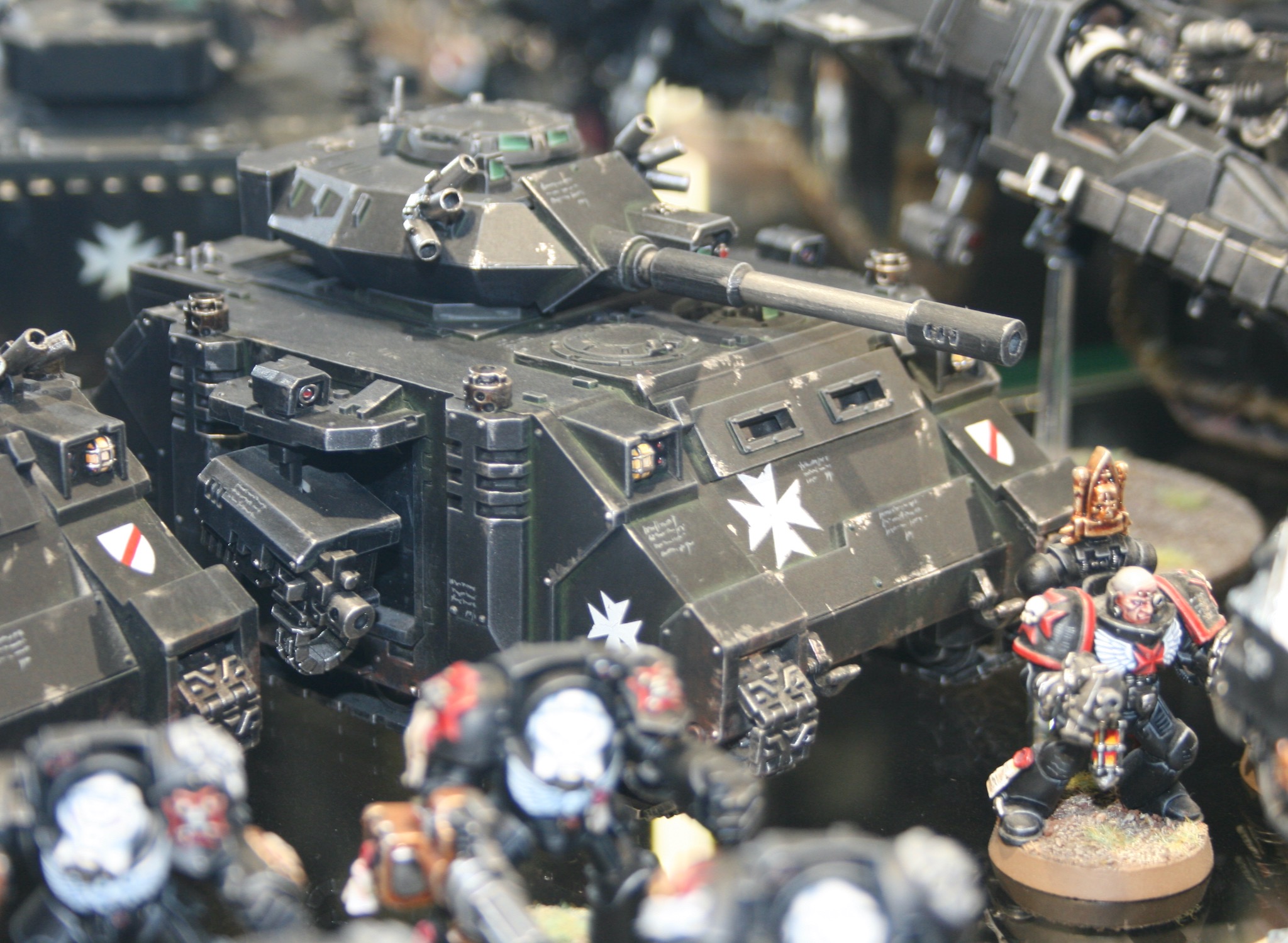
Predator Tank

This Black Templars Predator was in the display cabinets at Warhammer World.

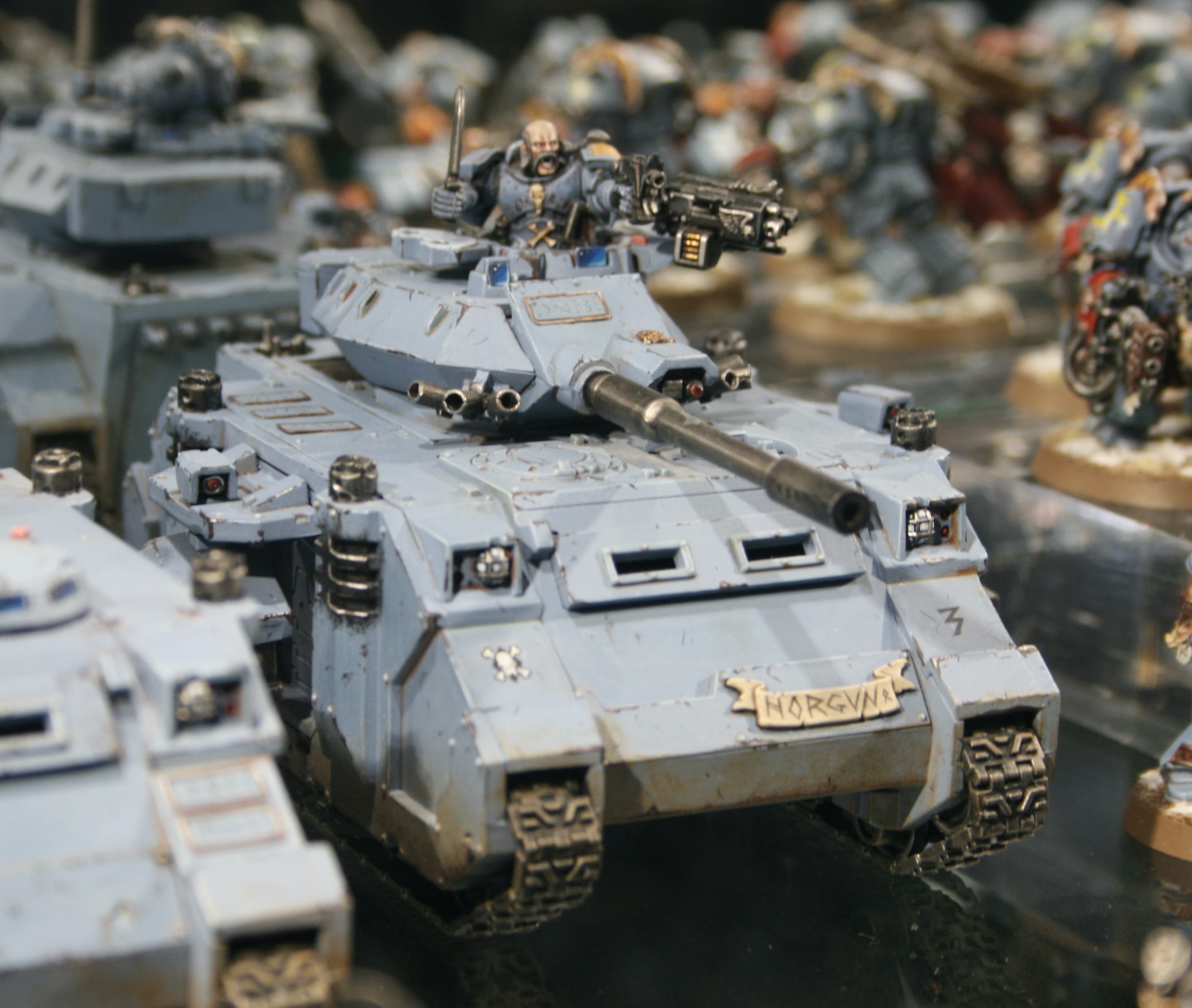
The Predator, is the most common main battle tank employed by the Space Marines of the Imperium of Man. It is a more heavily armed and armoured version of the Rhino armoured personnel carrier.

This Space Wolves Predator was on display at Warhammer World.

More photographs of the Predator tank.

Land Raider Crusader

This Blood Angels Land Raider Crusader was on display at Warhammer World.

Blood Angels Land Raider Crusader on display at Warhammer World

The Land Raider Crusader is a variant of the standard Land Raider Phobos used by the Space Marines and the Inquisition. The Land Raider Crusader is rearmed to provide short-ranged, anti-infantry assault support for Astartes offensives. The Land Raider Crusader is intended to be an assault-based variant of the Land Raider that is a linebreaker without peer. The Crusader can smash through enemy formations, shrugging off small arms fire in order to disgorge a squad of Space Marines into the heart of the foe. In place of Lascannons, the Crusader is armed with Hurricane Bolters that cut down the first line of defenders before an assault is launched. A hull-mounted twin Assault Cannon adds to its formidable anti-infantry firepower, its Frag Assault Launchers suppressing the foe while the tank closes in. The Crusader also boasts an improved transport capacity by reclaiming the space normally given over to the Land Raider Phobos’ bulky las-power generators.

Black Templars Land Raider Crusader on display at Warhammer World.

More photographs of the Land Raider Crusader.