The Marauder Destroyer variant was developed during the second war for Armageddon after heavy losses in the Naval airforces.
Marauder Destroyer
Orkish dominance of the skies over certain areas of Armageddon forced the few remaining Marauders to be refitted to operate at night, flying at extremely low level where they could evade detection.
Their new heavier weapon payload made anything which got in the way seriously regret it!
Marauder Destroyer
This is a really nice model, I really like the paint job on this. I would like to be able to paint like this if I could. I certainly don’t have both the skills and the airbrush to make this happen.
Having bought some metal models recently from Warhammer World, I have been thinking about how I could build my Old World Dwarf army. There are plenty of plastics now available, as well as some metal models.
This was very much an impulse buy. I was in my FLGS looking at the shelves across The Old World range and decided I would get some dwarf miniatures.
I went for the Dwarf Miner box, which gives you twenty miners and four miner’s carts.
Dwarf Miners often join their brethren when they march to war. As a point of pride, they wield the same heavy, two-handed mining picks and mattocks they use to carve out tunnels, rather than the axes and hammers typically favoured by other Dwarfs. They are accompanied into battle by sturdy wooden carts drawn by rugged draft ponies to ensure they are properly equipped to face the trials that await them.
I like the candles on the helmets, but in reality how long would they stay alight on the battlefield? You get four large sprues and a bundle of bases in the box.
I am planning to paint them in the same way as some (metal) Dwarf Miners I painted a while back, a long while back.
I am thinking I might have to go to the eBay to get some OOP miniatures.
In Warhammer World was a range of Skaven miniatures from across the years.
I realise looking at the catalogue entry for the original Skaven, the C47 Chaos Ratmen that. bought some of these when they first came out. There are some photographs in the Skaven Gallery.
As I toured the exhibition, I decided that I would probably get some more Grot tanks, as I had enjoyed building and painting the ones I had bought before.
In the end I bought some other stuff.
So when I was looking on the online store recently I was really disappointed to see that the Grot Tanks have been retired and are no longer available. That’s a real pity, I liked those models. Not sure if I will be able to get some more secondhand.
Across the Warhammer World displays were various armoured vehicles of the White Scars Space Marine chapter.
The Repulsor is an Imperial anti-gravitic main battle tank intended to provide armoured support for the Primaris Space Marines of many different Chapters. This is a White Scars Primaris Repulsor.
The Stormtalon Gunship serves the armies of the Adeptus Astartes as both an interceptor and ground-attack craft. It is fast enough to engage all but the swiftest of enemies, and sufficiently well-armed to reduce the chosen foe to a mangle of twisted wreckage and ruined flesh.
The Hammerstrike excels at rooting out enemies from trench and bunker networks. Sweeping low over the battlefield, it employs searing melta blasts and volleys of rockets to crack the foe’s defence lines wide open.
One of the reveals at the World Championships Preview was a plastic Arvus Lighter for The Horus Heresy.
The Arvus Lighter is a small, general purpose cargo shuttle that is widely used by the Imperium of Man for many tasks, both in space and on the surface of planets. The Arvus is commonly used by both Imperial Navy warships and Imperial merchant vessels, including Rogue Traders.
I really like this model and I will probably get this when it is released.
Though released for The Horus Heresy, I suspect it would also make a great model for, not just Warhammer 40K, but also Necromunda.
One of the reveals at the World Championships Preview was the Death Korps of Krieg models for Warhammer 40K.
Across the range there are soldiers, artillery, heavy weapons, and cavalry.
We first saw the Death Korps of Krieg as a Forge World resin release back in the day. I remember thinking really nice concept, but those resin models filled me with dread, lots of small parts and a high price tag to match. Of course these new plastic models will probably have an equally high price tag as well.
In addition to the infantry, guns, and horses, there are a few plastic tank kits from the Horus Heresy range that the Death Korps of Krieg could use. In addition resin models such as the Gorgon Armoured Assault Transport are still available as well.
For me, the release of the Death Korps of Krieg provides a little hope that other Imperial Guard regiments might again see the light of day, specifically the Tallarn Desert troops. Might be some time though.
The Rynn’s World diorama was on display at Warhammer World. Inspired by the artwork from the original Warhammer 40000 Rogue Trader rulebook, this diorama shows the Crimson Fists making a heroic last stand against hordes of Orks.
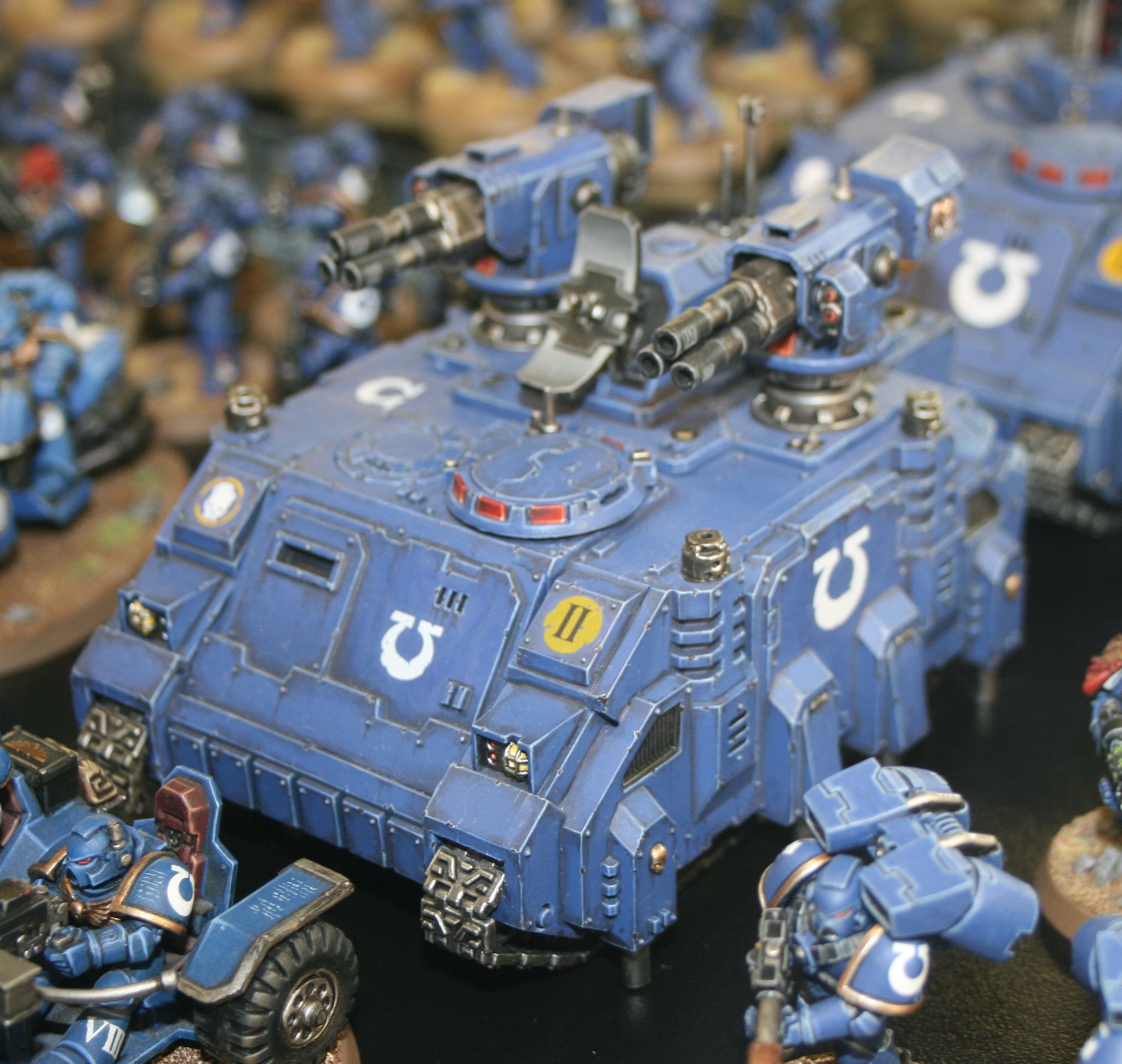
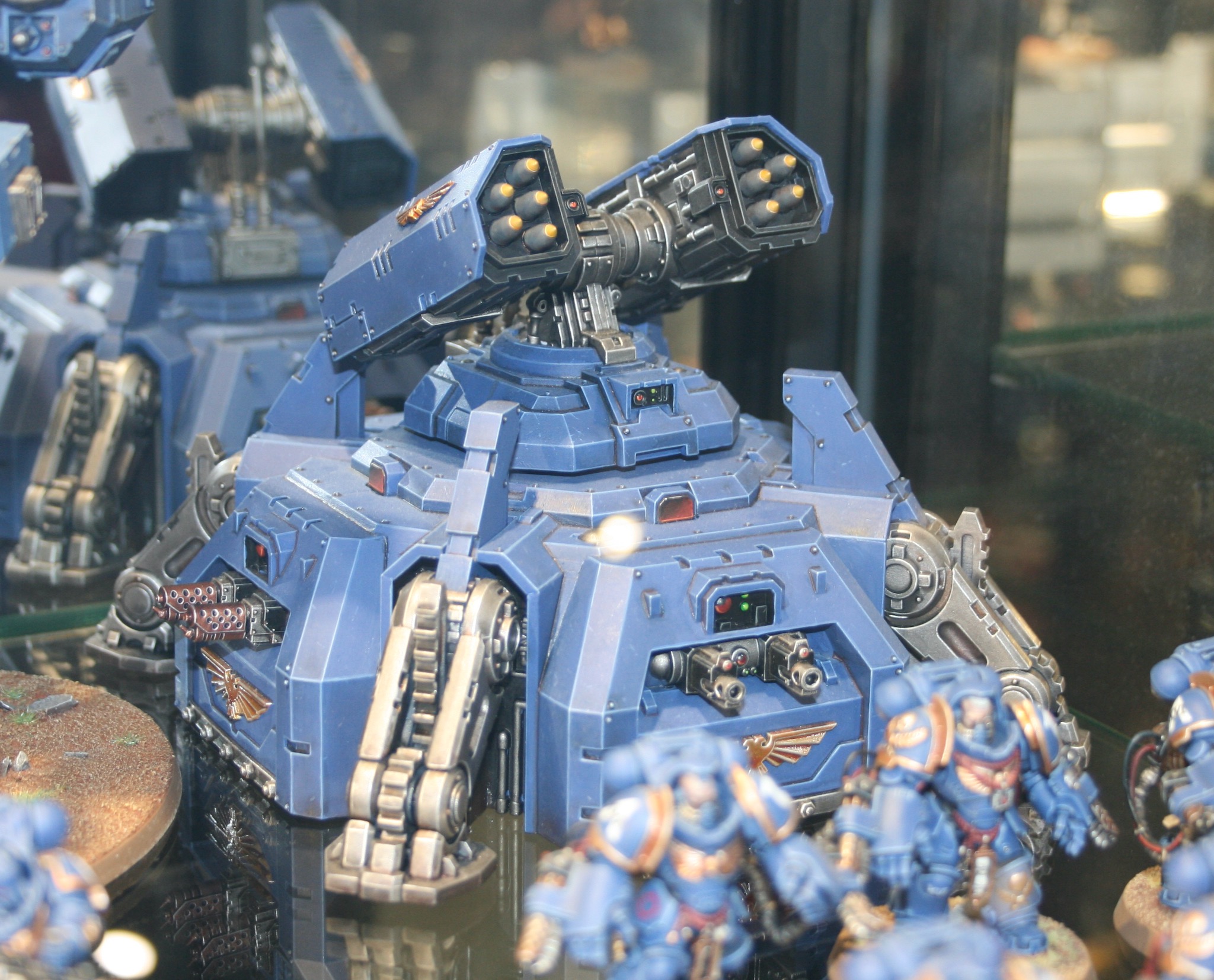
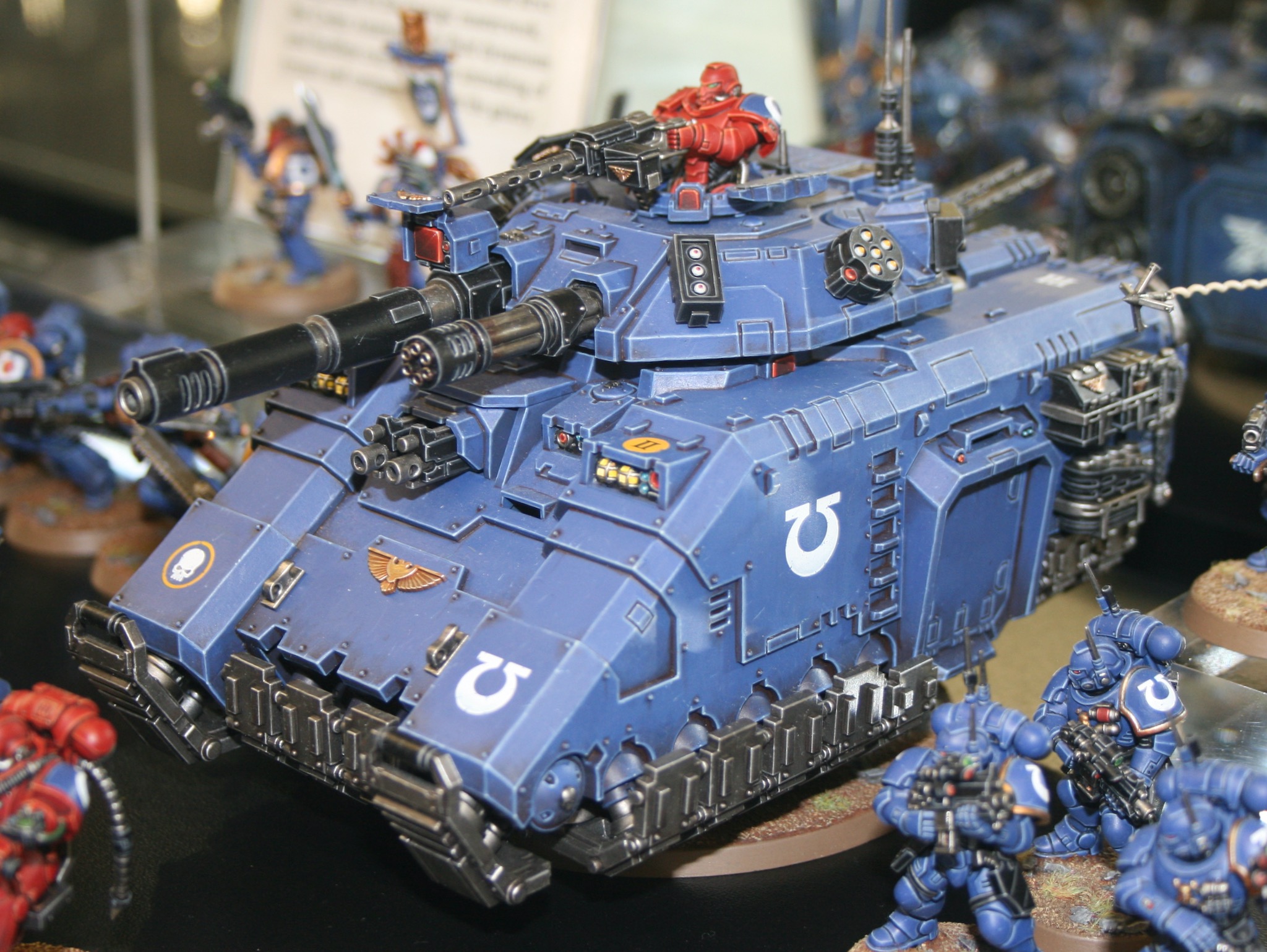
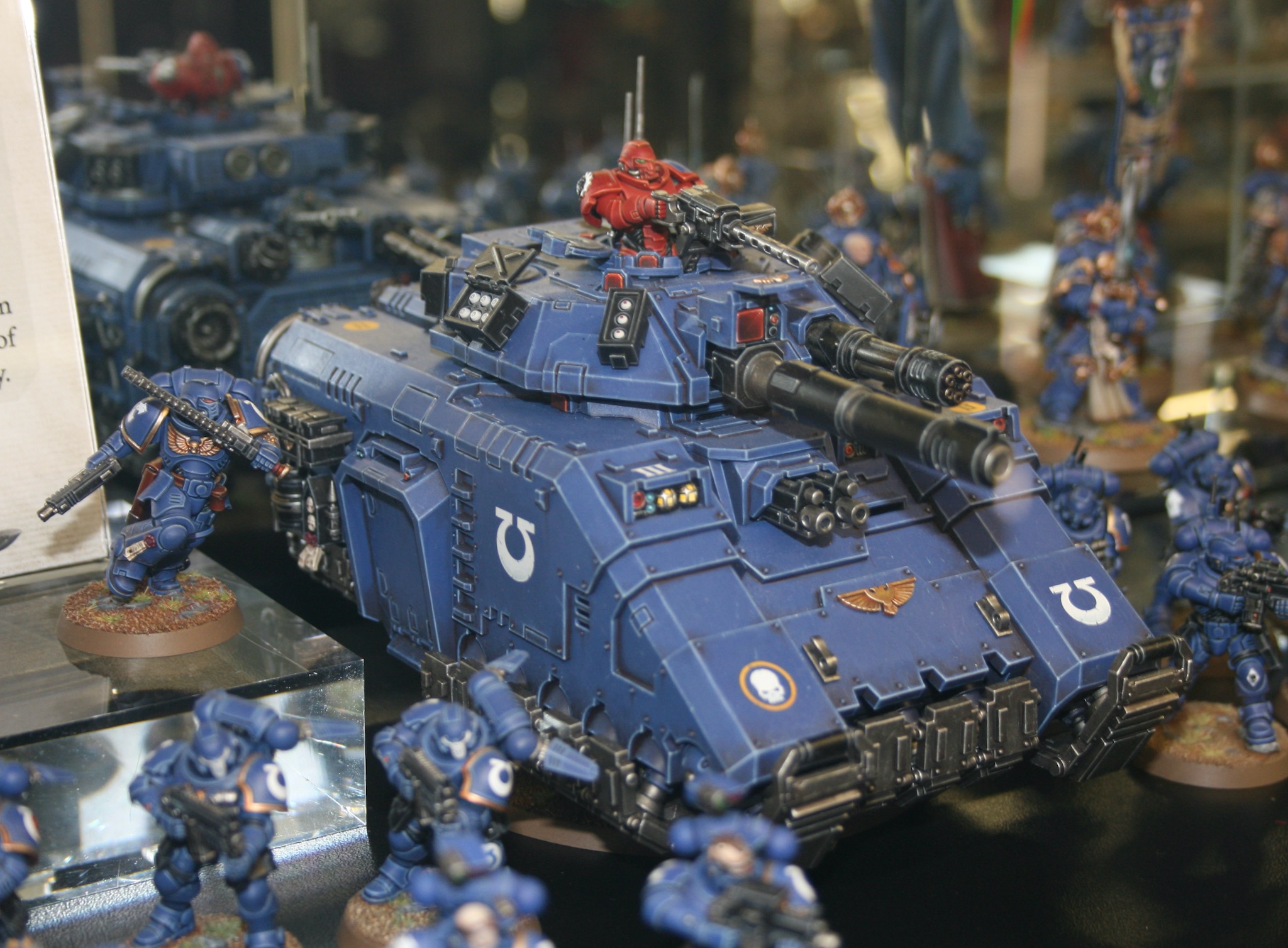
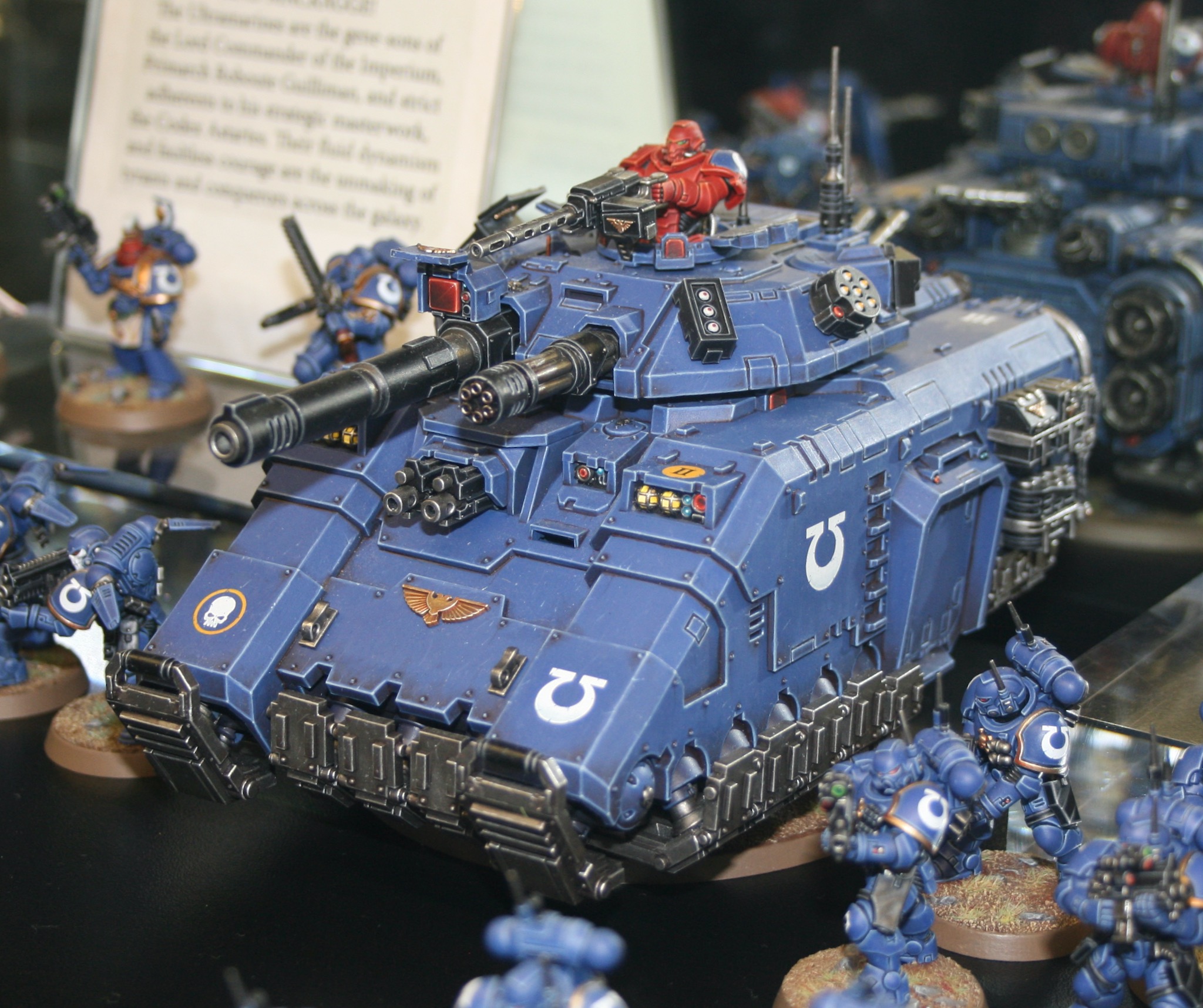
Across the Warhammer World displays were various armoured vehicles of the Ultramarines Space Marine chapter.
The Gladiator Valiant lays down blistering volleys of fire as its escorts transports or supports infantry in ferocious fighting, crossing rushing watercourses, sucking marshlands and bubbling lava with equal ease. Its twin las-talons spit death at the foe, making short work of enemy armour and cracking open fortified positions.
Like the Predator is to a Rhino, the design of the Gladiator is based upon that of an Impulsor’s chassis, and has been designed to serve as a front line battle tank rather than a transport vehicle.
As the main surface-to-air tank, the Hunter scours the the skies of enemy bombers and fighter craft with its skyspear missile launcher.
The primary weapon of the Space Marine Stalker is the skyspear missile launcher. There are also options to include re-inforced armour on the sides of the tank, as well as pneumatic pins along the base.
The Stalker wields two independently targeting rotary autocannons that fill the air with armour piercing death so that no foe is safe in Imperial air space.
The Invader ATV is a highly flexible all-terrain vehicle, perfectly adapted to an aggressive reconnaissance role. Outfitted with either a multi-melta or an onslaught gatling cannon, it can rapidly deliver punishing fire against vulnerable parts of the enemy line, or swiftly engage and destroy scouting elements of opposing forces.
Ultramarines Primaris Invader ATV
Not quite a vehicle, but the Hammerfall Bunker was also in the displays. Hammerfall Bunkers are launched from Space Marine warships in the same manner as Drop Pods. Automated area-denial assets crewed by hard-wired servitors, they have all kinds of battlefield roles, including securing beachheads, hampering enemy assaults and wreaking havoc behind the foe’s lines.
The Repulsor Executioner is the most heavily armed battle tank available to the Adeptus Astartes, with a choice of murderously powerful, primary turret-mounted weapon – a macro plasma incinerator or heavy laser destructor – supported by a coaxial heavy onslaught gatling cannon.
This was an Attack Bike.
The Stormtalon Gunship serves the armies of the Adeptus Astartes as both an interceptor and ground-attack craft. It is fast enough to engage all but the swiftest of enemies, and sufficiently well-armed to reduce the chosen foe to a mangle of twisted wreckage and ruined flesh. The tide of many a battle has turned with the thunderbolt descent of a Stormtalon Gunship from the war-torn skies.
Alongside the vehicles was this Assault Space Marine.
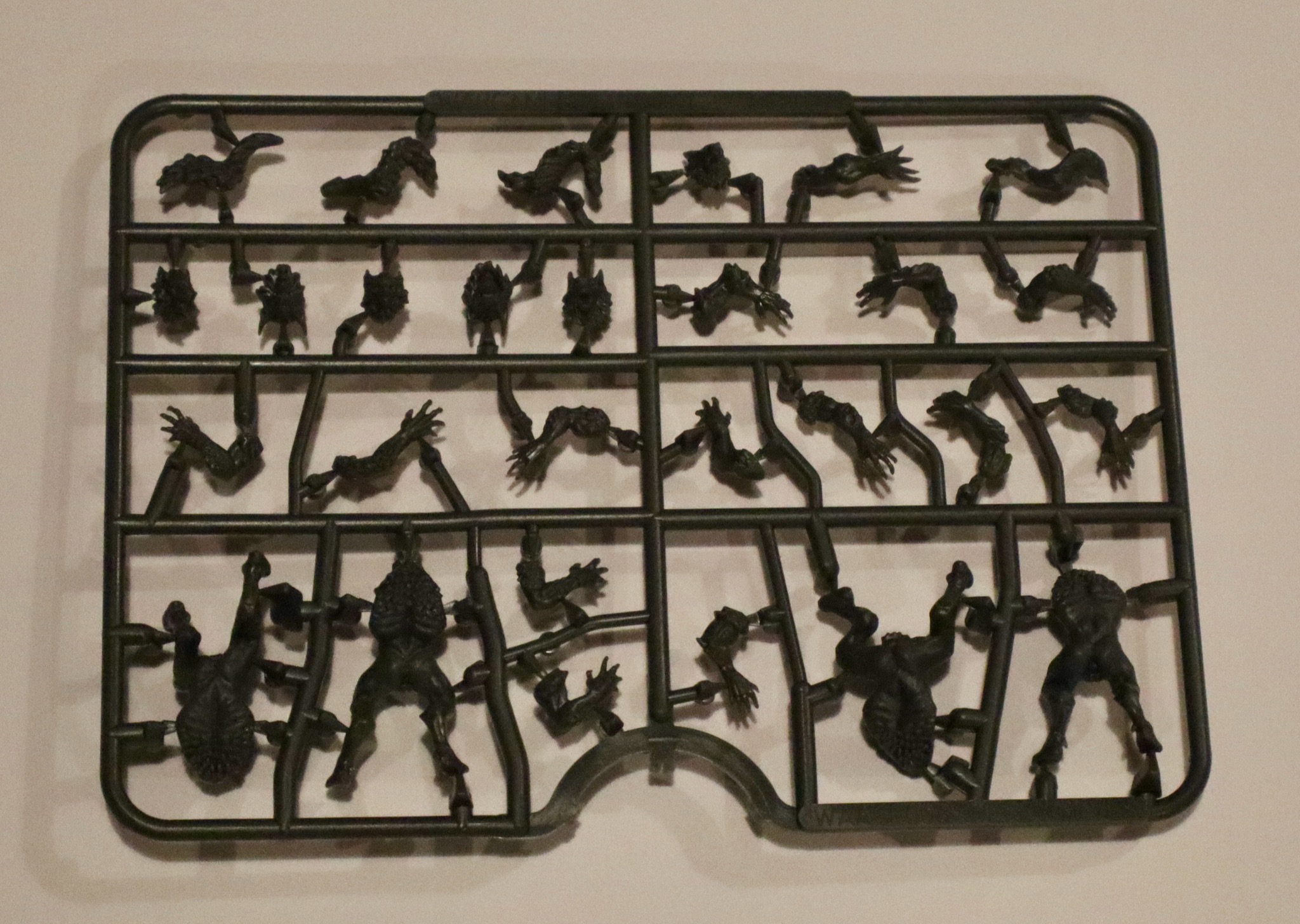
On the cover of this month’s Miniature Wargames was a sprue of Wargames Atlantic Werewolves.
The Blood Cursed…the Fanged Ones…Nightpack…Lost Children of the Forest…whatever you call them the men and women who turn when the full moon shines are a scourge upon the Free Kingdoms. These half-man half-wolf beasts are both cunning and ferocious and once they pick up the scent of prey they are relentless. Villagers pray for the coming of the sun when the moon is full.
This is how the finished and painted versions look on the Wargames Atlantic website.
I like getting these free sprues on magazines as it gives you a chance to get an idea of what the models and quality are like from a manufacturer without initially spending money. Also, as with these werewolves you get a few models that would be ideal for a quick scenario idea.
These would be great for a weird world war scenario. It’s a full moon one night in 1940. A platoon of Home Guard are tasked with exploring strange lights and noises emanating from a deserted farmhouse. They are wondering if these are German spies, or even German paratroopers. However what they will be facing will be much worse, a band of werewolves.
Another idea for a scenario. During the Peninsular War the 95th Rifles are on the move to hunt down a French spy in a Spanish village. However unknown to them, the village is cursed and there is a full moon.