Centurion Mark 3

This Centurion Mark 3 was on display at the Tank Museum at Bovington. It is missing its side-skirts.

It has been painted as a tank that fought in the Korean War. The Centurion depicted, participated in a fiercely contested action defending a location called ‘The Hook’ against Chinese forces in Korea in May 1953.

The Centurion tank was one of the most successful post-war tank designs. It was introduced in 1945, just too late to see combat in the Second World War. However, it went on to serve in a number of conflicts, including the Korean War, the Vietnam War, and the Arab-Israeli wars.

The Centurion was a well-balanced tank with a good mix of armament, armour, and mobility. It was armed with a 105mm rifled gun, which was capable of firing both high-explosive and armour-piercing rounds. The Centurion’s armour was also very effective, and it was able to withstand the fire of most enemy tanks. The tank was also highly mobile, and it was able to keep up with the latest advances in tank warfare.

This Centurion Mark 3 was in fact the prototype Centurion Crocodile flame throwing tank; a type that never entered production.

Centurion Crocodile

Dark Angels Ravenwing Storm Speeder Thunderstrike

This Dark Angels Ravenwing  Storm Speeder Thunderstrike was on display at Warhammer World.

Dark Angels Ravenwing  Storm Speeder Thunderstrike
Dark Angels Ravenwing Storm Speeder Thunderstrike at Warhammer World

Storm Speeder Thunderstrikes outmanoeuvre the foe at every turn, targeting vulnerable points in armour, fuel tanks and missile hoppers to turn engines of war into raging fireballs. Just a single Thunderstrike is capable of destroying armoured breakthrough attempts, and when one is on the battlefield, few enemies are safe.

80th Anniversary of D-Day Landings 6th June 1944

It was eighty years ago that the liberation of Europe began with Operation Overlord and the Normandy landings on the 6th June 1944.

In the depths of the Nothe Fort in Weymouth (as well as a civillian nuclear bunker (now abandoned)) there is a really beautiful 54mm scale model of the D-Day landings. Lots of different models in there including an Horsa glider.

Landing on the beaches

Landings

Horsa Glider

It is a representative model and does not reflect an actual beachhead.

Landing on the beaches

Churchill Tank

D-Day

More photographs of the evocative 54mm scale D-Day model at the Nothe Fort in Weymouth.

Landing Craft at D-Day

Beachead

Landing...

Sherman Firefly

This Sherman Firefly was on display at the Bovington Tank Museum.

The Sherman Firefly was a World War II British variant of the American Sherman tank, fitted with the powerful British 17 pounder anti-tank gun as its main weapon.

Originally conceived as a stopgap until future British tank designs came into service, the Sherman Firefly became the most common vehicle with the 17 pounder in World War II.

Though the British expected to have their own new tank models developed soon (and were loath to consider using American tanks), British Major George Brighty championed the already-rejected idea of mounting the 17 pounder in the existing Sherman.

With the help of Lieutenant Colonel Witheridge and despite official disapproval, he managed to get the concept accepted. This proved fortuitous, as both the Challenger and Cromwell tank designs experienced difficulties and delays.

After the problem of getting the gun to fit in the Sherman’s turret was solved, the Firefly was put into production in early 1944, in time to equip Field Marshal Montgomery’s forces for the Normandy landings.

It soon became highly valued as the only British tank capable of defeating the Panther and Tiger tanks it faced in Normandy at standard combat ranges. In recognition of this, German tank and anti-tank gun crews were instructed to attack Fireflies first.

See the workbench feature on my Flames of War Sherman Firefly VC.

Ironhead Squat Prospectors Skalvian Explorator

This Ironhead Squat Prospectors Skalvian Explorator was on display at Warhammer World.

Ironhead Squat Prospectors Skalvian Explorator

The Skalvian Explorator is an indomitable example of Ironhead Squat technology, a heavy all-terrain exploration and excavation vehicle suited to extracting the wealth of the Great Equatorial Wastes, surviving its many perils, and ferrying cargo back to safety. Though the Ironhead Squat Prospectors are master weapon makers, much of their equipment is based upon mining tools, and the Explorator’s armoured bulk makes it a match for many purpose-built war machines.

I do like this model, it has some real charm. I do think there are some really nice Necromunda models out there.

Challenger 1 Main Battle Tank

The FV4030/4 Challenger 1 is a British main battle tank used by the British Army from 1983 to 2001, when it was superseded by the Challenger 2. 

The Challenger design by the former Military Vehicles and Engineering Establishment near Chobham in Surrey originated in an Iranian order for an improved version of the Chieftain line of tanks in service around the world. These were the Chieftain Mk5, Shir 1 and Shir 2. With the fall of the Shah of Iran and the collapse of the UK MBT-80 project, the British Army became the customer and the tank was further developed by MVEE to meet Western European requirements. 

Chobham armour is the informal name of a composite armour developed in the 1960s at the Military Vehicles and Engineering Establishment, a British tank research centre 

The Challenger 1 tank saw service in the First Gulf War in 1991.

Salamanders Land Raider Tanks

This Salamander Land Raider Phobos was on display at Warhammer World.

 Salamander Land Raider Phobos
Salamanders Land Raider Phobos

The standard Land Raider, also known as the Land Raider Phobos, is an Imperial main battle tank and troop transport which serves as the “armoured fist of the Space Marines.” Available to the Space Marines, the Traitor Legions of the Chaos Space Marines and the forces of the Inquisition and Adeptus Mechanicus, it is one of the most resilient and iconic armoured vehicles in the galaxy.

The Land Raider Redeemer is a variant of the Land Raider Crusader, which itself is a variant of the standard Land Raider used by the many Chapters of the Adeptus Astartes to provide short-range, anti-infantry assault support during urban offensives.

The Land Raider Redeemer replaces the Land Raider Crusader’s weapons with the dreaded sponson-mounted Flamestorm Cannons. These massive flame-based weapons send burning sheets of promethium into the thick of the foe, purging even well-defended bunker complexes in solar seconds. This enables the Redeemer to be highly effective against infantry during gruelling and dangerous urban combat.

This Salamanders Land Raider Redeemer was in the displays at Warhammer World.

Salamanders Land Raider Redeemer

The Land Raider’s heritage predates even the founding of the Imperium of Man, yet it remains the single most destructive weapon in the Adeptus Astartes’ arsenal. Protected by bonded Ceramite and Adamantium armour, the Land Raider is nearly impervious to all save the most destructive weaponry.

Heavy Gun Tank Conqueror Mark I

This Heavy Gun Tank Conqueror Mark I was on display at The Tank Museum.

Heavy Gun Tank Conqueror Mark I

The FV 214 Conqueror, also known as Tank, Heavy No. 1, 120 mm Gun, Conqueror was a British heavy tank of the post-World War II era. It was developed as a response to the Soviet IS-3 heavy tank. 

The Conqueror’s main armament, an 120 mm gun, which was larger than the 20-pounder gun carried by its peer, the Centurion. 

Heavy Gun Tank Conqueror Mark I

The Conqueror’s role was to provide long range anti-tank support for the Centurion. Nine Conquerors were issued for each regiment in Germany, usually grouped in three tank troops. 

Overall 185 Heavy Gun Tank Conquerors were built. The first was produced in 1955.

They were in service until 1966, both the Conqueror and the Centurion were replaced by the Chieftain.

There was a Heavy Gun Tank Conqueror Mark I at the Land Warfare Exhibit at the Imperial War Museum Duxford. I managed to photograph it back when I visited in 2019.

Heavy Gun Tank Conqueror Mark I

It was in a wider shot of the Land Warfare Exhibit that included an FV433 Abbot SPG, which I have cropped for this post.

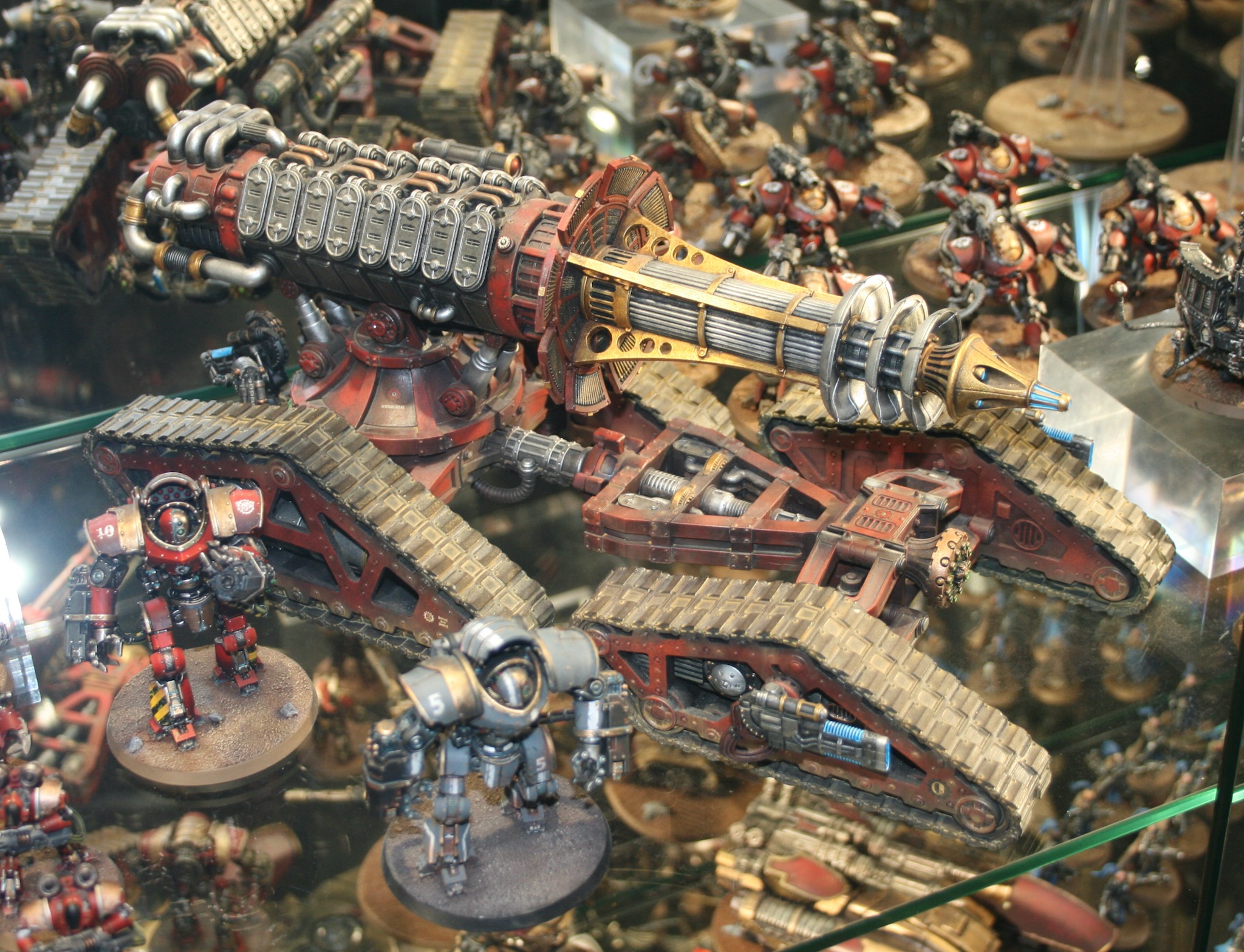
Sons of Horus Arquitor Bombard with Graviton-Charge Cannon

This Sons of Horus Arquitor Bombard with Graviton-Charge Cannon was on display at Warhammer World.

The Legion Arquitor is a heavy artillery platform designed to operate at the forefront of a Legiones Astartes advance. Equipped with a reinforced chassis and brutal short range firepower, it is called upon to break the most stubborn of fortifications or to annihilate massed enemy infantry and armour. The graviton-charge cannon fires energised canisters that impact among the enemy ranks, emitting a graviton field that crushes delicate circuitry and electronics, disrupting the advance of anything that survives the barrage.