This Sd.Kfz. 222 was driving around the arena at Tankfest 26.
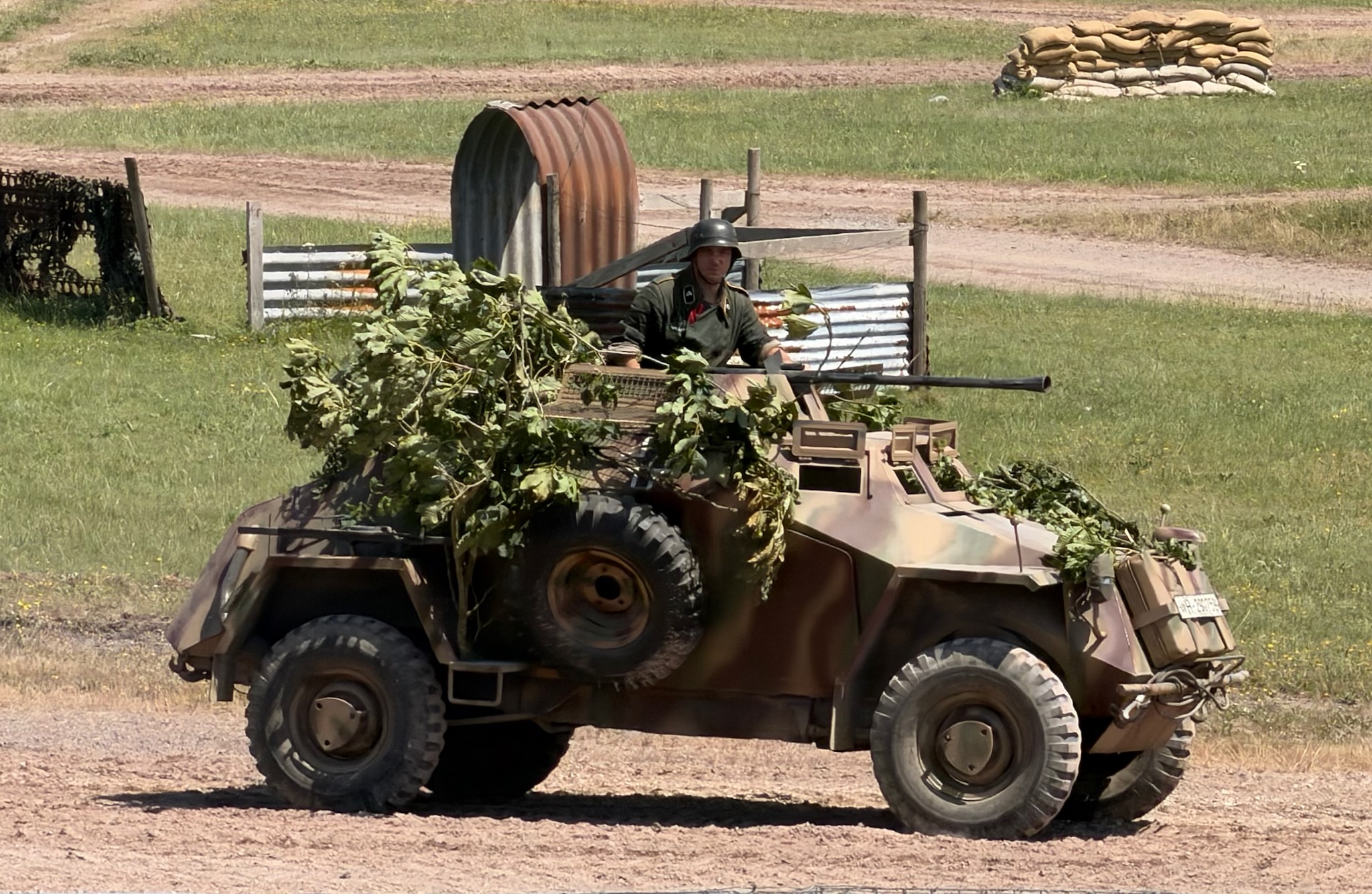
The Sonderkraftfahrzeug 222 (Sd.Kfz. 222), officially designated as the Leichter Panzerspähwagen (2 cm), was the primary light four-wheeled armored reconnaissance car used by the German Wehrmacht during World War II. Built on a heavy-duty Horch 801 chassis featuring four-wheel drive and all-wheel steering, the compact vehicle was designed for speed, agility, and cross-country mobility to perform scouting duties ahead of mechanized panzer divisions. Its open-topped, ten-sided polygonal turret was fitted with a wire-mesh anti-grenade screen and mounted a 2 cm KwK 30 (later KwK 38) autocannon alongside a coaxial 7.92mm MG 34 machine gun, providing surprisingly formidable firepower against light vehicles, infantry, and low-flying aircraft. First deployed during the invasions of Poland and France, the Sd.Kfz. 222 excelled on Western Europe’s developed road networks and saw widespread action with the Afrika Korps in North Africa. However, its operational limitations became starkly apparent on the Eastern Front, where the Soviet Union’s severe rasputitsa mud and harsh winters severely hampered four-wheeled off-road mobility, leading to its gradual replacement by eight-wheeled armored cars and half-tracks like the Sd.Kfz. 250/9.