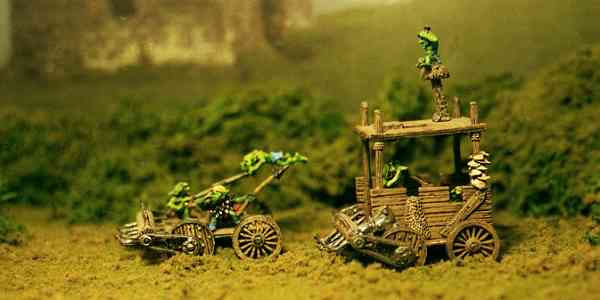
Skeleton Chariots are the pride of the Tomb Kings, gilded and lethal machines crewed even in death by Nehekhara’s finest warriors. Often fielded en masse, their rattling advance is heralded by clouds of dust, thrown high into the air as they thunder across the sands. Crashing into the enemy with bone-shattering force, these vehicles crush living bodies beneath their heavy wheels as their undead crew lay about the disorientated foe.
Category: warhammer the old world
Skeleton Archers and Skeleton Warriors
The most numerous and fundamental units in the armies of the Tomb Kings of Khemri are the Skeleton Warriors and Archers. These soldiers were once the living legions of ancient Nehekhara, loyal footsoldiers who were entombed with their kings to continue their service in the afterlife. Now, centuries after the great ritual that cursed their land, they are reanimated by the incantations of Liche Priests, rising from their sandy graves in a tide of brittle bone and rusted weapons.
Though individually weak and lacking the martial prowess of their living counterparts, their true strength lies in their numbers and unwavering loyalty. They march in relentless, disciplined ranks, forming the unyielding core of the Tomb Kings’ army, serving as an anvil against which the foe is broken. The Skeleton Warriors, armed with spears or hand weapons and shields, are a formidable block of infantry, while the Skeleton Archers, with their warbows, provide a storm of arrows to harry and weaken the enemy from a distance.
Dwarf Warriors
Solid, broad, and fiercely resilient, Dwarf Warriors are built for the grind of war.
When they advance, the momentum of their heavily armoured frames hits the enemy like a tidal wave of iron.
With a resounding crash, they shatter enemy defences and plow through formations, leaving only ruin in their wake.
These Dwarf Warriors were on display at Warhammer World.
More photographs of miniatures of the Dwarfen Mountain Holds.
Terracotta Cathayan Grand Cannons
When I made a trip to Warhammer World in June 2025 I was pleased to see the then new models for the Army of Grand Cathay for Warhammer Old World on display. I really liked the Cathayan Sentinel especially the paint job which made it look like it was terracotta. I also saw a posting on the Warhammer Community site about where Lewis from the Warhammer Studio had painted some Jade Warriors as terracotta warriors.
I started thinking about creating and painting a whole army in this style, so I bought a Cathayan Sentinel and the Grand Cathay Battalion.
I started constructing the Jade Warriors. After finishing some of those models I started on the Grand Cannon.
Cast in the likeness of roaring dragons, the Grand Cannons of Cathay unleash torrents of flame and iron upon the foe. Whether saturating a wide front or concentrating their explosive power into a single, devastating projectile for sieges, they remain a cornerstone of Cathayan might.
First models to be made were the crew.
These were a lot easier to construct than the warriors.
I have been thinking about how I will paint the Grand Cannon. The human crew will be terracotta like the Jade Warriors. I think I will also need to reflect on how to paint the Ogre Loaders, who are mercenaries. First thoughts are to paint them as terracotta too. As for the cannon itself, that I think will be more brass than clay. I think a cannon made out of terracotta would explode upon firing. I have also gone down the cannon route rather than the Fire Rain Rocket Battery option.
Next step will be to make some more models.
The Battle of Matorea at Warhammer World
The Warhammer Old World diorama, “The Battle of Matorea,” is a breathtaking tableau that vividly brings to life a dramatic clash between the chivalrous Bretonnian Knights and the ancient, undead legions of the Tomb Kings of Khemri. This expertly crafted scene captures a pivotal moment in what must have been a desperate struggle, highlighting the contrasting aesthetics and fighting styles of these two iconic factions.
Settra the Imperishable lays siege to the coastal city of Matorea with a massive undead host as Cecil Gastonne, the Wyrm Slayer rallies its hopelessly outnumbered defenders. Just as the city’s defences begin to fail, the trumpeting of silver clarions sounds in the east, heralding the arrival of Duke Gastille. Have the duke and his knights arrived in time to lift the siege, or will they join the doomed defenders in a heroic death?
At the heart of the diorama, the Bretonnian Knights, resplendent in their vibrant heraldry and polished plate armor, are depicted mid-charge, lances lowered and banners flying high. The dynamism of their assault is palpable, conveying the sheer force and faith with which these champions of the Lady throw themselves into battle. One can almost hear the thundering hooves and the shouts of “For the Lady!” as they aim to shatter the brittle ranks of their skeletal foes. The diorama likely showcases various knightly orders, perhaps even a Duke or a Grail Knight, leading the charge with unwavering determination, their mounts rearing or galloping furiously into the fray.
Opposing this glorious charge, the Tomb Kings of Khemri present a stark and unsettling contrast. Their skeletal warriors, ancient and unfeeling, form an unyielding tide of bone and rusted bronze. Hierophants and Tomb Princes, perhaps astride macabre chariots or mighty constructs like Ushabti, would be strategically positioned, directing their automaton armies with an eerie, silent resolve. The diorama would no doubt emphasize the sheer numbers of the Tomb Kings, with ranks of skeleton warriors, archers, and perhaps even animated constructs like Screaming Skull Catapults or Necrolith Colossi, adding to the sense of overwhelming, relentless pressure. The bleached bones and dusty, tattered banners of Khemri create an atmosphere of dread and ancient power, starkly contrasting with the vibrant colours of Bretonnia.
“The Battle of Matorea” isn’t just a collection of miniatures; it’s a narrative frozen in time. The composition likely draws the viewer’s eye to key points of conflict – a Bretonnian Knight’s lance impaling a skeletal champion, a Foot Knight desperately defending a standard against a tide of mummified horrors, or a magical duel between a Bretonnian Damsel and a Liche Priest. Through meticulous detail and expert painting, the diorama effectively conveys the chaos, heroism, and horror of war in the Old World, making it a truly immersive and captivating piece for any Warhammer enthusiast. It serves as a testament to the rich lore and enduring appeal of the setting, particularly the epic conflicts that define its factions.
Khemrian Warsphinx
Orc Boar Boyz
These Orc Boar Boyz were on display at Warhammer World.
Orc Boar Boyz represent the devastating, bad-tempered shock cavalry of the Orc & Goblin Tribes. Riding into battle atop ferocious War Boars—beasts so foul-tempered and thick-skulled that they are just as likely to gore an enemy as the Orc riding them is to hack them apart—these heavy cavalry units excel at breaking enemy lines through sheer brute force. A well-timed charge from these heavily armoured green skins can easily trample the disciplined infantry blocks of the Old World into the mud.
Empire of Man Witch Hunter
I was placing an order with Games Workshop and looking for something to add to ensure I could get free delivery. I found the online only Empire of Man Witch Hunter which I thought for £9 was cheap for Games Workshop.
This kit contains 3 metal components. I have to say I wasn’t clear if the two weapons had to be attached to the model, or if it was a choice. Looking over the web page on the Warhammer site, that didn’t really help. Searching Google also didn’t bring much to the situation. In the end I decided it was a choice and I went with the smaller sword and pistol rather than the great sword.
The next stage will be adding some scenic sand to the base and then undercoating the model.
Goblin Wolf Rider Mob
Across the desolate reaches of the Badlands and the dark canopies of the Great Forest, many Goblin tribes reject permanent settlements entirely, preferring a life of perpetual migration. They travel in immense, ramshackle caravans of creaking wagons, held together by spit, sinew, and stolen iron. To survive this hostile nomadic existence, these Goblins have mastered the taming of Giant Wolves—monstrous, agile predators bred for endurance and cruelty. Ahead of the main horde ride the Wolf Rider scouts, operating in lean, hungry packs. They are the eyes of the tribe, identifying enemy vulnerabilities and picking off isolated stragglers. On the battlefield, they are masters of harassment; they do not stand and fight, but instead encircle their prey, unleashing a hail of crude arrows before charging in to exploit the chaos. By the time the enemy prepares to strike back, the Wolf Riders have already vanished into the wilderness, leaving nothing but the wounded and the dead in their wake.
Orc Boyz
The battlefield trembles as Orc Boyz coalesce into unruly, rag-tag mobs, driven by a deafening chorus of bellows and war cries.
With zero regard for formation or tactical discipline, these frenzied regiments surge forward in a chaotic, enthusiastic tidal wave of green flesh. Clutched in their calloused fists are heavy, crude hand weapons—jagged choppas, rusted cleavers, and spiked clubs—paired with massive, dented iron shields. They do not fight with grace or finesse; instead, they hack, stab, and relentlessly batter their way through the enemy lines, relying on sheer mass and ferocious momentum to pulverize anything in their path.