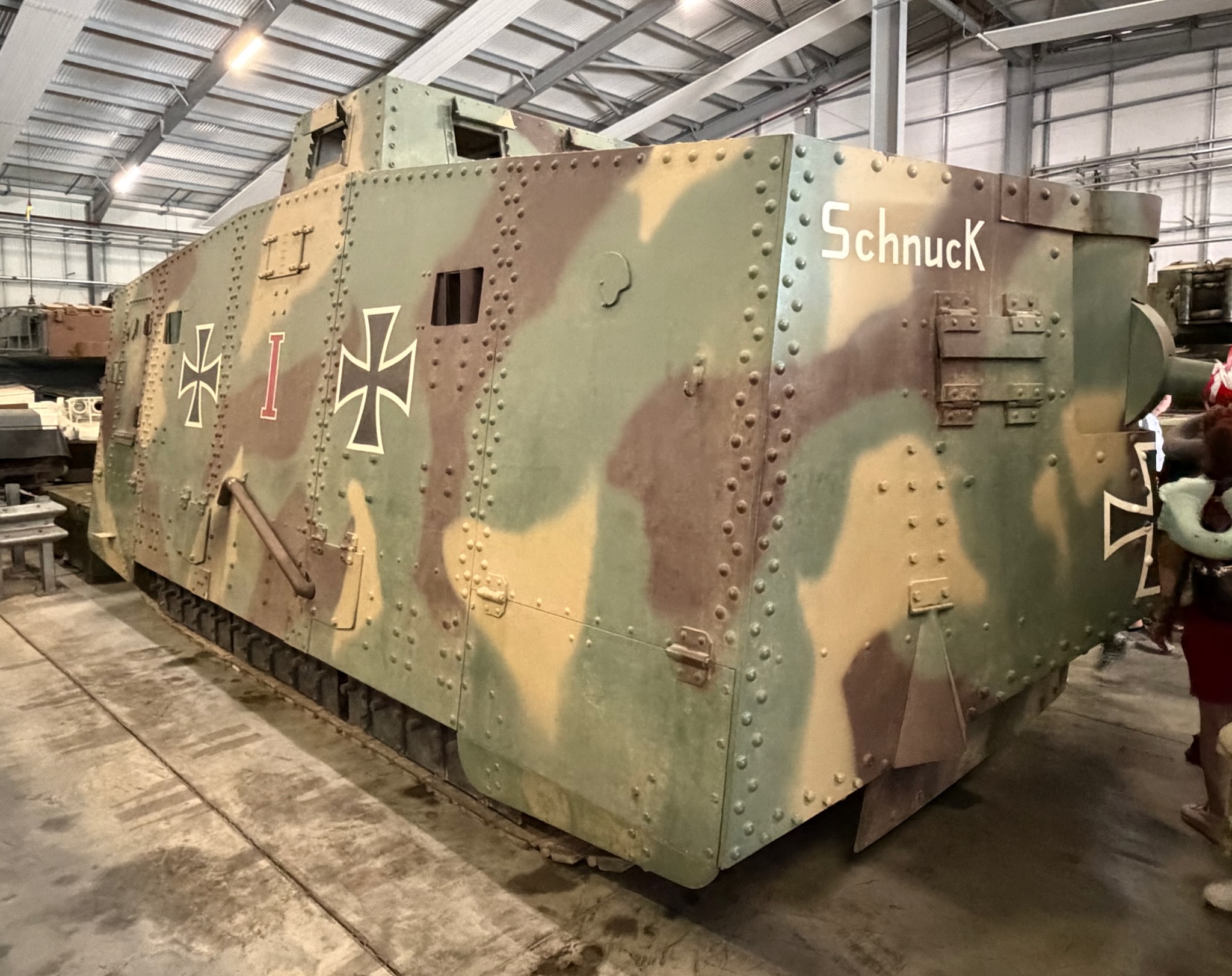
Introduced by Imperial Germany near the end of World War I in early 1918, the Sturmpanzerwagen A7V was the German Empire’s sole production tank of the war, designed in response to the unsettling appearance of British and French tanks on the Western Front.
Resembling a massive, armoured box on tracks, the 30-ton vehicle was armed with a front-mounted 57mm Maxim-Nordenfelt cannon and six 7.92mm MG 08 machine guns, requiring a unusually large crew of up to 18 men to operate effectively. Despite its thick steel plate protection and formidable firepower, the A7V was plagued by a high centre of gravity and low ground clearance, which severely limited its cross-country mobility and trench-crossing ability compared to the British rhomboid design.
Only 20 chassis were produced, but the A7V secured its place in military history on April 24, 1918, at the Second Battle of Villers-Bretonneux, where three A7Vs engaged three British Mark IVs in the world’s first tank-versus-tank combat.
This replica Sturmpanzerwagen A7V was in the Vehicle Conservation Centre at the Tank Museum.
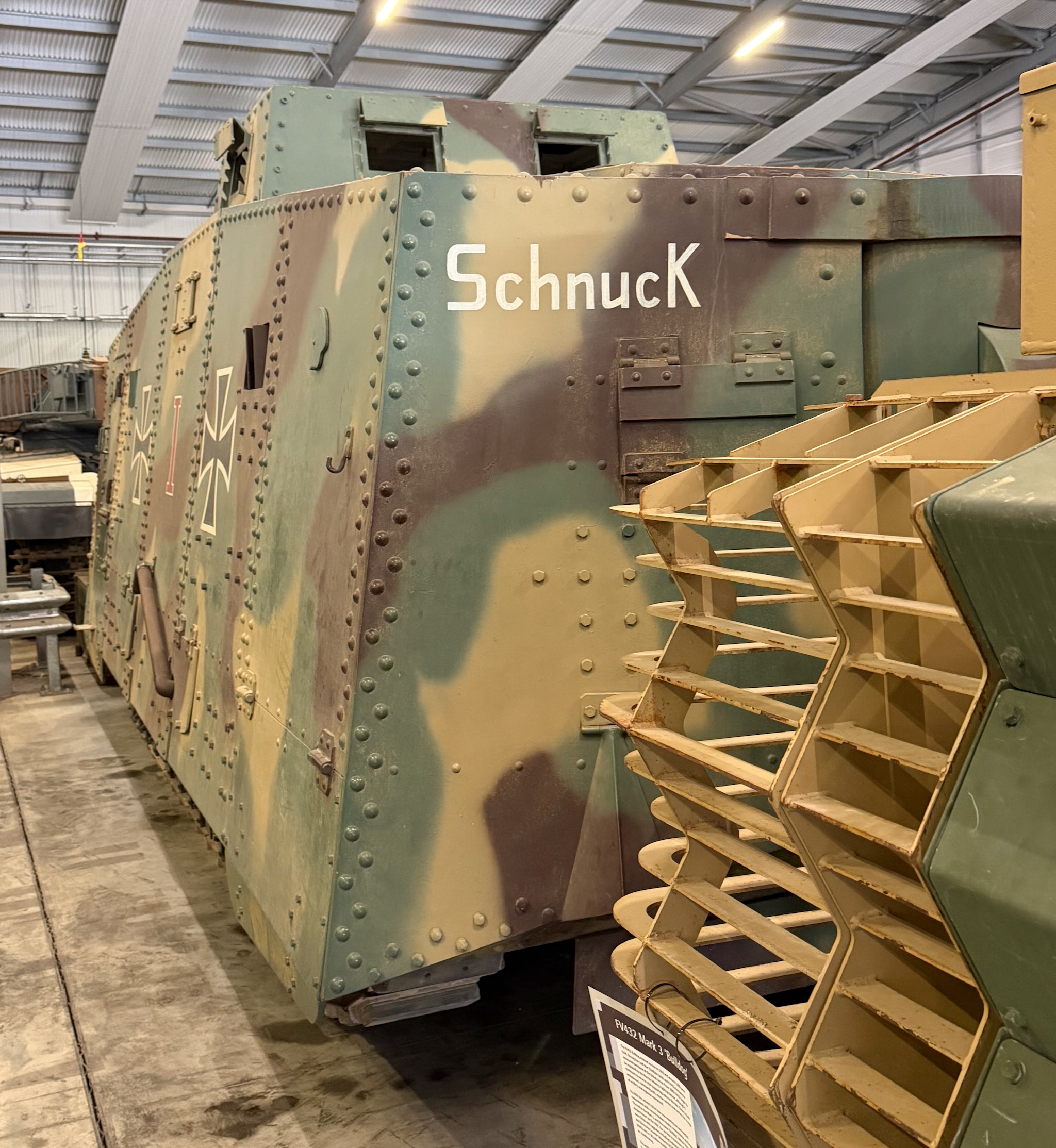
It is is painted to represent A7V number 504, Schnuck. The actual Schnuck was damaged by friendly fire at Fremicourt on 31 August 1918 then it was abandoned by crew, and captured by troops of the New Zealand Division three days later. Displayed in London on Horse Guards Parade 1918/19 and given to the Imperial War Museum in 1919 but was scrapped and disposed of in 1922.